
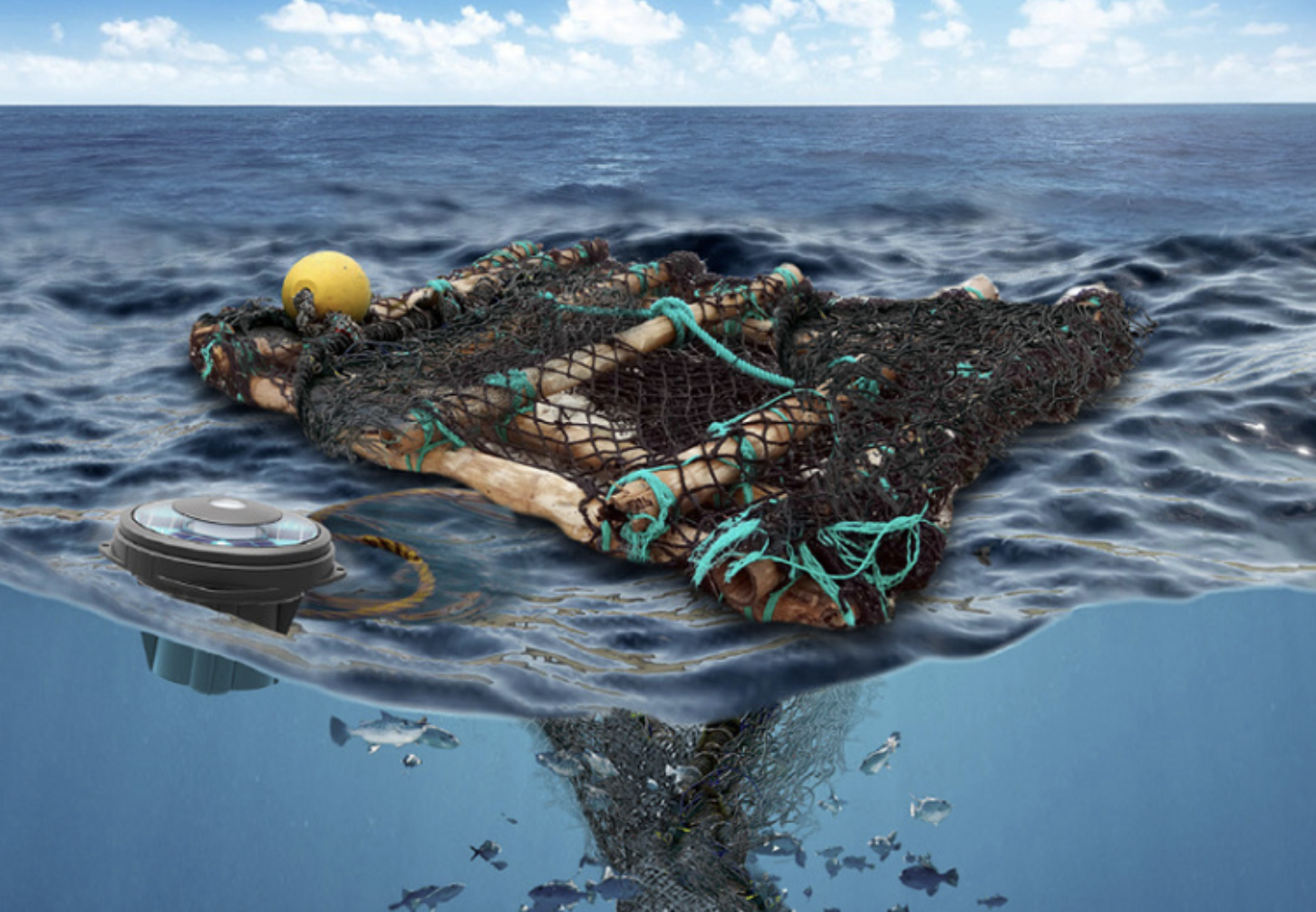
Tahiti, February 9, 2026 – Nearly 60,000 drifting fish concentration devices (DCPs) enter Polynesian waters every year. Abandoned by industrial fishing, these fish rafts often end up abandoned and run aground on the reefs. Polynesia, which only uses anchored DCPs, hosts an international workshop at Cesec bringing together Pacific countries, fisheries experts and professionals to move forward on concrete solutions to this « ecological disaster« : monitoring of beacons, recovery at sea, financing and the polluter-pays principle.
They are neither Polynesian nor desired, but they arrive by the thousands. Every year, nearly 60,000 drifting DCPs – these artificial rafts used by industrial senners (revolving net fishing vessels) – drift for months before finishing their run in our waters. A discreet tide but heavy consequences for reefs, the coast and marine species.
This is the whole issue of the international workshop dedicated to « the mitigation of the loss and abandonment of fish concentration devices in the Pacific Ocean », open from Monday to Wednesday at Cesec. It brings together island countries and territories, scientists, fisheries services and industry representatives, under the leadership of the Pacific Community.
In her opening speech, the president of Cesec, Maiana Bambridge, recalled the magnitude of the problem: lost DCP derivatives « come sustainable marine waste », which degrade reefs and coasts and threaten protected species. Polynesia, for its part, prohibits these drifting devices in its area and only uses anchored DCPs for coastal fishing.
“Why should we pick up other people’s dirt?”
As a good student, Fenua is an exception but nevertheless suffers the impact of external practices. “We are being polluted by DCPs derived from industrial fisheries located outside our area. When they run aground, they destroy the reef and become electronic and synthetic waste, » summarizes Thibaut Thellier, of the Marine Resources Directorate.
At Cesec, Patrick Galenon does not mince his words as always, and calls for a hard line: « These drifting DCPs are an ecological disaster. They cling to corals, weaken the atolls, the Marquises. Why do you want us to recover the dirt that comes from elsewhere? It’s like plastic!” For him, the only credible way is not the financial sanction but the outright ban: « We must remove drift rafts. Point. We must tell the boats to follow the current, to follow their DCP, and as soon as it arrives at our border, we stop them. »
Behind the shock of words, a reality: each industrial manager can manage several hundred active DCPs, while barely 10% would be recovered. The rest are abandoned as soon as they leave the profitable fishing areas, including the equatorial strip. Result: they continue their journey, driven by the currents, towards the island Pacific.
The battle of the satellite beacons
The node of the problem is technical and strategic: access to the data of the tags fixed on these DCPs. Without a precise position, it is impossible to intervene at sea before aming. « When a buoy is deactivated, for us, it is equivalent to throwing waste into the sea, » insists Thibaut Thellier. The Minister of Marine Resources, Taivini Teai, recalls for his part that « a great advance has been made since last year », with « the obligation, or in any case the will, of industrial fishermen to leave their DCPs on when they enter our exclusive economic zone », in order to be able to locate and recover them.
The objective of the discussions: to obtain the transmission of positions in real time to organize recovery. « We have means at sea: fishermen, longliners, national navy. But we need positions and we need funding.”
The sene fishing industry has acknowledged its responsibility and a polluter-pays mechanism is on the table. « A fund fed by the industrial fishing industry to finance recovery is being set up, » confirms Minister Taivini Teai, after the commitments made during the last regional workshops.
At sea, a more nuanced reality
On the fishermen’s side, the discourse is less sharp. Temurere Tehina, coastal fisherman and representative of the Rava’ai Mau union, does not plead for a total ban. He also sees it as a potential resource – provided you have the data. « A DCP drifting, when you come across it, it’s a boon: the fish is there. But the problem is to follow him. The next day, he can be from nautical miles.”
His request meets that of the technicians: access to beacons. « If they give us the positions, we can fish on them and recover them before they end up on the reef. Today, it’s their waste. Either they get them back, or they give us the means to do it.”
Between ecological red line and field pragmatism, the debate is posed. The work of the Cesec must now lead to concrete agreements with the fleets concerned, especially from Latin America, from which a large part of the devices that drift to Fenua comes. Because 60,000 DCP drifting per year is so many floating bombs for Polynesian reefs. And there is no question of letting yourself be carried away by the current.
source : tahiti infos