

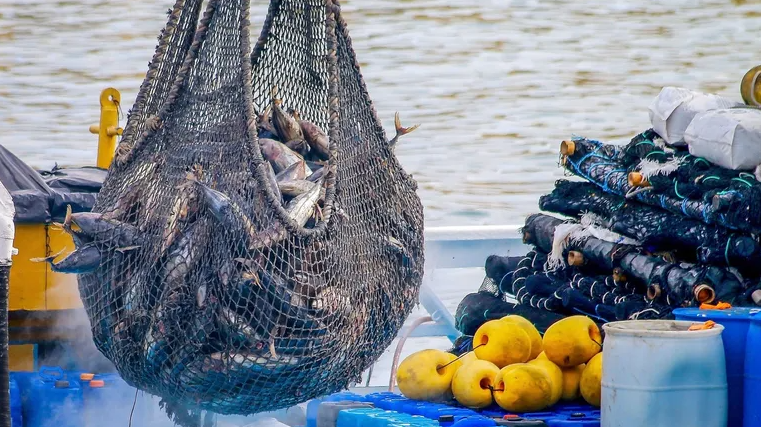
Oceans play a major role in carbon storage, particularly through the biomass they host. The life cycles of fish contribute to the long-term sequestration of CO₂ in the deep ocean, but industrial fishing has weakened this essential mechanism, which is also threatened by climate change. Restoring high-seas marine populations could strengthen this natural carbon sink while reducing conflicts with food security.
When we talk about natural carbon sinks—systems that trap more carbon than they emit—we usually think of forests and soils rather than oceans. Yet oceans represent the second-largest natural carbon sink.
The impact of human activities, particularly fishing, on oceanic carbon storage has been poorly studied until now, even though marine macrofauna, especially fish, account for about one-third of the organic carbon stored in the oceans. Our research, recently published in Nature Communications and One Earth, aimed to address this gap.
Our results show that fishing has already reduced carbon sequestration by fish by nearly half since 1950. By the end of the century, this decline is expected to reach 56% under the combined effects of fishing and climate change. These findings strongly advocate for more sustainable ocean management that considers the impact of fishing on carbon sequestration.
Why focus on carbon sequestration in oceans?
The Intergovernmental Panel on Climate Change (IPCC) explicitly states in its reports that achieving climate goals requires drastically and immediately reducing greenhouse gas emissions—currently about 40 billion tons of CO₂ equivalent per year from human activities—and then developing nature-based climate solutions.
These solutions include restoration, protection, and improved management of ecosystems that capture carbon, such as forests. Such measures could capture 10 billion tons of CO₂ equivalent per year and must be implemented complementary to emission reduction policies.
However, the carbon stored in these ecosystems is increasingly threatened by climate change. For example, wildfires in Canada released 2.5 billion tons of CO₂ equivalent in 2023, turning forests from a carbon sink into a source of emissions.
In response, the scientific community is now turning to oceans, seeking new solutions to enhance carbon sequestration in marine environments.
For this to be possible, it is first necessary to understand how ocean life interacts with the carbon cycle, as well as the influence of climate change on one hand, and fishing on the other. What role do fish play in this process?
The vast majority of the 38,000 billion tons of carbon stored in the ocean is locked up through physical processes. However, ocean biomass also contributes, accounting for about 1,300 billion tons of organic carbon. Fish represent roughly 30% of this stock.
This is made possible through their contribution to what is called the biological carbon pump, a series of biological processes that transport carbon from surface waters to the deep ocean. It is a key component of the carbon cycle.
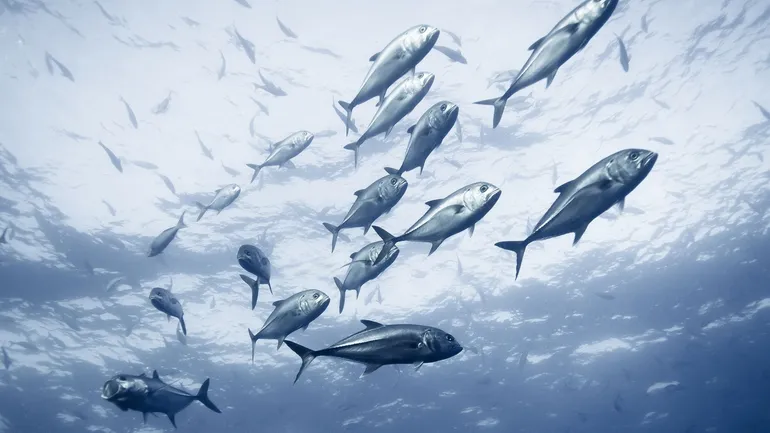
This biological pump begins with phytoplankton, which can transform CO₂ into carbon-based organic matter. When phytoplankton dies, part of this carbon sinks into the deep ocean, where it is sequestered long-term, while the remainder is consumed by predators. Again, it is when this carbon sinks to the depths—through fecal pellets or the carcasses of dead predators—that it is effectively sequestered.
Fish play a key role in this process: their carcasses and fecal pellets, being denser, sink much faster than those of plankton. The faster carbon sinks into the depths—and away from the atmosphere—the longer it remains stored, making the sequestration more durable.
Our study, which specifically focused on commercially important fish species (i.e., those targeted by fishing), estimates that in 1950 these fish were capable of sequestering 0.23 billion tons of carbon per year, equivalent to 0.85 billion tons of CO₂ per year.
Source: RTBF