
On the island of Djerba, underground cisterns, known as fesguias, bear witness to ancestral expertise in water management. Located in a territory now recognized by UNESCO, they are the focus of restoration and valorization projects aimed at strengthening climate resilience and preserving this unique hydraulic heritage.
These cisterns, subterranean structures designed to capture and store rainwater, reflect the ingenuity of a community that learned early on to cope with water scarcity. Passed down through generations, they continue to play a vital role in religious, domestic, and artisanal life, providing a natural solution to climate change even today.
Unlike the open-air basins of the classical Tunisian model, such as those of the Aghlabids in Kairouan, Djerba developed an entirely underground system: vast reservoirs fed by terracotta channels installed beneath sloped roofs to optimize water flow. According to heritage researcher Rawdha Hamzi, these structures date back to the Roman era and persisted through the Islamic period, nurtured by the Ibadi tradition, which gives water a sacred dimension, echoing the Quranic verse: “And We made from water every living thing.”
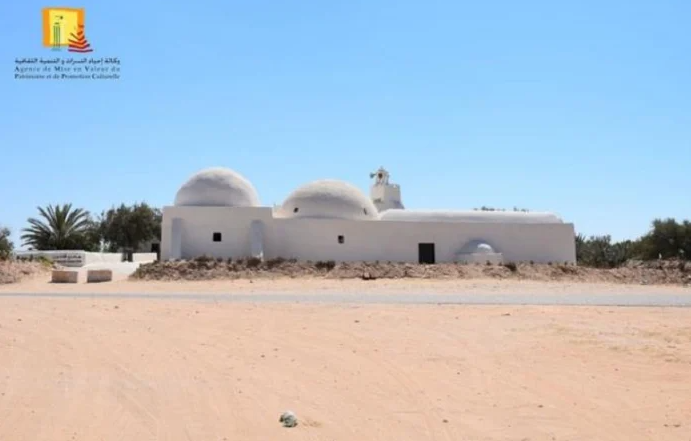
The island’s mosques highlight the centrality of water in religious architecture. Coastal mosques, known as “beach mosques,” typically had a single cistern to deprive potential enemies arriving from the sea of water, explains Hamzi. In contrast, inland refuge mosques feature multiple cisterns—up to six per site, as in the Fadhloun and Medrajen mosques. Mosque-schools, such as Sidi Sofien or Abou Massour, may have more than a dozen cisterns to provide water for students, worshippers, and travelers.
In domestic and economic architecture, fesguias remain essential: they are found in weaving workshops, olive oil mills, traditional ovens, pottery studios, and homes, where their location is carefully chosen to keep water cool. Neighborhood cisterns, called fessguiat essabil, were also built as acts of charity for passersby.
“At Djerba, water is sacred, cultural, and heritage,” emphasizes Rawdha Hamzi. She notes that storage tools, transport methods, and ritualized water use reflect a deeply embedded philosophy in architecture and resource management.
Djerba has been listed as a UNESCO World Heritage site since 2023 for its insular urbanism, villages, mosques, and cultural heritage. While the cisterns themselves are not individually listed, they fully embody sustainable water management and territorial adaptation practices.
In the face of climate pressures, these ancient cisterns have attracted renewed interest. Several local initiatives aim to protect and enhance them, including the 3R CC project (Recharge, Retention, and Reuse of Water Cisterns in Djerba), led by the Association for the Safeguarding of Djerba Island (ASSIDJE). The program seeks to strengthen sustainable cistern management, preserve this ancestral hydraulic heritage, and ensure a more resilient future for the population. The association has documented 121 public fesguias, restored several, and installed new cisterns in some schools.
Simultaneously, the Fesguietna (“Our Fesguia”) project, led by the Jlij Association for Marine Environment in partnership with the Regional Agricultural Development Commission and supported by the World Wide Fund for Nature (WWF) in North Africa, identifies and valorizes public cisterns while raising local awareness and involving the community in combating the island’s climate vulnerability. Activities include cleaning, sediment removal, wall reinforcement, improvement of water collection systems, and secure access arrangements.
In Djerba, these ancestral hydraulic structures are increasingly seen as a strategic resource to strengthen the island’s resilience and safeguard a heritage that has shaped, for centuries, the relationship between humans, water, and territory.
Source: African Manager