
The decision on a carbon emissions levy for the shipping sector, proposed by the United Nations’ International Maritime Organization, has been postponed to 2026. But is the industry ready for a decarbonized future?
Shipping plays a key role in our economy, with almost 50% of goods traded between the EU and non-EU countries transported by sea, according to 2024 data.
This role continues to grow, with figures showing that the share of seaborne trade increased by nine percentage points for imports and more than four points for exports between 2002 and 2023.
But as the UN’s International Maritime Organization (IMO) attempts to introduce a levy on carbon emissions from shipping, is the industry prepared to reduce its impact or cope with rising costs?
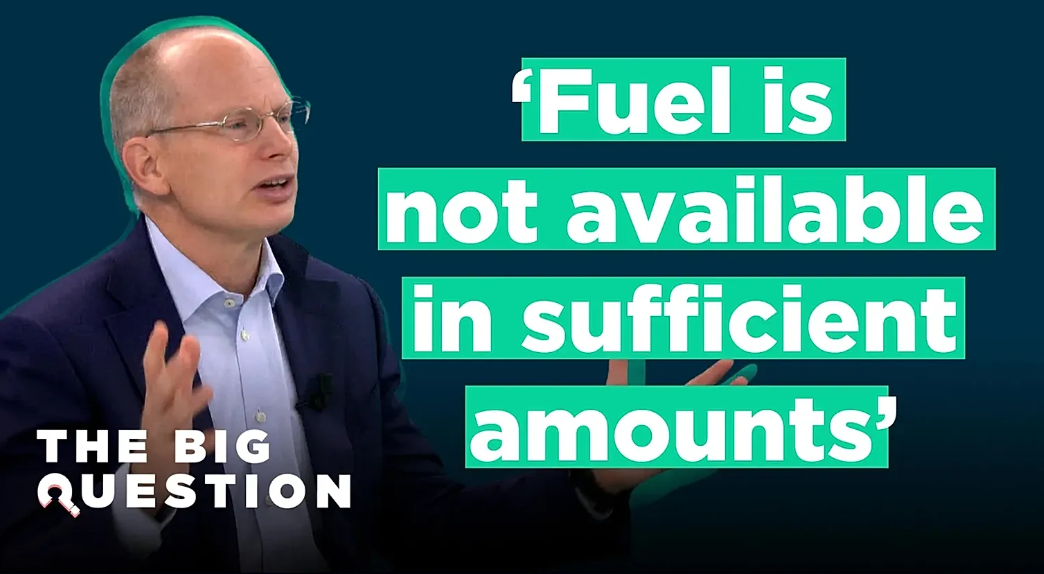
In this episode of The Big Question, Eleanor Butler is joined by Håkan Agnevall, CEO of Wärtsilä, to discuss the importance of the shipping industry and how it can become more sustainable.
What is the economic value of maritime transport?
One of the world’s most famous shipping routes is the Suez Canal. Built in the late 19th century, the artificial canal bypasses the Horn of Africa and reduces travel time, costs, and emissions between Asia and Europe.
“In 2021, that large container ship, the Ever Given, got stuck in the Suez Canal. Estimates put the cost of the canal’s closure at €10 billion per day for the global economy,” Håkan told The Big Question.
According to the OECD, over 80% of global goods are transported by sea. Between 1995 and 2020, an average of 22.8 million people were employed in maritime industries such as shipbuilding, equipment manufacturing, and maritime research and development.
Given the broader economic impact of shipping, Håkan estimated that in Europe, one in five jobs depended on the export industry.
Can shipping become more sustainable without harming the economy?
Currently, the maritime sector accounts for around 2–3% of global CO₂ emissions. That is roughly equivalent to the aviation industry, or to Japan—the world’s fifth-largest emitter.
As governments and global regulators like the IMO work to establish new emissions frameworks and targets for the industry, shipping companies are looking for ways to adapt.
“There are about 100,000 large vessels in the world, and we can’t just scrap them,” Håkan explained.
To reduce emissions from the existing global fleet, Wärtsilä has developed a carbon capture technology capable of removing around 70% of the CO₂ from a ship’s engine exhaust.
About half of today’s fleet runs on diesel, and 48% can already operate on alternative fuels. Håkan noted that liquefied natural gas (LNG) is classified as an alternative fuel, even though it is a fossil fuel.

More environmentally friendly alternative fuels are currently being developed, but their supply is not yet sufficient for sustained use on long-distance vessels.
“These vessels travel far out at sea, so we really need to find fuels and other solutions that can support that reality,” Håkan explained.
“Methanol engines are being delivered as we speak — the engines are ready for biofuel as soon as it becomes available.”
“Then we have the next step: what we call zero-carbon fuels, which include ammonia for shipping, and we are currently delivering our first ammonia engines.”
“And then there is hydrogen. We believe this fuel will be more suitable for land-based applications because hydrogen’s energy density is not high enough for large-scale maritime transport. It requires many tanks, which limits cargo capacity.”
Green fuels are currently two to four times more expensive than traditional fossil fuels. A carbon emissions levy would level the playing field by reducing the cost gap between more polluting fuels and cleaner alternatives.
Despite uncertainty over the future of fuels and a looming carbon tax, new vessel orders are increasingly shifting toward ships that are green-fuel-ready.
Håkan concluded: “The momentum has started, and I can clearly see it accelerating. With a positive outlook, a lot is happening. But is it going fast enough? No.”
Source: Euro News