Ministers
Excellencies
Ladies and Gentlemen.
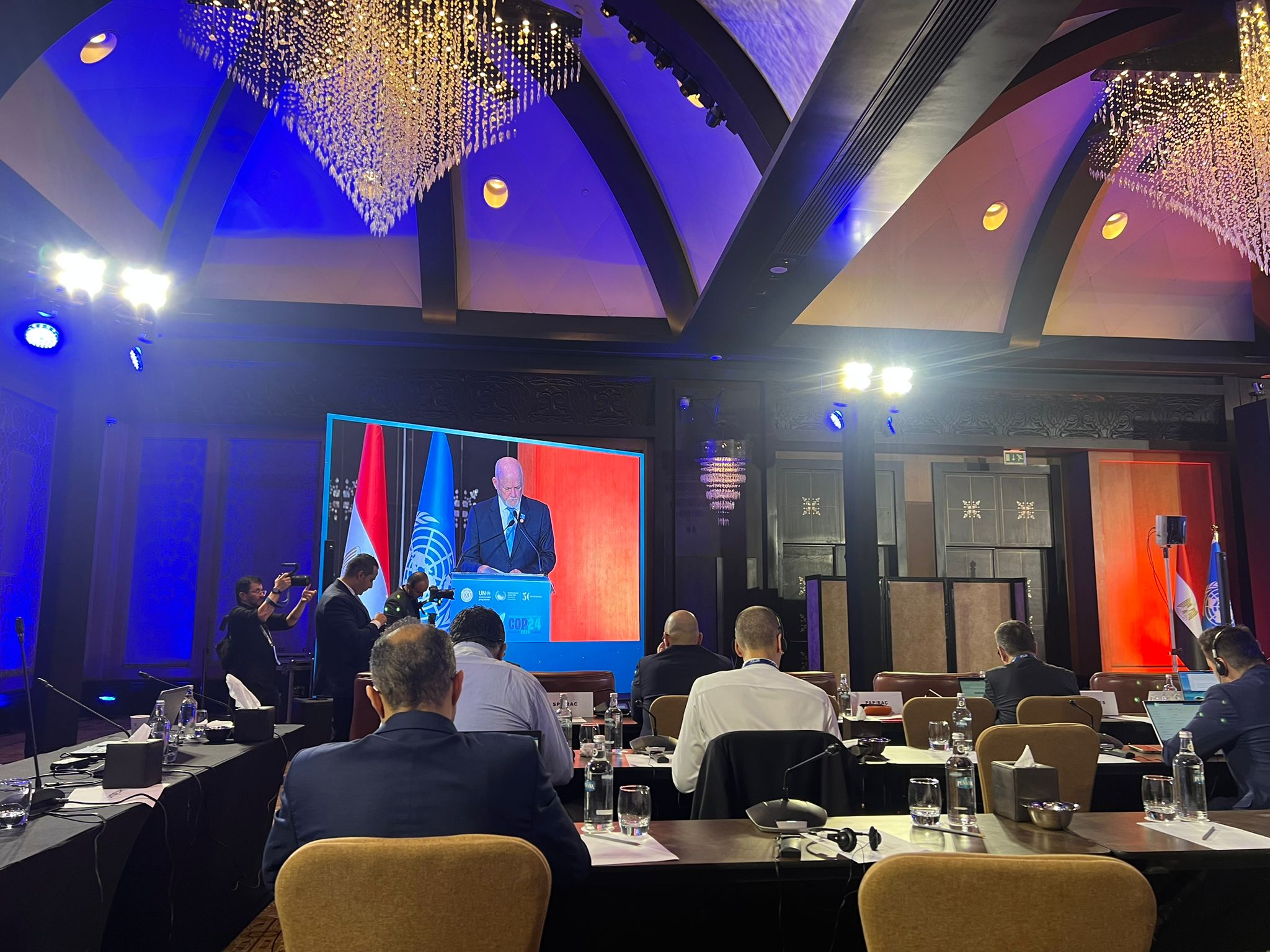
All courtesies observed. Thank you for the privilege of addressing you this morning, especially in this landmark year for MAP- Barcelona Convention and its 50th anniversary. Permit me on behalf of all of us visiting Egypt for this conference, through you Minister Awad, to thank the Government and People of Egypt for the warmth of the welcome we have received in Cairo.
I will cut to the quick. The daily ocean mantra says, “No healthy planet without a healthy ocean and the ocean’s health is currently, measurably in decline.” Address all the indices of over-fishing, biodiversity loss, pollution, acidification, warming, deoxygenation, loss of coral, rising sea levels – the list goes on – and you will find the ocean’s well-being under threat, in most cases under accelerating threat.
This year, WMO reported that last year levels of heat-trapping carbon dioxide in the Earth’s atmosphere surged by the largest margin ever recorded. WMO’s Greenhouse Gas Bulletin pinned the spike on three key drivers: continued emissions from fossil fuels, increased CO2 released by wildfires, and weakening carbon sinks like forests and the ocean. To quote WMO, “These sinks normally absorb a large portion of human-made carbon emissions, but in 2024 they fell short, and set the stage for a dangerous feedback loop.”
I am advised that the Mediterranean is warming 20% faster than the global ocean, with marine heatwaves, unprecedented in scale, damaging fisheries, seagrass meadows, and other ecosystems. We have an existential problem, and it is local, regional and global.
So, what are we going to do about it? Well, we’ve been aware of the challenges facing the ocean for some time now, and I remind you that back in 2015 we all agreed to the Paris Climate Agreement and the UN’s 2030 Sustainable Development Agenda, incorporated into which is the ocean goal – SDG14 – which sets out to conserve and sustainably use the ocean’s resources.
To keep the implementation of SDG14 honest, we instituted the UN Ocean Conference system – the third conference in this system having been held in Nice this year, jointly hosted by France and Costa Rica, from which a huge wave of ocean action emanated. The fact that over 60 Heads of Government and State, along with well over a hundred Ministers, and 15,000 official delegates attended the Nice conference, demonstrates the world is engaged with the ocean’s problems. It’s no longer okay, as it was prior to 2015, to hide behind a veil of benighted innocence on the ocean’s plight.
And then, knowing that our remedial policies and actions must be based upon the best of scientific consensus, we instituted the UN Decade of Ocean Science, and in spite of some recent recalcitrance, we can observe that never before in human history has so much attention been given to ocean science.
We have negotiated, signed and ratified the BBNJ High Seas Treaty, which comes into force early next year, allowing us for the first time to effectively govern the High Seas.
At the World Trade Organisation we have negotiated, signed and ratified the first part of the Agreement on Fisheries Subsidies, curtailing the madness of public monies being spent on subsidising industrialised fishing fleets to continue their over-fishing of the ocean.
Recognising that so much of the climate’s, and thereby the ocean’s ailments, relate directly to the burning of fossil fuels, Vanuatu initiated a request for an advisory opinion from humanity’s highest global court, the International Court of Justice, on the subject of climate change obligations. The court’s opinion was duly delivered in July this year, in which it affirmed that States have binding obligations to prevent climate harm and that they can be held responsible for failing to do so.
Excellencies,
Ladies and Gentlemen
Much has been done, but as long as the decline in the ocean’s health continues, we have so much more to do. And while game-changing innovations and technological breakthroughs are exciting moments, we need to remember that for the most part progress is plodding, is at times prosaic, and where international consensus is required, often protracted.
But push on we must. Hope demands it of us. Intergenerational justice demands it of us.
We must push on to the achievement of an internationally binding treaty to regulate plastic, adopting full life-cycle, circular models that minimize waste.
We must push on with IMO’s commitment to reducing GHG emissions from international shipping.
We must push on to complete the job at the WTO on banning harmful fisheries subsidies.
We must push on with the transition to a clean, equitably electrified world, powered by wind, hydropower, biomass, geothermal and solar energy. Scientific logic demands that of us, and now, economic logic demands the same.
Excellencies,
Ladies and Gentlemen,
There can be little doubt, that done right, an enhanced sustainable blue economy can be the next great driver for the Mediterranean region. Of course, doing it right means protecting the Mediterranean’s marine and coastal environment and resources, while promoting an economic growth that adopts circular and efficient practices for sustainable and resilient development.
Around the world, when we talk about the sustainable blue economy, it has become necessary to add the word “regenerative” to our discussions. This has become so because of the poor state of the ocean’s health, and because thankfully, the ocean possesses amazing abilities of recovery and resilience. If we are prepared to take necessary actions to unleash these regenerative processes, we will in tandem be able to replenish our own reserves of hope. Vigilance is called for, lest we be bullied out of doing the right thing for people and planet.
There is a logical train of thought which demonstrates that wherever you are in the world, it’s just not possible to have a sustainable blue economy unless you have a healthy ocean, with the corollary that renewable energy is essential to a healthy ocean. One need think only of ocean warming to find the veracity in that statement. Whether its sustainable aquaculture, coastal tourism, or marine biotechnology, we cannot expect to enjoy economic progress from a marine environment that is over-heated, acidic, polluted and over-exploited. It is thus that if the ocean had one thing to say to us it would be, “Stop burning fossil fuels.”
Excellencies,
Ladies and Gentlemen
There are some clear opportunities emerging for the Regional Seas Conventions and Action Plans, and obviously I am addressing the Mediterranean Action Plan in what I’m about to say.
Successful development of the sustainable blue economy will rest on ensuring that as much of the ocean as possible, both on the High Seas and within EEZs, is covered by Sustainable Ocean Plans. These are critical instruments for the integration of ocean-related priorities into national development agendas, and for contributing to the implementation of the Kunming-Montreal Global Biodiversity Framework, including its target of conserving and effectively managing at least 30% of marine and coastal areas by 2030.
30×30 is a high task for us all. None should dodge it, lest we be prepared to see millions of species go the way of extinction. In recognition of our communal responsibility, at the UN Ocean Conference in Nice this year we launched the 30×30 Ocean Action Plan, and in the context of developing the sustainable blue economy, I commend it to you all for policy guidance.
Sustainable ocean economies must be based on the principle that everything is connected; curbing pollution, the greening of shipping, the development of truly sustainable aquaculture, blue biotech and nature-friendly off-shore energy production, nothing stands alone. The good news is that the ocean, the blue thread of connectivity, is our greatest ally in the planetary challenges posed by climate change, biodiversity loss, and pollution. And happily, the green transition to renewable energy is now undeniably underway, driven on, as I have said, by the implacable force of scientific and economic logic.
And so, as we get nearer to 2030, we must redouble our efforts to reach the targets we’ve set for ourselves. We must also look beyond them and begin the envisioning of a future in which the sustainable blue economy is central to humankind’s well-being.
This forward-thinking should be central to the global considerations taking place at the fourth UN Ocean Conference in 2028, where we expect a picture to emerge of a world in which humanity’s relationship with the ocean is one of regeneration, reciprocity and respect.
It is hugely encouraging to observe how since the 3rd UN Ocean Conference in Nice, the momentum has been with us. And it is also heartening to see that following on from the One Ocean Science Congress in Nice, preparations are underway for ocean science’s next great advance at the UN Decade Conference in Rio in 2027. Meanwhile an event-filled course has been laid out to take us towards the 4th UN Ocean Conference in Korea in 2028.
In these challenging times, Ladies and Gentlemen, let us rededicate ourselves to the true course set by multilateralism and international law. I urge you to mobilize action in the Mediterranean region to overcome the acute impacts of the triple crisis of pollution, biodiversity loss and climate change.
Going forward, we will have to be strong in thought and deed, so that reason and innovation will overcome the regressive forces at play. And we must take the tide while it serves, the tide of regeneration and resilience, of trust in the best of science, and of fidelity to intergenerational justice.
I thank you for attention.