
Even deeper than Japan’s Seikan Tunnel or the Channel Tunnel, Norway’s Rogfast project is set to break every record for an underwater roadway.
Norway’s new source of pride? The country is accelerating construction of the world’s longest and deepest subsea road tunnel. Named Rogfast—short for Rogaland fastforbindelse, literally “Rogaland fixed link,” after the region it will traverse—the underground passage will stretch 27 kilometers and reach a depth of 392 meters below sea level, far deeper than the Seikan Tunnel (Japan), which previously held the record at 240 meters. The aim is to improve connectivity along the west coast by replacing ferry crossings. Travel time between Bergen and Stavanger, Norway’s second- and fourth-largest cities, will be reduced “by about 40 minutes.”
Anne Brit Moen, project manager at Skanska, the company building the northern and deepest section of the tunnel, told CNN it will offer a “faster and more reliable” route.
A technological challenge
Construction on Rogfast officially began in January 2018, but was halted in 2019 due to cost overruns. Work resumed at the end of 2021. Local authorities now expect completion in 2033, at an estimated cost of 25 billion Norwegian kroner (around €2.2 billion).
The tunnel will consist of two separate tubes, each with two road-only lanes. It will include a double roundabout halfway through, 260 meters below sea level, providing access to the island of Kvitsøy—the smallest municipality in Norway.
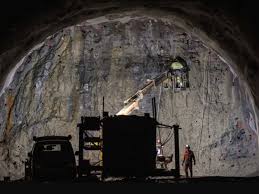
Two construction teams are working simultaneously from each end, aiming to meet in the middle with a margin of error of just 5 centimeters. Achieving this level of precision requires advanced equipment.
To assist workers, rotating-mirror laser scanners create a constantly updated “digital twin” of the tunnel, which is then compared to the original design plans. “It may be far removed from the romantic image of a surveyor looking through an instrument, but it saves time, money, and material errors,” explains Burkhard Boeckem, Chief Technology Officer at Hexagon.
Impact on the regional economy
Other challenges continue to arise. “The main difficulty so far has been finding injection-grouting methods effective enough to seal the rock. We are currently 300 meters below sea level, and we’ve already experienced significant saltwater infiltration in the tunnel system,” says Anne Brit Moen.
Safety systems will be installed throughout the tunnel. It will feature longitudinal ventilation, supported by ducts to Kvitsøy, as well as a real-time monitoring system for incidents and traffic.
Rogfast is one component of the modernization plan for the E39 coastal highway, which runs 1,100 kilometers. Its long-term goal is to eliminate all ferry crossings by 2050. Local authorities say the project will lead to significant economic and social benefits, despite the job losses linked to ferry closures.