
On December 1, 2025, according to the Wall Street Journal, Benoit Faucon and Nicholas Bariyo revealed in the article “Sudan Offers Russia Its First Naval Base in Africa” that the Sudanese military government has officially offered the Russian Federation the establishment of what would be its first naval base on African soil.
A 25-Year Pact for a Russian Presence on the Sudanese Coast
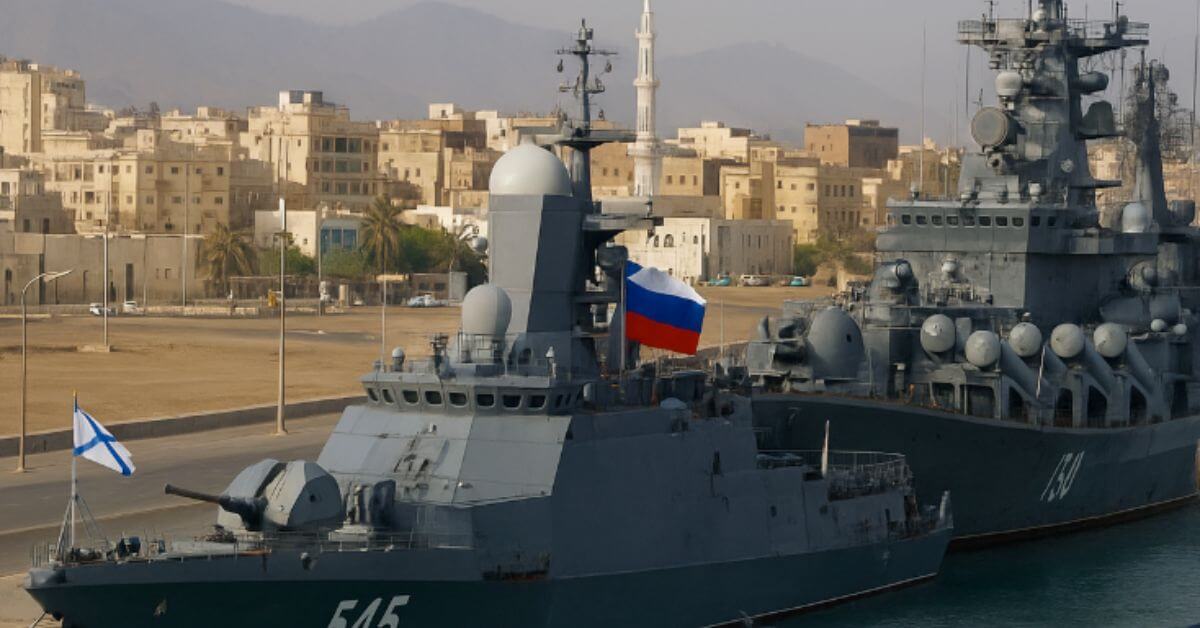
The offer submitted to Moscow involves a 25-year contract, potentially renewable, granting the Russian navy the right to deploy up to 300 soldiers and dock four warships, including nuclear-powered vessels, at the Port Sudan or another yet undisclosed facility on the Red Sea.
In return, Khartoum hopes to receive Russian weaponry — notably air defense systems — on preferential terms, as part of its ongoing conflict with the Rapid Support Forces (RSF) militia.
Another aspect of the agreement could grant Russia access to Sudanese mining concessions, the country being, according to the WSJ, the third-largest gold producer in Africa.
Why Does This Offer Come Now?
The naval base proposal coincides with a turning point in the Sudanese civil war, which began in 2023 between the regular army and the RSF. Militarily isolated, the Khartoum military regime appears determined to secure external support — and Moscow, seeking permanent access to the sea, offers a strategic outlet.
For Russia, this base on the Red Sea would provide a gateway to crucial maritime corridors, particularly the route via the Suez Canal, which accounts for about 12% of global trade, according to the WSJ.
It is an opportunity to address a strategic gap: the Russian navy lacks warm-water ports where its vessels can resupply or undergo repairs, limiting its projection beyond the Mediterranean and Arctic Oceans. A base in Africa would offer Moscow a new naval redeployment point toward the Indian Ocean and beyond.
A Gamble with Major Geopolitical Consequences
If realized, the project could profoundly alter the strategic balance in the Red Sea and Indian Ocean. The presence of Russian ships — potentially nuclear — in the heart of a vital maritime corridor would alert several powers, especially those seeking to limit Russian and Chinese influence in Africa.
More broadly, the arms-for-base deal illustrates the growing trend of linking military projection and access to natural resources: Moscow would not be satisfied with a mere naval outpost but would also pursue economic interests, making the base much more than just a strategic site.
But the Context Remains Unstable — Between Civil War and Uncertainty
However, the Sudanese context — civil war, political instability, and precarious territorial control — creates significant uncertainty over the project’s outcome. The agreement, though proposed, remains fragile, as it depends on Khartoum’s ability to secure its coasts and maintain minimal stability.
Furthermore, the international community — the United States, the European Union, and Red Sea littoral states — could react strongly to this Russian foothold, raising alarms about the militarization of a corridor vital to global trade. The cost for Sudan could be high.
The Sudanese offer to Russia, reported by the Wall Street Journal, appears to be a bold gamble: a direct exchange between military support and naval leverage, at a time when Moscow seeks to regain a presence in warm waters. If the base materializes, it could redraw the map of naval power in the Red Sea and Indian Ocean — but it also takes place in an environment of extreme fragility, for both Khartoum and the regional maritime balance.