
Numerous countries participated in Grand African Nemo 2025, the annual exercise aimed at enhancing the maritime security capabilities of West African coastal navies.
This week-long event focused on strengthening the cooperation capacity of navies in response to maritime crimes in the Gulf of Guinea, including illegal fishing, piracy, human trafficking, and drug smuggling. The exercise began on 10 November in Accra, Ghana.
Led by the French Navy, the exercise involved national maritime operations centers, multinational maritime coordination centers (MMCCs), and regional information centers in Abidjan (Côte d’Ivoire) and Pointe-Noire (Republic of Congo). The main emphasis was on improving regional coordination, collaboration, and interoperability.
Over 55 naval and coast guard units and 11 aircraft were deployed across multiple maritime zones. Commodore Stephen Billince Anyam, Deputy Chief of Staff for Operations and Training at the Ghana Navy Headquarters in Camp Burma, emphasized the exercise’s importance for regional maritime security.
“Each participating country has a specific responsibility. Some focus on anti-piracy operations, others address human trafficking and drug smuggling, while others conduct search and rescue missions. This coordination ensures a rapid and effective response to maritime threats,” he told the online news outlet The Sikaman Times.
Participating countries included Angola, Benin, Cameroon, Côte d’Ivoire, Senegal, Democratic Republic of Congo, Equatorial Guinea, Gabon, Gambia, Ghana, Guinea, Guinea-Bissau, Liberia, Nigeria, Republic of Congo, São Tomé and Príncipe, Sierra Leone, and Togo. Denmark, Spain, Italy, Morocco, Mauritania, and Portugal supported the exercise with naval assets, aircraft, and specialized teams.
According to defenceWeb, France deployed the FS Tonnerre, a Mistral-class amphibious assault ship, in cooperation with several African navies. The ship hosted a regional training course for around 40 officers, combining command-and-control instruction with at-sea exercises, including a simulated anti-drug interdiction conducted with the Nigerian Navy.
Captain Daniel Gnamien Ehu of the Ivorian Navy, Director of the MMCC for Zone F in Accra, praised the French Navy for its continuous support since the inception of Grand African Nemo in 2018.
“Over seven days, navies and coast guards will deploy their vessels alongside French and Spanish navies in our waters to practice real-time scenarios involving illegal, unreported, and unregulated fishing, piracy, drug trafficking, human trafficking, and marine pollution,” Captain Ehu told the Ghana News Agency at the start of the exercise.
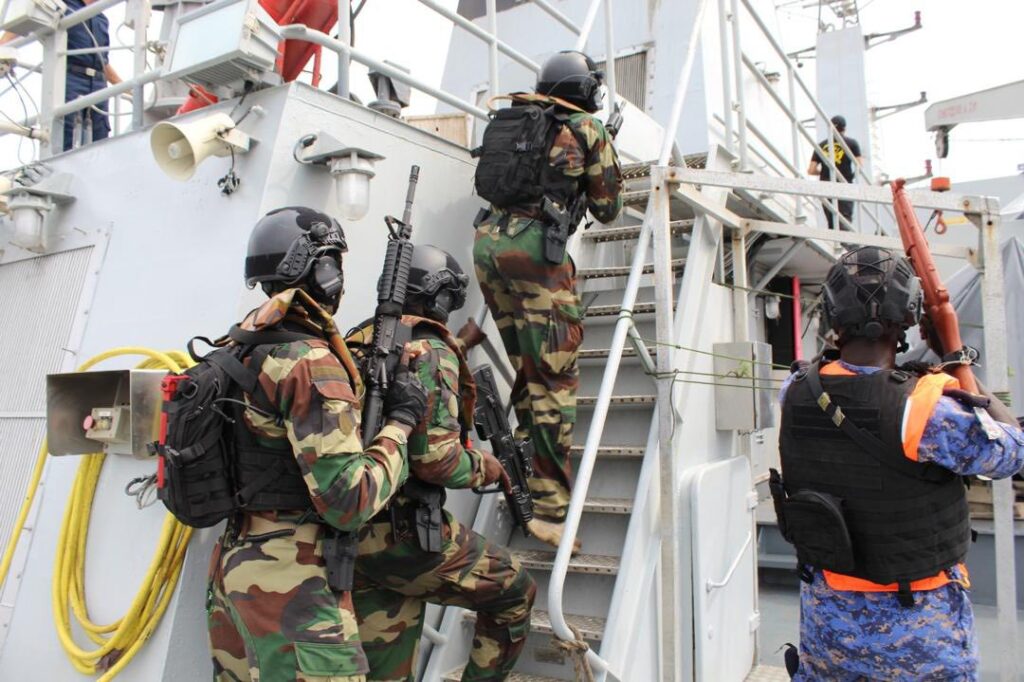
Through the MMCC for Zone G in Praia, Cape Verde, boarding teams from the Senegalese and Gambian navies conducted maritime security operations aboard a Moroccan Navy vessel. Zone G comprises Cape Verde, Gambia, Guinea-Bissau, Mali, and Senegal.
Other exercises focused on drug and contraband interdiction, pollution response and environmental protection, search and rescue, boarding and inspection procedures, and information sharing via regional coordination centers.
Several international maritime agencies contributed expertise, including the United Nations Office on Drugs and Crime (UNODC), Interpol, the European Union, the European Fisheries Control Agency, CEDRE (French marine pollution response agency), the Central-West Gulf of Guinea Fisheries Committee, and the Regional Fisheries Commission of the Gulf of Guinea.
Source: adf