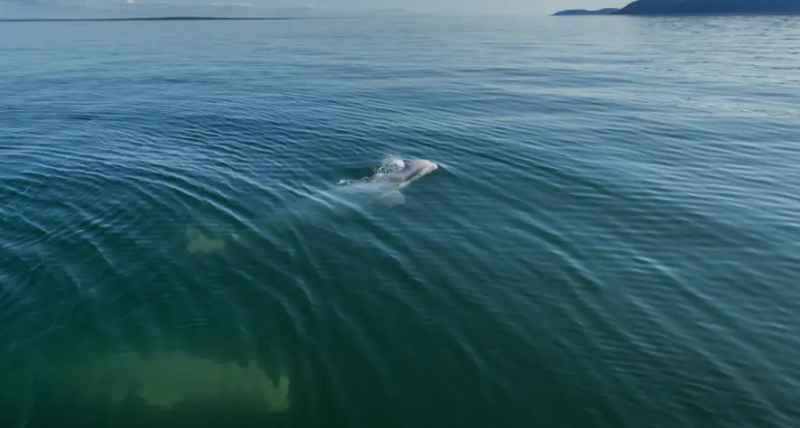

Alexis Rosenfeld and the 1 OCEAN team have captured the planet’s largest animal migration, documenting this extraordinary natural phenomenon in South African waters. Every winter, in the cold waters where the Atlantic and Indian Oceans converge, life stirs, accelerates, and moves northward in one of the most powerful natural events on Earth. Together, UNESCO and the 1 OCEAN initiative, led by photographer and documentary filmmaker Alexis Rosenfeld, have chronicled this spectacle: the planet’s largest animal migration.
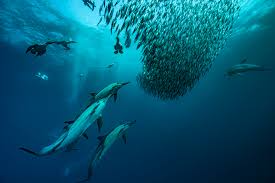
Often described as the “heartbeat” of the sea, the sardine migration occurs along South Africa’s coastline between May and July. Billions of sardines move in massive, coordinated shoals, forming dark ribbons stretching for kilometers across the ocean surface. From the air, the scale of this living movement is visible; underwater, predators converge in a rare synchronization of time, place, and abundance.
This migration is more than just a spectacle. Each austral winter, sardines travel over 1,600 kilometers, guided by cold currents and seasonal plankton blooms. In doing so, they create the largest biomass migration on Earth, sustaining an exceptional diversity of life. African penguins, fur seals, albatrosses, petrels, gannets, leatherback turtles, dolphins, sharks, and multiple whale species all depend on this seasonal rhythm. It is a true river of living energy upon which the entire marine food web relies.
A Fragile and Threatened Pulse
Yet, this ancient rhythm is increasingly under threat. Climate change is warming ocean waters and altering currents, disrupting the delicate conditions that make this migration possible. At the same time, the expansion of industrial activities at sea places additional pressure on already vulnerable marine ecosystems. The future of this phenomenon—and the countless species it supports—can no longer be taken for granted.

Understanding and protecting such processes is an integral part of UNESCO’s ocean mandate. Through the Intergovernmental Oceanographic Commission (IOC-UNESCO), UNESCO supports long-term ocean observation, scientific research, and data sharing to better understand how climate change is transforming marine ecosystems and migratory patterns.
UNESCO also supports the designation and effective management of marine protected areas, helping to preserve critical habitats along migratory routes. As the UN’s lead agency for the United Nations Decade of Ocean Science for Sustainable Development (2021–2030), UNESCO brings together scientists, policymakers, and communities worldwide to safeguard the living systems of the ocean.
This migration, the largest on the planet in terms of biomass, goes beyond the mere movement of fish. It is a living river, a vital pulse upon which entire marine ecosystems depend.
Alexis Rosenfeld
1 Ocean–UNESCO Explorer, Photographer, Documentary Filmmaker
By documenting the great migration of life with 1 OCEAN and advancing ocean science, protection, and international cooperation, UNESCO strives to ensure that the living rhythms of the ocean endure — today and for generations to come.
Source: unesco