

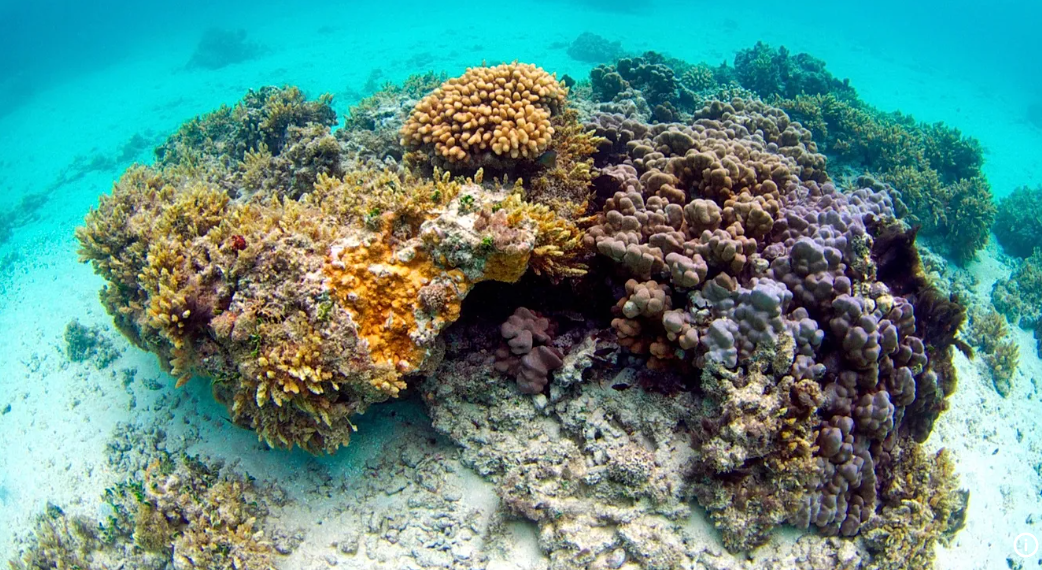
On this archive photo from November 26, 2009, we see orange ringed rice coral, also called Montipora patula, in the waters off the coast of Waimanalo, Hawaii.
Overfishing and global warming are impoverishing our oceans in food, but restoring coral reefs could help provide millions of meals a year.
Coral reefs could become a key element of the strategy to fight hunger in the world and improve nutrition globally.
According to UNICEF data, about 2.3 billion people faced moderate or severe food insecurity in 2024, 336 million more than in 2019. At the same time, many reef fish populations have been impoverished under the effect of overfishing, while warming due to climate change has triggered an « unprecedented coral withering ».
However, new research conducted by the Smithsonian Tropical Research Institute (STRI) indicates that it is still possible to replenish these stocks and manage them at a « sustainable level », which could help fight malnutrition.
Coral reefs could roop fish yields
The study, published in the journal PNAS, analyzed data from all territories of the world that are home to coral reefs, including the Dominican Republic, Panama, Jamaica, Kenya, Mauritius, Oman, Jamaica, Madagascar, the Philippines and Indonesia.
The researchers calculated how much fish stocks should grow to achieve « maximum sustainable yields » and « fairly good yields », as well as recovery time according to different management scenarios.
They found that the time to reconstitution of the fish depended on the extent of the overfishing in the area and that it could take an average of six to fifty years. However, the researchers concluded that coral reefs around the world could increase sustainable yields by almost 50% if fish populations were allowed to recover to their maximum production levels, rather than being exhausted by overfishing.
Wind is now a major source of electricity in the world Why stop wind turbines?
This could provide countries with between 20,000 and 162 million additional sustainable meals, covering the recommended intake of seafood for several million people each year.
The countries that would benefit the most are those that currently suffer the most from hunger and micronutrient deficiencies, such as some regions of Africa and Southeast Asia.
« Our conclusions also confirm that the effective monitoring and management of reef fisheries brings substantial and measurable benefits beyond environmental conservation, » says Jessica Zamborain-Mason, lead author of the article. « They have implications for food safety and public health. «
Will our coral reefs ever recover?
Restoring healthy reefs and more abundant fish stocks is far from easy. The researchers believe that such a plan would require the implementation of a clear strategy to improve fisheries management.
Those working in the fishing industry may also need alternative livelihoods during recovery periods. For some sites, these changes may require international support.
« The next challenge is to design specific strategies that balance conservation and livelihoods for populations, in order to fully exploit the potential of the ocean, » says the study.