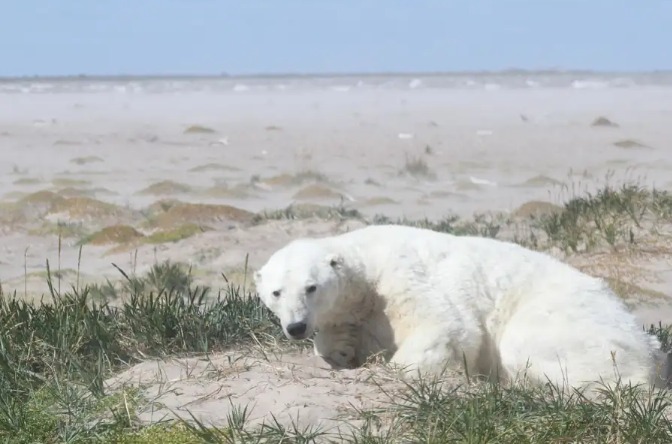
Despite the melting of the ice at sea, Canada’s polar bears are holding up. White bear cubs were born in 2025, but these newborns are fragile. Scientists and circumpolar communities want to protect them from human activity by creating a millennia-old ice refuge, in the event of the collapse of Arctic sea ice.
The « last ice refuge » – also known as the Polar Arch – is located in the High Arctic, in the Tuvaijuittuq region, « where ice never melts » in Inuktitut. It is a marine protection zone (MPP) where ice is considered eternal, north of Ellesmere Island, which is itself in northern Nunavut.
A ministerial order, adopted last summer under the Oceans Act, protects this area for the next five years, to limit human activity over an area of 319,411 km².
The ultimate goal: to create a long-term Inuit protected and conservation area. There are now 17,246 polar bears in the country, compared to 16,232 in 2013, according to data from Environment and Climate Change Canada. Their habitat extends from the ice of the far north of Newfoundland to the Yukon ice floes.
« The Canadian [polar bear] population is described as stable, » said Ministry spokeswoman Eleni Armenakis by email. « Their presence is closely linked to the distribution of sea ice and their main source of food, seals. In areas where the ice is seasonal, polar bears also frequent the land coasts and islands when the ice recedes during the summer. «
Polar bears in danger
Hudson’s Bay polar bears have « more difficult life than others » because of global warming and ice that disappears earlier in the year, explains Bruno Tremblay, professor in the Department of Atmospheric and Oceanic Sciences at McGill University, who has been passionate about this issue for more than 15 years.
« Hudson Bay females pull out because they have to breastfeed their young from January to March, even until April. After this period, they have a few months to eat, get fat. Ice is their hunting territory. It is critical to their survival because they do not eat afterwards, an almost complete fast from November to January. With the erasure of ice floes earlier in the year, it is easy to guess that it affects their reproduction rate, the survival of the cubs, « details the ocean expert.
Canada is home to about a third of the world’s polar bear population.
Environment and Climate Change Canada adds that the number of new cubs is « extremely » difficult to count because of the extent of their territory. A polar bear can have between one and three cubs. The little ones stay with their mother until the age of 1 to 2 years.
Females tend to return to the same den every year. To have a more complete portrait, burror sites are therefore observed in 13 subpopulations in different habitats (strait, basin, bay). In the west of Hudson’s Bay, the experts managed to install collars with GPS to know the locations of the burrows and the movements of the bears.
In the trash cans
In April, a bear scared the population by feeding in the garbage cans of the small community of West Saint Modeste, Labrador, from where he then swam to Blanc-Sablon, on the North Shore, Quebec, about forty kilometers away. A consequence of the melting of the ice, according to scientists.
WWF-Canada (Global Wildlife Fund) is increasing efforts to ensure the survival of polar bears, with the government and the Inuit communities. In Nunavut, the hunt for polar bears is strictly supervised, and permits are distributed by lot. Indigenous communities monitor human-bear coexistence.
Makivvik, the organization responsible for the development of Nunavik and Aboriginal rights, declined our request for an interview on this subject.
Reducing pollutant emissions and combating climate change are essential to safeguarding sea ice, explains Brandon Laforest, a senior WWF-Canada specialist for conservation in the Arctic. The organization is focusing on the creation of the protected area and funds local groups that hire Inuit to keep bears away from communities.
« Polar bears are extremely resilient, but we know that there is a decline in their population in Hudson Bay and northern Labrador, » he said. The marine protection zone designated by a Tuvaijuittuq stop would clearly become Noah’s Ark if we were to know the disappearance of the circumpolar pack ice. It must be protected. «