
Capelin, a small Arctic fish that plays a vital role in marine ecosystems, gathers every year to reproduce, attracting thousands of predators, particularly Atlantic cod. This year, scientists from the Massachusetts Institute of Technology (MIT) and the Norwegian Institute of Marine Research observed one of these predation events on an unprecedented scale.
Observing the Invisible
Studying such phenomena in the vast and constantly moving ocean poses a major challenge for oceanographers. How can millions of fish interacting over tens of kilometers be observed? To address this, researchers used an advanced technology known as Ocean Acoustic Waveguide Remote Sensing (OAWRS), which can map large fish populations using sound waves.
By emitting acoustic signals from a vessel, the system captures echoes reflected by fish schools, much like radar. Designed to operate over hundreds of square kilometers, this imaging system allows scientists to track fish movements in real time and understand how they aggregate.
To precisely capture interactions between species, the MIT research team also used a multispectral technique that analyzes sounds according to species-specific frequencies. This enabled them to distinguish capelin—whose small, resonant swim bladders (gas-filled internal organs that regulate buoyancy) vibrate at higher frequencies—from cod, which have larger swim bladders that resonate at lower frequencies.
A Massive Confrontation
During this unique observation in the Barents Sea, off the coast of Norway, capelin behavior quickly reached an extraordinary scale. Early in the day, the fish were scattered in small groups searching for suitable spawning grounds. As they moved, however, they began to aggregate into a massive school.
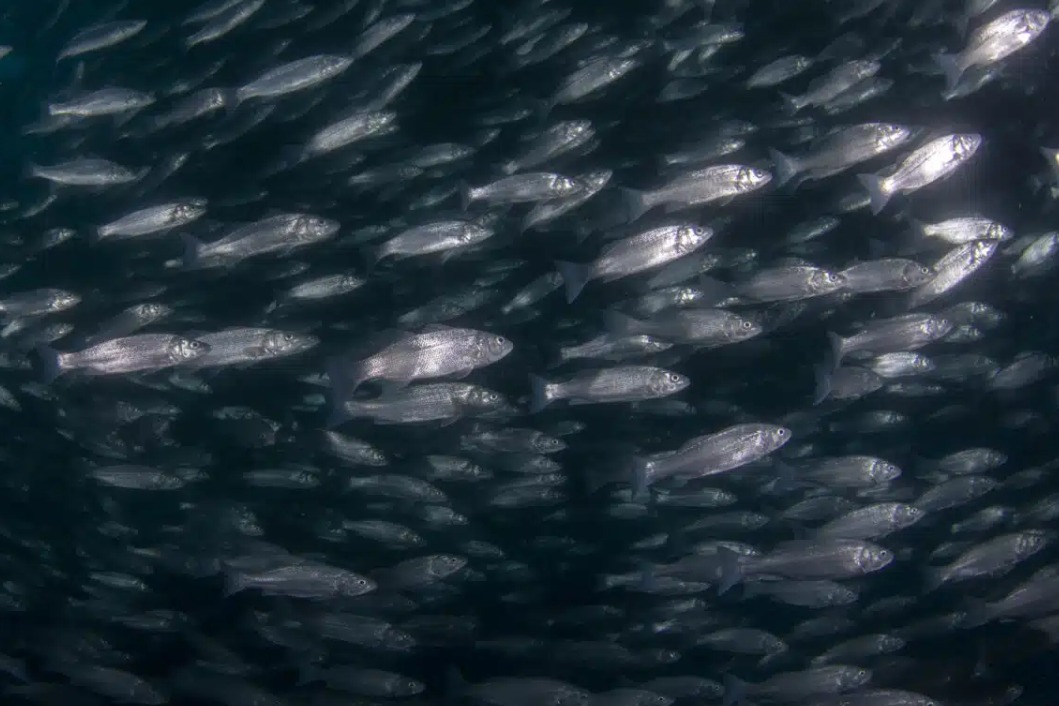
Researchers estimate that approximately 23 million capelin formed a hotspot stretching about ten kilometers, moving together like a coherent wave.
This defensive aggregation soon attracted the attention of Atlantic cod, which also gathered into a massive school to feed. Within a few hours, nearly 2.5 million cod had assembled to prey on the capelin. The resulting predation event was both spectacular and devastating: more than ten million capelin were consumed in just a few hours, representing over half of the original school. Such an event has never before been observed or documented in the ocean.
A Fragile Balance
Capelin play a crucial role in marine ecosystems, serving as a key food source for species such as cod, seals, and various seabirds. A decline in their population could therefore disrupt the entire ecosystem, triggering a domino effect impacting species that depend directly or indirectly on this small fish for survival.
Although this particular capelin school represents only a small fraction of the overall population, researchers warn that climate change could exacerbate such phenomena. As Arctic ice continues to melt, capelin must swim farther to find suitable spawning grounds, increasing their vulnerability to predators.
Scientists emphasize that large-scale predation events of this kind may become more frequent as climate conditions evolve, posing a risk to the stability of capelin populations and, by extension, to overall marine balance.
The research team plans to use OAWRS technology to study other species in the coming years. Through this work, they hope to provide critical information to marine conservation organizations to help prevent population collapses by identifying predation hotspots where ecological pressure is most intense. In the long term, these efforts could prove essential not only for protecting capelin but also for preserving the health of marine ecosystems as a whole.
Toward Better Management of Marine Ecosystems
The observation of such a massive predation event offers valuable insights for the sustainable management of marine ecosystems. By combining advanced technologies like OAWRS and multispectral imaging, researchers can now identify critical zones where species interactions are most intense.
This information is essential for guiding conservation policies and limiting human pressures—such as overfishing—that further destabilize already fragile systems. Moreover, by accounting for the impacts of climate change on species migration and reproduction, these studies help anticipate shifts in marine population dynamics and support the development of adaptive strategies to maintain ecosystem balance over the long term.