
Morocco is no longer merely “a country with a coastline.” It is rediscovering itself and positioning itself as a strategic maritime actor. With 3,500 km of coastline, two complementary seaboards (Mediterranean and Atlantic), and an Exclusive Economic Zone (EEZ) of around 1.2 million km², the Kingdom enjoys a rare geographical asset. But geography alone is not enough: it exposes as much as it protects. This is the core argument of the report “Morocco’s Maritime Security: Stakes, Challenges and Prospects in the Mediterranean–Atlantic Space”, published in January 2026 by the German foundation Konrad-Adenauer-Stiftung.
The sea has become a system in itself, encompassing trade routes, straits, hubs, energy corridors, submarine cables, climate norms, tourism pressures, and hybrid threats.
Rethinking Water Governance
Speaking on the program “Fi Al-Omq” (produced and broadcast by the Party of Progress and Socialism), Charafat Afailal, former Secretary of State in charge of Water, questioned the coherence and relevance of current strategic orientations in water resource governance. While warning of the repercussions of certain policy choices, the member of the PPS Political Bureau implicitly called for a redefinition of priorities and sound arbitration to ensure a sustainable balance between water security, environmental requirements, and economic rationality.
According to her, “the objective is neither to challenge the country’s agricultural vocation nor to hinder its economic contribution, but to seek an explicit trade-off between productive performance and water sustainability.”
A Maritime Issue at the Core of the Economy
In this transition, the economic weight of the coastline makes the maritime issue almost existential. According to data cited in the report, coastal areas contribute nearly 60% of national GDP and host 80% of industrial activity. More broadly, maritime and coastal potential accounts for over half of GDP, 52% of tourism space, and 92% of the industrial fabric linked to fisheries and seafood processing, port activities, maritime transport, seaside tourism, hydrocarbons, and renewable energies. In other words, the maritime challenge is not sectoral—it lies at the heart of the economy, employment, and sovereignty.
Ecosystems: Security Begins with a Living Sea
The report emphasizes that the first line of security is ecological. Rabat has placed the protection of fragile marine ecosystems at the heart of its National Sustainable Development Strategy, integrating it into cross-cutting policies, including a Coastal Law aligned with the ICZM Protocol of the Barcelona Convention, which mandates integrated coastal zone management.
The “Plastic-Free Coastline” plan is presented as a tangible indicator of this orientation: according to Moroccan officials, bathing water quality improved from 88% compliance in 2021 to 93% in 2024, while waste collected on beaches fell by 21%. These gains are reinforced by the National Emergency Plan against Accidental Marine Pollution, designed to better respond to pollution risks in increasingly pressured maritime spaces.
This national strategy is also aligned with an ocean diplomacy approach. Morocco has been active in international negotiations on ocean governance within the African Group, notably through the signing of the BBNJ Treaty (Biodiversity Beyond National Jurisdiction) on September 21, 2023. The report nevertheless underlines structural limitations: only 50 countries have ratified the treaty out of the 60 required, and the absence of the United States and China weakens its scope. Rabat has nonetheless sought to influence discussions by defending the concept of the “common heritage of humankind”, aiming to protect the interests of Global South countries against major scientific and economic powers.
On the ground, Marine Protected Areas (MPAs) are a key lever. Globally, the objective is to exceed 10% of protected seas, compared to 8.4% today, while remaining far from the 30% target by 2030. Since 2004, Morocco has designated eight MPAs along its Mediterranean and Atlantic coasts, including Al Hoceima National Park (19,600 marine hectares) and Souss-Massa National Park (33,800 hectares, including Ramsar zones). The network is complemented by marine-oriented sites such as Cap des Trois Fourches and the Moulouya estuary, classified in 2005. Authorities aim to reach 10% of protected maritime area by 2030, a target expected to increase fish biomass by 500% and stabilize the fisheries sector. Preparations are underway to extend protection to nine additional sites, including Cap Spartel and the Smir Lagoon.
Governance relies on a unified legal framework and enhanced coordination since 2017, supported by technical partners such as WWF, IUCN Mediterranean, and MedPAN. Two flagship projects illustrate priorities: the Boujdour coastal MPA (around 1,000 km²) and the National MPA–Fisheries Network. However, the report also points to weaknesses, including fragmented competencies, limited funding, and insufficient integration of local stakeholders, even as Morocco accelerates the designation of five MPAs as natural parks under Law 22-07 and implements 20-year regional coastal plans under Law 81-12.
Tangier–Nador–Dakhla: Logistics as a Source of Power
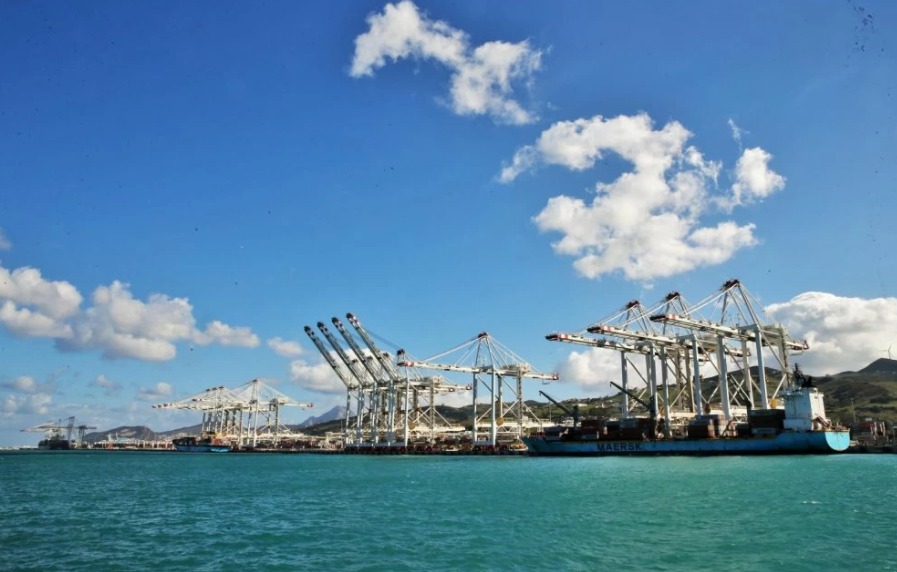
The second pillar of Morocco’s maritime power is port infrastructure. Nearly 90% of global trade flows by sea, and the immobilization of a 24,000-TEU container ship costs hundreds of thousands of dollars per day, making port security, fluidity, and connectivity a strategic advantage. Within this framework, Morocco is developing a complementary triad: Tanger Med, Nador West Med, and Dakhla Atlantique, designed to link Europe, Africa, and the Atlantic.
- Tanger Med is the cornerstone. In 2024, it handled 10.24 million TEUs, ranking first in the Mediterranean and Africa and 17th worldwide, with 180 connections to 70 countries. It placed 4th in the Container Port Performance Index (CPPI) and handled around 17,500 vessels, over 600,000 vehicles, 142 million tons of goods, and more than 3 million passengers.
- Nador West Med is positioned as a relay of the IMEC corridor and as a transitional energy hub, preparing for e-methane and e-methanol bunkering linked to green hydrogen. The CMA CGM / Marsa Maroc joint venture is cited as a key anchor.
- Dakhla Atlantique, expected to become operational in 2028 and connected by a 1,055 km expressway, is envisioned as a Sahelian gateway to the Atlantic and a pillar of the Atlantic Africa Initiative.
However, the report stresses that maritime sovereignty cannot be reduced to efficient terminals alone. Morocco must “move from the quay to the flag.” Despite world-class hubs, the country suffers from a critical shortage of a national merchant fleet—a “port without ships” phenomenon—largely inherited from the privatization of COMANAV in 2007. By 2025, the State reportedly counted only around 17 active vessels, highlighting heavy dependence on foreign flags and loss of value along the logistics chain.
Toward Integrated Maritime Security
The third front is both energy-related and security-driven. The Nigeria–Morocco Africa–Atlantic Gas Pipeline, launched in 2016, is described as a corridor stretching 5,600 to 6,800 km along the Atlantic coast, crossing 13 to 16 countries, with a capacity of 30 to 40 billion cubic meters per year. Initial commissioning is expected from 2029, with a potential European outlet of around 18 billion cubic meters annually and a macro-regional electrification impact benefiting 400 to 500 million people.
Between 2024 and 2025, the project reached a milestone with completed FEED studies, segmented environmental impact assessments, and renewed intergovernmental momentum during the Rabat meetings of July 10–11, 2025. The project finance structure is estimated at around USD 25 billion, via an SPV led by ONHYM and NNPC Ltd. The Moroccan segment from Nador to Dakhla is valued at approximately USD 6 billion, with a target return above 12% and a hydrogen-ready design from the outset.
In this context, the report underscores the evolution of threats and the urgency of integrated maritime security. Protecting critical port infrastructure, securing Gibraltar Strait routes, and adapting to cyberattacks, economic piracy, and technological interference are now as decisive as traditional surveillance.
The core message is clear: Morocco’s maritime power must align sea power, blue economy, and ecological protection. The report sums up this doctrine succinctly: the blue economy cannot thrive without a secure sea—but the sea will only be secure if it is economically fair, ecologically resilient, and humanly protected.

