
During his appearance on the program Heure du Bilan on RTG, Guinea’s Minister of Fisheries and Maritime Economy outlined the concept of the blue economy, a notion still little known to the general public but now at the heart of his ministry’s strategy.
The minister first acknowledged the novelty of the concept in Guinea’s public debate. “I spoke about the blue economy because it is new, and people are wondering what the ‘blue’ actually refers to,” he explained, emphasizing the need to raise awareness and popularize this development approach.
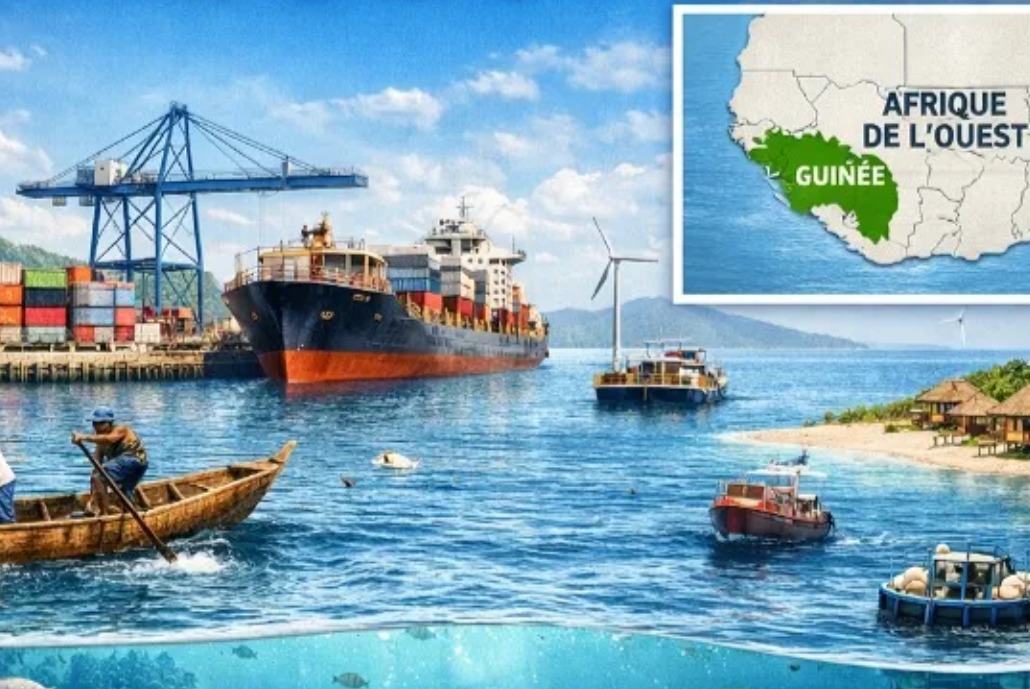
According to him, the blue economy is based on the sustainable management of aquatic resources, with a long-term vision. “The blue economy is the rational exploitation of aquatic resources for the well-being of populations, but above all for the well-being of future generations,” the minister stated, highlighting the intergenerational dimension of this policy.
In this context, the ministry has reached out to technical and financial partners to mobilize substantial resources. A broad network of collaboration with donors has been established to strengthen the foundations of the project.
The minister announced tangible progress in terms of financing. “Today, we are pleased to inform you that we have completed the mission with BATS, with an agreement already signed. A unit of account, amounting to nearly over one thousand dollars, has already been financed by BATS and will support the preparation phase of the blue economy project,” he said.
He added that this step could pave the way for much larger funding. “With the experts who came, we went forward with the ambition of further scaling up this project to around USD 60 to 80 million.”
Beyond financing, Guinean authorities have made their regional ambitions clear. “We want to position our blue economy as a leader in West Africa, because Côte d’Ivoire was the first to secure USD 24 million. If we obtain USD 60 million or USD 80 million, we will become the leader,” the minister affirmed, placing Guinea within a framework of competitiveness and sub-regional leadership.
Source: Guinee360