
The Mediterranean remains one of the seas where sharks and rays are among the most threatened in the world. In 2025, the most recent figures confirm a structural crisis driven by overfishing, bycatch and pollution, while the accelerated warming of the basin further complicates the situation. Between regulatory progress and shortcomings on the ground, the question is no longer whether the situation is serious, but whether action will come fast enough.
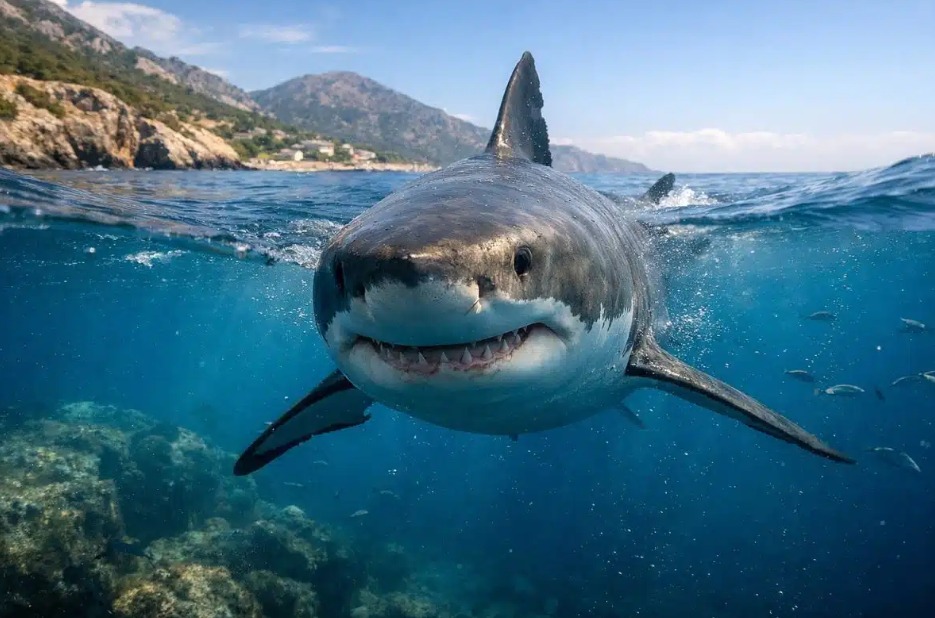
Sixgill shark filmed in open water, a dark silhouette gliding through the deep blue of a calm ocean, seen in profile beneath the surface.
A sixgill shark observed in open water, similar to what researchers filmed near Cabrera.
Credit: NOAA / Wikimedia Commons
A small sea, a huge challenge
The Mediterranean represents only a fraction of the world’s oceans, yet it concentrates remarkable biodiversity, intensive uses and constant human pressure. It is also a semi-enclosed sea bordered by dozens of countries, where artisanal and industrial fishing, maritime trade, tourism and coastal urbanization coexist—sometimes at the expense of marine life.
In this setting, sharks and rays play a key role. They are top predators or “ecosystem engineers” of the seabed, capable of structuring food webs, selecting the most vulnerable prey and contributing to the balance of fragile ecosystems. When they decline, the entire structure weakens, triggering cascading effects on fish populations, habitat health and, ultimately, the resilience of fisheries.
58% of shark and ray species threatened: a world record… in the Mediterranean
Data consolidated by WWF in its assessment of the Mediterranean basin paint a stark picture: of the 73 species of cartilaginous fish recorded in the Mediterranean (sharks, rays and chimaeras), 42 are considered threatened—58%. The report also highlights that the situation in the Mediterranean is worse than the global average, estimated at 37%.
This figure is more than an indicator: it reflects the accumulation of threats, the slow reproductive rates of many species and the difficulty of enforcing consistent rules in a shared marine space. WWF also points to another blind spot explaining the basin’s vulnerability: dozens of species remain insufficiently covered by management measures or by international conventions, even though some are already classified as “endangered” or “critically endangered.”
A massive lemon shark moving through turquoise water, flanked by remoras clinging to its body above a dark seabed.
A close-up of a lemon shark, recalling the power of large tropical sharks.
Fishing is not the only problem: it is mainly how we fish
At the heart of the issue in 2025 are three words: catches, selectivity and enforcement. The decline of sharks and rays is not explained solely by targeted fishing; it is primarily driven by non-selective fishing that catches, injures and kills species “along the way.”
At the global level, the scientific community behind the IUCN report on the status of sharks, rays and chimaeras stresses a point often overlooked by the public: most captures are unintentional, and a large share of these bycatches are nevertheless retained, sold or consumed.
In the Mediterranean, this “bycatch effect” is particularly destructive because many species are coastal, use nursery areas and encounter fishing gear at the most vulnerable stages of their life cycle. Longlines, gillnets, trawls—sometimes drifting in illegal contexts—even when sharks are not the target, they end up paying the ecological price.