
The planet’s ice is disappearing — and with it, the memory that our planet holds of itself.
During a very southern inauguration ceremony on the snow-covered Antarctic plateau on Wednesday, scientists stored long ice cores taken from two dying Alpine glaciers inside a 30-meter tunnel — protected, for now, from climate change and global geopolitical upheavals.
Each ice sample contains tiny microbes and air bubbles trapped in the distant past. Future scientists, using techniques not yet known today, could use these ice cores to gain new insights into the evolution of viruses or global climate patterns.
Extracting ice from glaciers worldwide and transporting it to Antarctica requires complex scientific and diplomatic collaboration — exactly the kind of work disparaged by the Trump administration in the United States, said Olivier Poivre d’Arvor, special envoy of French President Emmanuel Macron and ambassador for Earth’s polar regions.
“Scientists are threatened by those who doubt science and want to muzzle it. Climate change is not a hoax, as President Trump and others claim. Absolutely not,” Poivre d’Arvor said at an online press conference Wednesday.
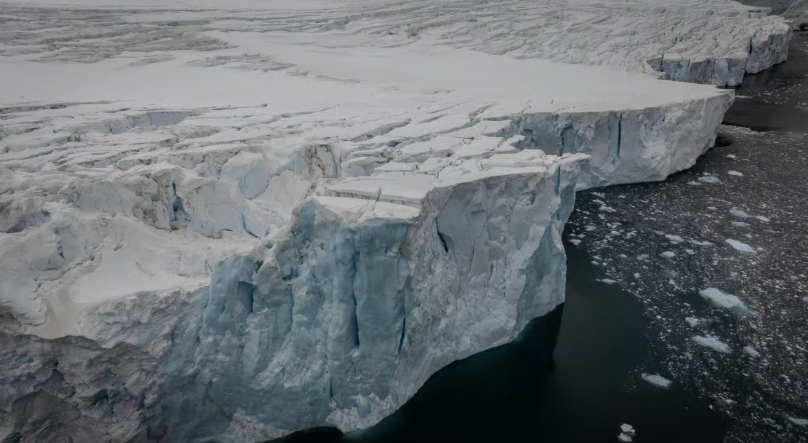
Global warming is causing glaciers to retreat worldwide. In some regions, the information they hold about the past will be lost forever in the coming decades, regardless of efforts to slow climate change.
“Our time machines are melting very quickly,” said Carlo Barbante, an Italian scientist and vice president of the Ice Memory Foundation.
The tunnel, called the Ice Memory Sanctuary, is located less than a kilometer from the Franco-Italian Concordia base in Antarctica. It rests on a 3,200-meter-thick ice layer, and the temperature remains constant at -52 °C. Scientists estimate that the tunnel will remain structurally stable for more than 70 years before needing reconstruction.
In addition to the two ice samples that arrived this month by ship and plane, scientists have collected cores from eight other glaciers, from Svalbard to Kilimanjaro. These cores are currently stored in freezers awaiting transport to Antarctica. Jérôme Chappellaz, a French sociologist and co-founder of the sanctuary, called for the establishment of more facilities of this type across Antarctica and expects China to soon create its own storage site for Tibetan ice.
Poivre d’Arvor advocated for an international treaty requiring countries to donate ice to the sanctuary and guarantee scientists’ access.
France and Italy collaborated on the construction of the sanctuary and provided resources to facilitate the transport of samples. “This is not a short-term investment, but a strategic choice based on scientific responsibility and international cooperation,” said Gianluigi Consoli, an official from the Italian Ministry of Higher Education and Research.
Inside the door enclosing the ice, someone had written in black marker: “Quo Vadis?” (Latin for “where are you going?”). It is a question that hangs even over the protected Antarctic continent.
Antarctica is governed by a 1959 treaty that suspended territorial claims and preserved the continent for scientific and peaceful purposes. But given former U.S. President Donald Trump’s territorial ambitions near the North Pole, in Greenland, the internationalist ideals that have ensured Antarctic stability for over half a century no longer seem shared by the United States.
William Muntean, who served as senior adviser for Antarctica at the State Department during Trump’s first term and under President Biden, said there has been “no sign” that U.S. policy in Antarctica will change, and he does not expect it to.
“The southern polar region is very different from the Western Hemisphere and the Arctic,” Muntean said. The United States claims no sovereignty, military competition is negligible, and there are no commercially viable energy or mining projects at the South Pole. “Any disruptive or significant action in Antarctica would serve none of the Trump administration’s priorities.”
That said, he added, “one can never rule out a change.”