
The future of the fishing industry in Mauritius now goes beyond the sole issue of catching fish. It affects food security, maritime sovereignty, job creation and the stability of the Indian Ocean. These issues were at the heart of a public conference given on Wednesday in Port-Louis by Professor Haruko Yamashita, from Daito Bunka University in Tokyo, devoted to the blue economy and the vision of a Free and Open Indo-Pacific.
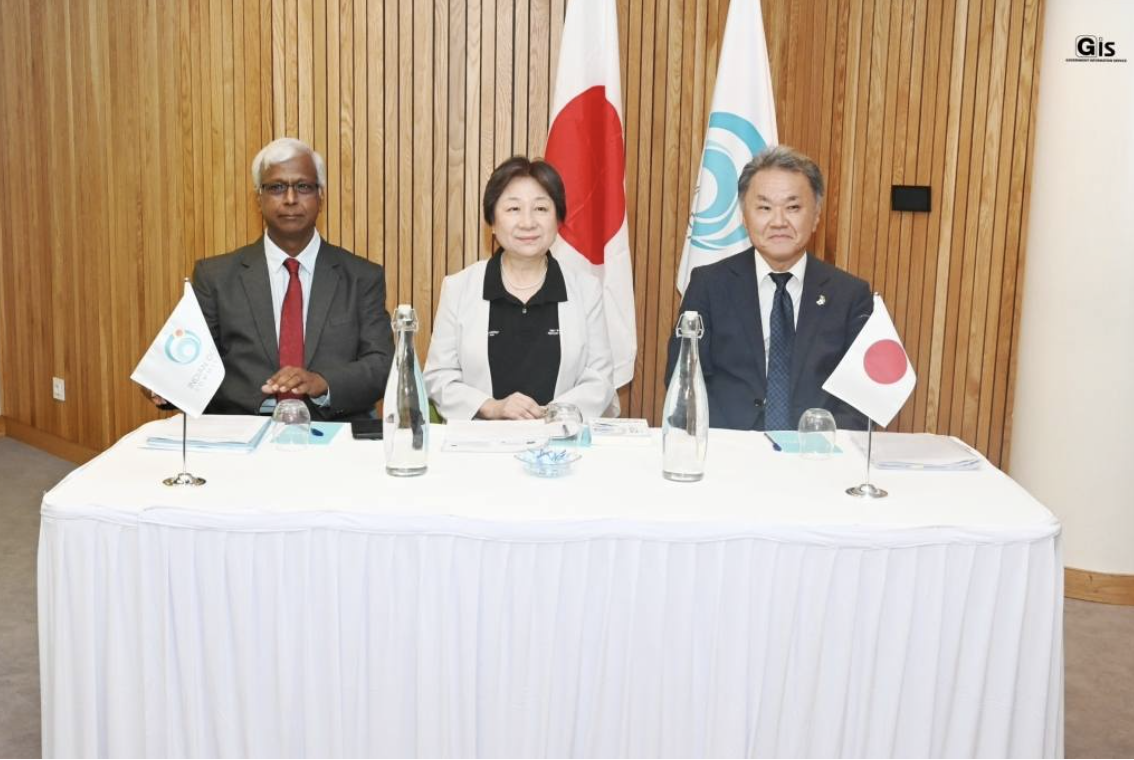
The meeting, organized jointly by the Japanese Embassy and the Indian Ocean Commission (IOC) at the Caudan Arts Centre, was held in the presence of the Japanese Ambassador to Mauritius, Kan Masahiro, as well as Raj Mohabeer, Officer-in-Charge of the IOC General Secretariat. It has made it possible to place Mauritian fishing in a broader strategic reflection, combining economic development, environmental sustainability and regional cooperation.
From the outset, Professor Yamashita invited the audience to review the geographical perception of Mauritius. Like Japan, whose Exclusive Economic Zone (EEZ) is about 11 times larger than its land surface, Mauritius has a huge underwater territory – up to a thousand times larger than its emerged territory.
« They are large oceans for small states, » she said, stressing that this immensity is not only an economic resource, but also a strategic frontier. « In Japan, the maintenance of fishing communities on remote islands is a matter of a national security logic. For Mauritius, the stakes are comparable: occupying the maritime space by a real and structured fishing activity is one of the most effective ways to assert its sovereignty. «
On the productive level, explained Haruko Yamashita, Mauritius faces a reality shared by many small island states: the overexploitation of reef resources. As lagoon fish stocks are already heavily requested, the transition to offshore and semi-industrial fishing appears as « a necessity to preserve coastal ecosystems while maintaining the supply of the local market ».
This development is all the more crucial as the country remains highly dependent on food imports, including seafood. « Strengthening offshore fishing capacities, better organizing the sector and developing infrastructure are all levers to improve food self-sufficiency and secure local supply, » said Haruko Yamashita.
One of the main points addressed by the speaker concerns the competition of fish imported at low prices. Increased productivity of global industrial fleets has led to excessive pressure on stocks, while global warming is changing marine habitats. As a result, local fish struggle to align with international market prices.
Rather than suffering this constraint, Haruko Yamashita proposes to turn it « into an opportunity ». She pleads for Mauritius to encourage foreign ships operating in its EEZ to land some of their catches locally. Such an approach would power processing plants, create domestic jobs and strengthen local added value.
Fishing, the professor insisted, can no longer be considered only from the perspective of capture. According to her, the seafood processing sector is a central pillar of the blue economy, « capable of generating sustainable jobs and diversifying the incomes of coastal communities ».
In Mauritius, the challenge is not so much the overall volume of jobs as the diversification of livelihoods in a context of population growth and increased vulnerability to climate change. The modernization of the fisheries sector is thus becoming a social and economic issue.
Technology is called upon to play a driving role in this change. Haruko Yamashita cited the example of Nauru, where fishermen use digital tools in a simple and effective way: they photograph their catches at sea, publish them on social networks with a price, and customers reserve the fish even before the boat arrives at the port.
She praised the progress already made in Mauritius in the collection of fisheries data, as fishermen are familiar with the recording of catches. An essential practice, she stressed, not only for the sustainable management of resources, but also to allow, in the future, « financial compensation during industrial projects at sea », such as the installation of offshore wind turbines.
In order to guide public decisions, Professor Yamashita proposed an analysis grid based on the cost-effort-time-impact ratio. Low-cost, fast-acting initiatives, such as digital-driven direct sales, can generate immediate revenue and increase the pride of fishermen. In the medium term, local processing supports employment and food security, while heavier projects, such as ecological restoration by algae or mudflats, are part of a long-term sustainability logic.
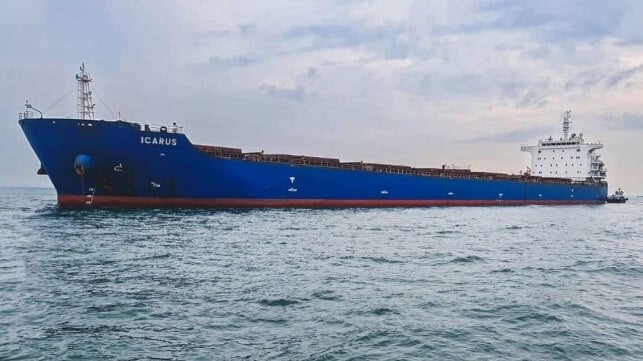
In conclusion, emotion took place over technical analysis, Professor Haruko Yamashita who wore a shirt produced in tribute to Wakashio said that this shipwreck in 2020 deeply marked Japanese public opinion. « The majority of Japanese, young and old, now know the name and location of Mauritius, » recalled Haruko Yamashita.
This tragedy sealed a relationship of lasting solidarity. Japan now aims to make Mauritius a regional training center for African technicians, relying on research infrastructure financed by Tokyo since the 1990s, as a foundation for a new regional autonomy in the field of the blue economy.
Speaking, the Japanese ambassador, Kan Masahiro, placed these issues in the broader framework of the Free and Open Indo-Pacific, a strategic vision proposed by Japan in 2016 to ensure that the Indian Ocean remains a free, secure and rule-of-law-state trade area.
For Mauritius, the FOIP is a geopolitical shield against the looting of fishery resources and transnational threats such as illegal, unreported and unregulated fishing, trafficking in drugs, weapons and human beings. With this in mind, Japan, through the Japan International Cooperation Agency, works closely with Mauritius on several technical cooperation projects related to the protection of marine resources and the sustainable development of fisheries.
For Raj Mohabeer of the Indian Ocean Commission, the challenges facing the Indian Ocean require a collective and coordinated approach. He recalled the role of the IOC in the establishment of regional maritime architecture, supported by Japan, in order to strengthen the governance of maritime areas and to « promote a sustainable, resilient and inclusive ocean economy ».
source : lemauricien