
« We were surprised by both the magnitude and speed of the progress of the breeding season, » says Ignacio Juarez Martínez, of the British universities of Oxford and Oxford Brookes, the lead author of the study published in the Journal of Animal Ecology, for AFP.
This change is the fastest observed among « all vertebrates on Earth, » he says.
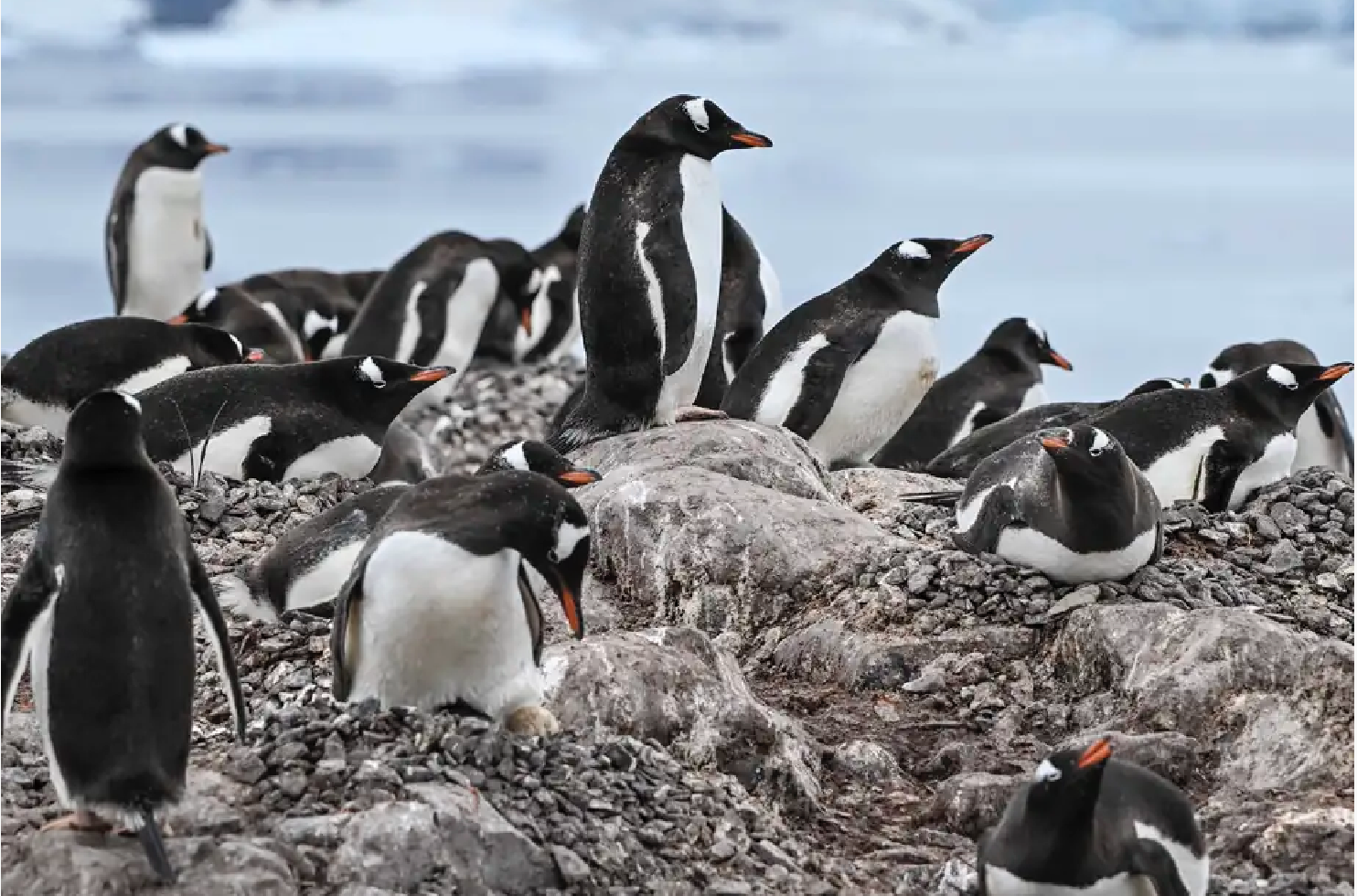
An international team of scientists examined the periods during which animals established their nesting colonies during the austral summer, between 2012 and 2022. They relied on images taken by dozens of cameras monitoring 37 different colonies.
Nesting dates have advanced at « record rates » during the decade for the penguin species studied: 13 days on average in the Papuan penguin (up to 24 days in some colonies).
The Adélie and jugular penguins have for their part advanced their breeding period by 10 days during the decade.
Upset rhythms
The precise mechanisms by which rising temperatures affect the behavior of penguins are not yet well understood by scientists, who highlight several factors that can affect certain species differently.
« For example, Adélie penguins hunt in sea ice and advance their breeding season where this sea ice breaks faster as a result of warming, » explains Ignacio Juarez Martínez.
For jugular penguins, this advance is rather linked to an evolution of ocean photosynthesis, favoring food production. Researchers believe that this may allow them to gain weight earlier in the year than before.
Antarctica is one of the fastest warming regions in the world and the average annual temperature reached record levels last year, according to the latest report from the European service Copernicus.
The penguin colonies, which choose ice-free areas, are even in some of the most exposed areas in the world to climate change.
These upheavals in their rhythms now put the three species that previously mable to live together in competition, because they reproduced at slightly different times, which is less the case today.
« This is true for food, but also for other resources such as snow-free nesting areas: we have already seen Papuan penguins use nests that were previously occupied by Adélie or jugular penguins, » says Ignacio Juarez Martínez.
« Winners and losers »
With this new situation, there are « winners and losers of climate change, » warn the authors in their study.
The number of Papuan penguins, a « generalist » species that easily changes its diet and adapts better to a relatively more temperate climate, is already increasing. The other two species, more dependent on the abundance of krill or particular ice conditions, decline.
« Pinoins are considered an « indicator of climate change », so the results of this study have implications for species around the planet, » says Fiona Jones, of the University of Oxford, co-author of the research work, in a statement.
Is it ultimately good news if some animals manage to evolve to survive in a new environment? « It’s too early to say, » answers Ignacio Juarez Martínez.
« We are studying their ability, for each species, to raise chicks. If they manage to maintain a high number, it will mean that it is good news and that they are indeed adapting to climate change, » he concludes.
Source : lapresse