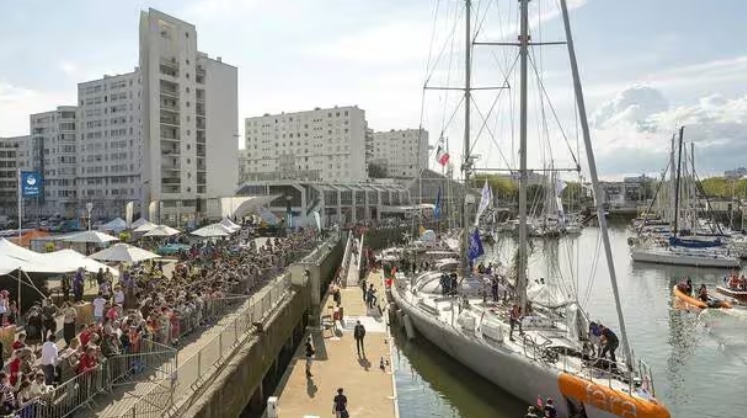
Aboard the Oceanxplorer (AFP) – A descent to a depth of nearly 1,000 meters into the kingdom of purple corals and bioluminescent shrimps: AFP boarded a submersible of OceanX, the NGO that is trying to better understand the marine world, during a mission in Indonesia.
Scientists study the biodiversity of a largely unexplored world, looking for unknown species, plastic-eating microbes and compounds that could one day be used to produce new medicines.
This work is being carried out from the OceanXplorer ship, equipped with a helicopter, a vast genetic analysis laboratory and two submersibles. Armed with impressive equipment, from hydraulic collection arms to suction tubes to ultra-high-definition cameras, these machines are capable of discovering unlikely life forms in some of the most extreme conditions on the planet.
OceanX’s most recent mission focused on an underwater mountain range off the coast of Sulawesi. After mapping it last year, scientists explored its depths aboard their extreme craft.
After a first level of minus 200 meters, the last traces of light disappear and the indigo melts into total darkness.
The submersible’s spotlights then reveal a constant whirlwind of « sea snow », debris, including decomposing animals, floating in the water column, like a cloudy image from an old television set stuck between two channels.
Sea creatures that most humans will never see appear, including delicate ctenophora, often mistaken for jellyfish, illuminated with glittering garlands on their sides.
Siphonophores, largely translucent, drift, while fingernail-sized fish sparkle.
Husna Nugrahapraja, an Indonesian scientist, said he was « a little nervous and anxious » for his first run. Before looking forward to being able to « observe many unique organisms », from delicate starfish to soft corals.
Vue à 360 degrés
Les submersibles ont été utilisés depuis des décennies pour l’exploration sous-marine. OceanXplorer en transporte deux: le Neptune, destiné à la collecte et à l’observation scientifiques, et le Nadir, conçu pour la production de contenu médiatique.
Car OceanX, fondée par le financier américain Ray Dalio et son fils, estime que des images percutantes rendent la recherche scientifique plus accessible et plus efficace.
Les deux mini-sous-marins peuvent plonger à un kilomètre de profondeur, bien moins que les 6.000 mètres que peut atteindre le véhicule télécommandé (ROV) d’OceanXplorer.
Mais les deux engins offrent une vision unique des grands fonds marins, « une perspective totalement différente » de la vidéo transmise au navire par le ROV, relève Dave Pollock, qui dirige l’équipe en charge des submersibles.
« Nous recevons beaucoup de scientifiques très sceptiques à l’égard des submersibles », explique-t-il. Mais « presque tous ceux qui embarquent et qui participent à une plongée changent d’avis, sans exception ».
From the transparent sphere of the device, scientists can see for the first time organisms or places that they have studied for years.
Bioluminescence
Among the most memorable moments of his hundreds of hours spent diving, Dave Pollock cites the « reflected bioluminescence », a unique spectacle of light signals emitted by animals from the abyssal depths to communicate, defend themselves or attract a mate.
To trigger the phenomenon, the submersible turns off all its lights. Even the control screens are covered to create complete darkness.
Then the craft flashes its powerful light beams while the passengers close their eyes. When they open them, a galaxy of bluish stars appears, emitted by plankton, jellyfish or fish.
Unknown crustaceans
While many associate submersibles with the implosion in 2023 of a device diving towards the wreck of the Titanic (five deaths), Dave Pollock wants to be reassuring.
The machines used by OceanXplorer « are designed to be safe », are equipped with backup systems, including a four-day autonomy in case of emergency and are regularly inspected, he said.
To explore deeper areas, OceanX’s ROV can be operated from a futuristic control room on the ship, where two operators activate its hydraulic arm using joysticks.
On the wall of screens appears a desolate landscape that could make you think of another planet. With its own aliens, which the remote-controlled craft will try to capture: a white lobster or a sea cucumber covered in spikes that collapse like black spaghetti once on the surface. Also spotted: a hermit crab that does not live in a shell but in a starfish corpse where it has laid bright orange eggs.
When the ROV returns with her samples, Pipit Pitriana, from Indonesia’s state-owned research agency BRIN, is particularly fascinated by the lobster caught, as well as small, pearl-sized crustaceans that she thinks are unknown to science.
« Our land, our sea, are largely made up of the deep seabed, » says this crustacean specialist. « But (…) we know so little about deep-sea biodiversity. »
source : france24