A Schmidt Ocean Institute expedition along the Argentine coast documented amazing marine specimens.
The depths off the coast of Argentina are full of natural riches. A team of researchers aboard the Schmidt Ocean Institute’s Falkor (too) research vessel sailed the coast, from Buenos Aires to Tierra del Fuego, discovering 28 potential new species and remarkable specimens. The new documented organisms include worms, corals, sea urchins, sea snails and sea anemones.
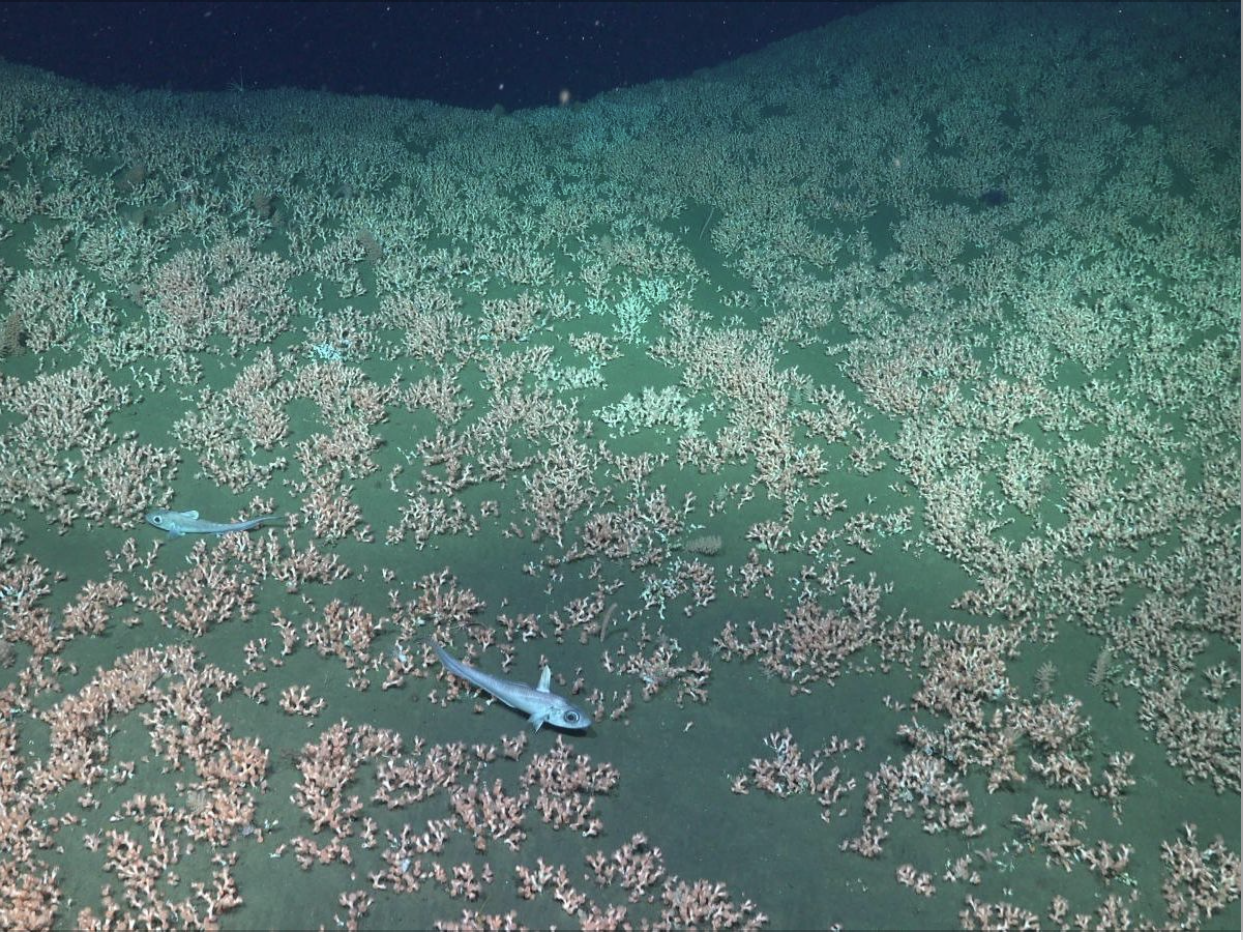
The crew also observed the largest coral reef of the species Bathelia candida identified to date. It covers at least 0.4 square kilometers, which makes this cold water reef almost as extensive as the Vatican. A precious dimension, Bathelia candida being a refuge for many species, such as fish or crustaceans.
A whale corpse that provides thousands of years of food
At 3890 meters deep, scientists also documented a whale corpse, the deepest discovered off the coast of Argentina. If, at first glance, rejoicing in this discovery may seem morbid, it is not. Indeed, the corpses of whales that flow at the bottom of the ocean then become temporary ecosystems, offering shelter and food to the surrounding wildlife.
More specifically, whaling in the seabed « prove thousands of years of food to an environment accustomed to scarcity, » the Schmidt Ocean Institute comments in a statement. Once the flesh has been consumed, the corpse becomes a substrate where species can settle.

Scientists also had the chance to see a giant ghost jellyfish (Stygiomedusa gigantea) 250 meters deep. Its four oral arms can reach a length of 10 meters. And this « sea-to-sea jellyfish that can reach the length of a school bus, » notes the Schmidt Ocean Institute, which specifies that it is rare.

An almost new VHS
Unfortunately, the team certainly did not travel the unseabed of all human activities. She got her hands on fishing nets, garbage bags and, more amazingly, an almost new VHS tape, proof of « the longevity of plastics« , notes the research institute. He continues: « the label stuck on the side of the adhesive tape is in Korean, but the team does not know how he got off the Argentine coast and how old he is« . Curious, scientists have taken the cassette and now want to study if the local wildlife ingests this type of plastic.
source : sciencesetavenir