
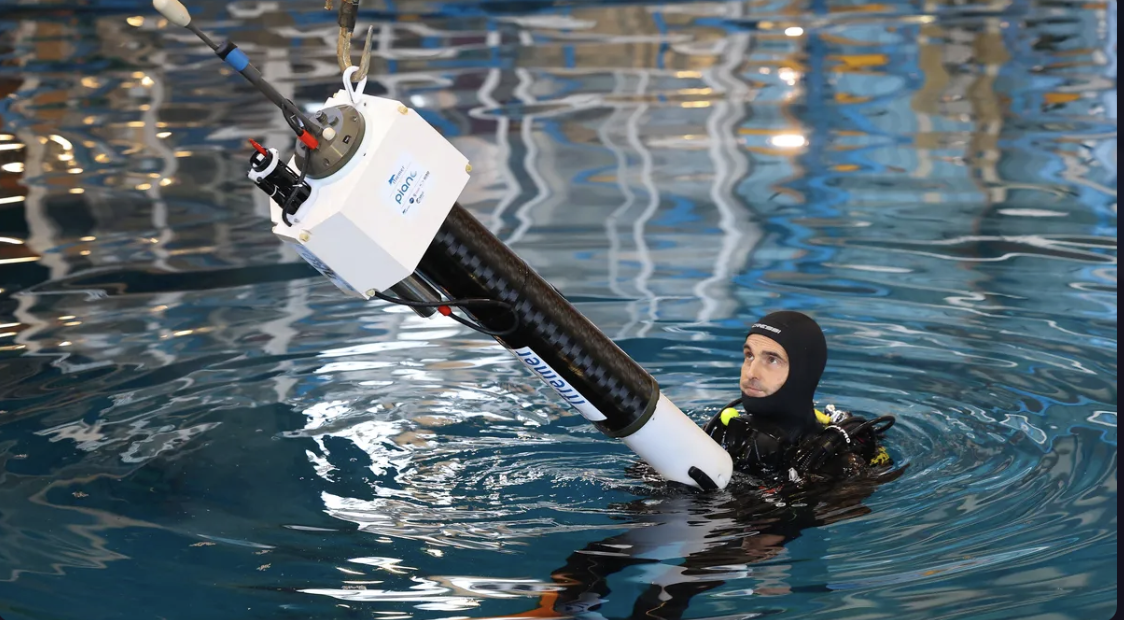
Ifremer has just announced that it had deployed its first two Argo floats. They will make it possible to analyze, in particular, the impact of global warming on the abyss.
France launches its first diving floats at the bottom of the oceans: the Argo beacons. They are probes capable of diving nearly 6,000 meters deep to take the pulse of the ocean. They have just been put into the water on the high seas, in the West Indies, the French Research Institute for the Exploitation of the Sea (Ifremer) announced on Monday, February 2, 2026. They will make it possible to study in particular the impact of global warming in the abysses.
Argo is the name of this international program for real-time monitoring of the state of the ocean. Currently, 4,000 probes of this type crisscross the seas of the globe according to the currents. These machines look like balls, but they do not stay on the surface, they generally dive 2,000 meters deep to collect essential data for scientists, as explained by Virginie Thierry, a researcher at the Physical and Spatial Oceanography Laboratory at Ifremer. « It is by going up to the surface that they will make measurements of temperature, salinity and sometimes additional parameters, such as oxygen or pH. This data is retrieved, made available in less than 24 hours and during this time, the float leaves for a 10-day cycle. It continues like this for 5, 6, or even 7 years for some floats. »
These floats are fully autonomous, they were first deployed in the early 2000s, the data are used for fundamental research, especially on warming or sea level rise, but they are also used for weather forecasting and storm prediction for example.
« The ocean stores 90% of excess heat due to human activities »
The novelty is that some Argo beacons can now go even deeper. Until then, there was a limit: 4,000 meters deep, technologies did not allow us to go any further, given the pressures in the abyss. China and the United States have finally developed beacons capable of withsuffering these extreme conditions.
France has therefore just joined this very closed club. Two probes manufactured in Morbihan thus carried out several data collection cycles at a depth of 6,000 meters in January 2026 in the West Indies. Abyssal areas still very little known, but whose exploration is necessary to understand the impact of warming. « The ocean stores 90% of the excess heat due to human activities, » says Virginie Thierry. There is a strong warming signal that is observed in the abyssal areas and we need to quantify or know exactly where the excess heat goes and therefore we need to be able to quantify the contribution of these deep layers to this heat storage. » France hopes to deploy, by 2028, 30 additional Argo floats capable of reaching these famous 6000 meters of depth.
source : radiofrance