
In Antarctica, a population of orcas uses an amazing technique passed down from generation to generation to hunt prey installed on the pack ice, sheltered from most marine predators.
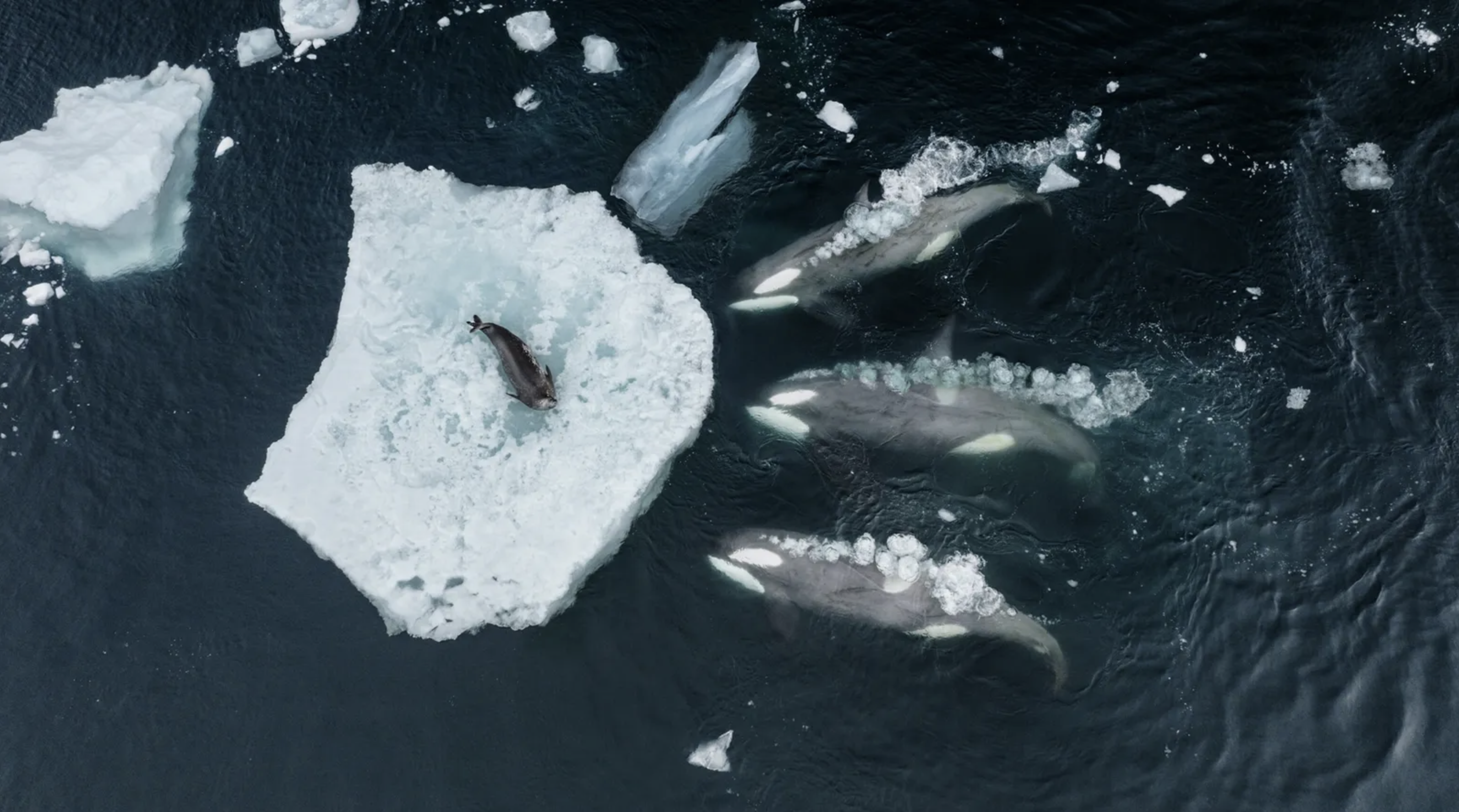
When he finally notices the presence of the orcas, the Weddell seal is already surrounded. A few moments before, before the heads of three orcas came out of the water, the animal rested quietly on a piece of pack ice at the bottom of an Antarctic canal. But the rest is over, the orcas have now found their prey.
On this ice platform, the nearly 450 kg mammal would be inaccessible to the vast majority of other marine predators. This group of orcas, composed of a matriarch accompanied by her daughter and granddaughter, is however one of about a hundred individuals who have managed to master a unique hunting technique that consists of gathering and forming a wave powerful enough to tip the prey housed on the pack ice.

An orca bites a crab seal. Unlike large and docile Weddell seals, crab seals are aggressive and can be difficult to tip over using the wave technique. Since the melting of the ice has the effect of keeping more seals on dry land, these orcas must hunt everything they have at their disposal.
Once their target has been identified, the orcs form a line of battle and rush towards the pack ice. Just before reaching it, in a single synchronized movement, the members of the group rotate to stand on their side, then dive under the water. This momentum creates a wave so powerful that it floods the ice layer, cracks its surface and hits the seal, which stirs in all directions. Slowly and methodically, the orcas repeat the movement. The ice cracks more. At the third charge, the wave destabilizes the seal, which falls into the water. The unfortunate man tries to climb on a piece of ice and then, caught by an orca, disappears into the depths.

Orcas observe a group of crab seals lying on a piece of pack ice. This surface spying technique allows orcs to observe their environment by keeping their head out of the water, sometimes for several minutes, and using their pectoral fins to stay afloat.

A Weddell seal lies down while an orca comes out of the water to spy on it behind its back. Later, a group of orcs managed to knock him into the water.
« It’s a very sinister moment to observe, » says Bertie Gregory, an award-winning animal film director who spent a decade following these super-predators, known as type B1 orcas, a population that lives near the pack ice. The level of intelligence they show to create each wave « is amazing, » he adds. « It’s not subtle. They solve problems through very complex teamwork. They use water as a tool. Sometimes it only takes one wave, about five minutes, for a seal to be thrown into the sea. Other times, a group can make up to thirty waves, which can take two to three hours, before catching its prey. With this method, it is rare to observe failed hunts. « This behavior is not innate; they have learned to control it for decades, » explains Gregory. « Every time they make waves, it almost feels like it’s more of an experience for learning than for hunting. «

Several family groups of orcs, who use the waves to destabilize their prey, come together to socialize. This gathering of about twenty individuals consists of about 20% of the known population of B1 type orcas in the western Antarctic Peninsula.

A crab seal and an Adélie penguin rest on a piece of pack ice, spied on by a male orca. The orca tried to chase the seal, but after several waves followed by a chase in the water, the seal managed to escape.
With the warming of Antarctica and the disappearance of sea ice, however, Weddell seals spend more and more time on the mainland, out of reach of the predators. To determine how B1 orcs adapt to a warming habitat, scientists have identified all the individuals in the group, about a hundred. They found that type B1 orcas lose about 5% of their population each year. We do not know if this subgroup « will go out or if it will simply adapt its behavior, » admits Gregory. In any case, as orcas have fewer and fewer opportunities to apply this unique hunting technique, « we are witnessing the extinction of a culture ».

An orca is looking for seals to hunt, surrounded by pieces of sea ice and glaciers floating on the surface of an Antarctic canal. The ice cover was supposed to be much more important in this area a few years ago. Last February, the sea ice of Antarctica reached very low levels, which had never been reached before.
When he was a child in England, Bertie Gregory remembers being the target of ridicule because he was « totally obsessed with the natural world ». This enthusiasm, combined with his skills as a photographer and director, earned him a BAFTA for photography and the Best Presenter Award at the Jackson Wild Film Festival in 2019. In his series Up Close to Animals with Bertie Gregory, available for streaming on Disney+, Gregory takes viewers in front of and behind the camera, as well as on land and underwater, in search of behaviors rarely observed in wild animals. National Geographic explorer since 2015, he spent several years following type B1 orcas in Antarctica.
source : national geographic