
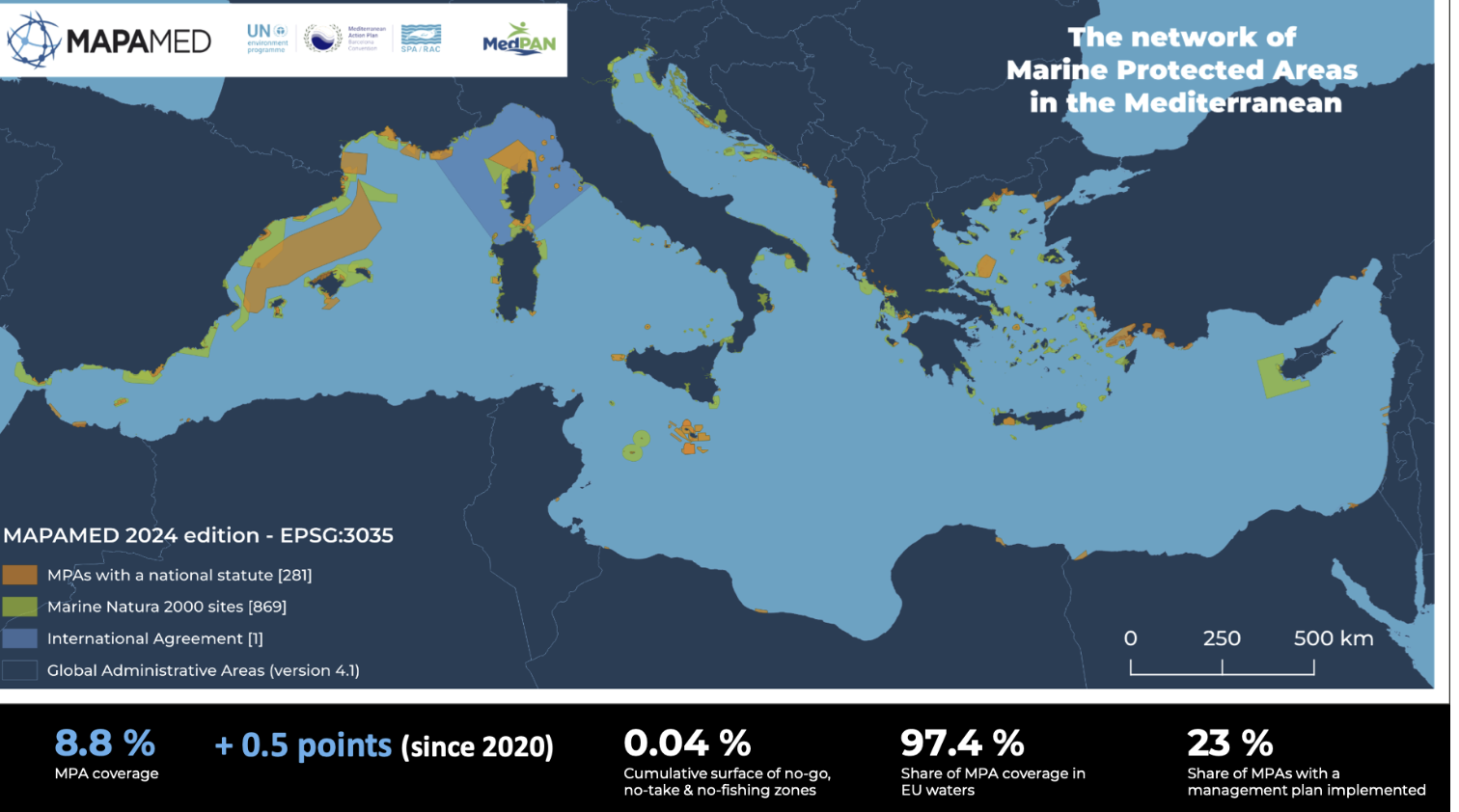
Under the Barcelona Convention, the EU and Mediterranean countries aim to protect 30% of marine waters by 2030, including 10% under strict protection. Yet provisional findings from the 2025 report of MedPAN, the network of Marine Protected Area (MPA) managers in the Mediterranean, reveal that the region remains far from this target. Just 8.8% of the Mediterranean Sea is currently designated as MPAs – an increase of only 0.5 percentage points since 2020 – while strictly protected areas account for a mere 0.04%.
Stark regional and management gaps
Since 2010, MedPAN, in partnership with the UNEP/MAP Regional Activity Centre for Specially Protected Areas (SPA/RAC), has monitored the evolution of MPAs across the basin. The latest findings, due for full release in late spring, expose a striking imbalance: more than 97% of existing MPAs are located in EU waters, leaving countries in the southern and eastern Mediterranean significantly underrepresented. ‘Regional cooperation is essential, and initiatives like the EU Pact for the Mediterranean can help bridge the gap,’ says Carole Martinez, Senior Policy Manager at MedPAN.
Beyond designation, effective management remains a persistent challenge. Only 23% of surveyed MPAs have an implemented management plan in place. While awareness of key pressures – including pollution and invasive species – is high, and 42% of MPAs report taking action to mitigate these threats, other critical issues receive less attention. As an example, just 10% assess tourism carrying capacity, despite the intense seasonal pressure placed on many Mediterranean coastal areas.
Climate change: a growing threat, limited response
The Mediterranean is warming three times faster than the global ocean, making it one of the world’s climate change hotspots. Yet the survey indicates that only 32% of MPA managers identify climate change as a priority, and just 30% report taking concrete action to address its impacts.
In response, MedPAN has joined forces with CSIC, WWF Mediterranean, IUCN Mediterranean, the Union for the Mediterranean and SPA/RAC to launch the 100MPA MedAlliance, aiming to enhance climate resilience in 100 MPAs by 2030. It will provide toolkits, expert guidance, policy support and advocacy actions to strengthen the capacity of MPAs to confront the climate crisis. MPAs ready to implement climate adaptation measures are invited to join the initiative, while organisations across the region, such as the new Climate Change Regional Activity Centre of the UNEP/MAP, are encouraged to contribute expertise to support protected areas on their adaptation journey.
Putting people at the centre
For Carole Martinez, conservation is ultimately about people. ‘The ocean is the biggest development agency, our life insurance; we cannot live without protecting and stewarding it. But the first challenge is human,’ she stresses.
Strengthening human capacity and fostering communities of practice through networks of MPA managers are central to building effective MPAs. Initiatives such as the EU Blue Parks Community – now bringing together more than 130 active members – place this human dimension at the heart of marine protection efforts.
‘Connecting the wider European blue parks network is incredibly valuable and instrumental. It’s a major step toward linking different regional communities of practice,’ Carole Martinez adds.
Learn more form EU Blue Parks Community members!
The upcoming workshop Open Dialogue: Next Steps for the European Blue Parks Initiative will take place on 4 March 2026 at 14:00 CET and will be available via livestream.
This sixth session in the series will focus on the next steps for the EU Blue Parks initiative during the Mission’s deployment phase. Established under Mission Ocean and Waters, the EU Blue Parks Community brings together organisations actively engaged in marine protection across Europe.
source : European Commission