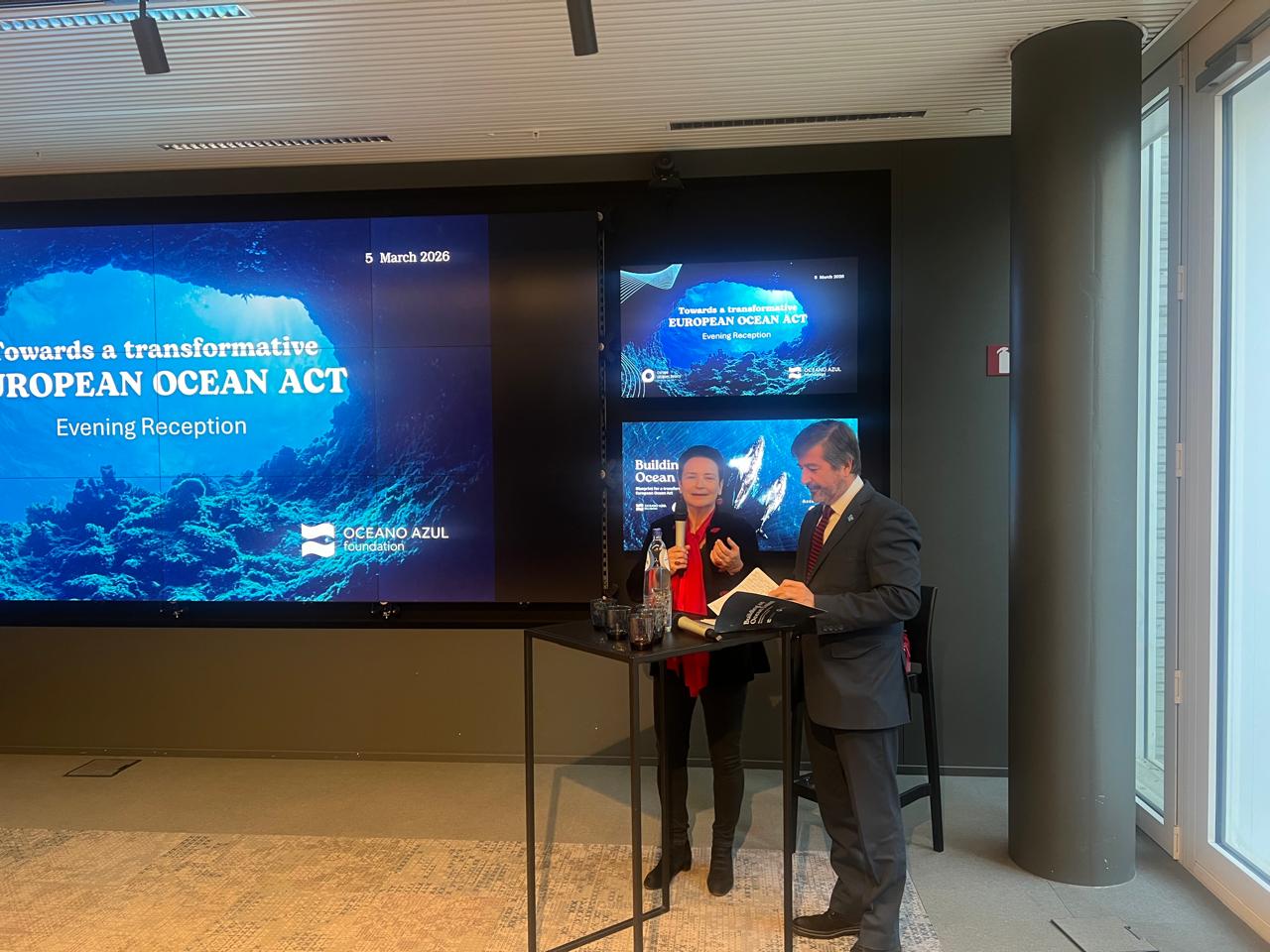
On March 5th in Brussels, the event « Toward a Transformative European Ocean Act, » organized by the Jacques Delors Europe Foundation and the Oceana Azul Foundation, brought together key stakeholders in maritime governance. The goal was to emphasize the urgent need to strengthen ocean protection and management in the face of increasing threats.
From the start, Geneviève Pons, Director general and President of the Europe Jacques Delors , opened the discussions, attended by Tiago Pitta de Canu, CEO of the Oceana Azul Foundation. They recalled that the « European Ocean Act » project is part of a long-standing effort to establish an ambitious strategic framework for Europe’s oceans. Pascal Lamy, Vice President of Europe Jacques Delors, emphasized the importance of supporting the « Building an Ocean Union » manifesto to advance this shared vision.
Speakers highlighted that for an « Ocean Act » to be effective, it must enable smarter coordination of maritime policies, simplify legislation, and position Europe as a global leader in responsible ocean governance. Costa Kadis, the European Commissioner for Maritime Affairs, expressed pride in participating in the creation of the European Ocean Pact, a comprehensive framework for all ocean-related policies. He reminded that despite growing geopolitical challenges and pressures on sovereignty, the ocean remains a vital strategic asset for the security, defense, economic growth, and environmental sustainability of the European Union.
He also highlighted recent progress, such as the adoption of the marine resilience strategy, efforts to combat illegal fishing through digital systems, and the implementation of initiatives for maritime governance, biodiversity, and sustainable development. According to him, these efforts must continue by strengthening governance, simplifying legislation, and ensuring adequate funding. The future « Ocean Act » should be a key step in positioning Europe as a global leader in responsible ocean governance.
Maria Damanaki stressed the urgency of fundamentally transforming ocean governance to preserve the health of marine ecosystems, mentioning the « thirty by thirty » goal for a sustainable ocean. Karmenu Vella recalled that ocean protection must remain a strategic priority amid geopolitical and environmental challenges, viewing this initiative as a historic opportunity to turn fragmented governance into a coherent and ambitious policy. Finally, Monica Verbeek, Executive Director of Seas at Risk, emphasized the importance of mobilizing at least €7 billion to ensure sustainable management of marine areas, promote transparency, and encourage responsible use of European funds.
In his summary, Tiago Pitta de Canu presented the « Ocean Act » as a crucial lever to improve governance, management, and the impact of ocean policies. Key sectors identified include offshore renewable energy, clean maritime transport, subsea cables, innovative aquaculture, biotechnology, algae, biodiversity-related carbon credits, as well as secure communications and energy supply.
He concluded by affirming that the « European Ocean Act » offers a real opportunity for the European Union: to unify its efforts to unlock the full potential of its seas and establish Europe as a true oceanic power.