After one year of implementation of the pilot project for the development of high-tech aquaculture in Khanh Hoa, circular high-tech HDP cages have appeared in the open waters of the province. It is not only a change in materials or techniques, but also a change in mentalities among aquaculturists, an essential orientation today. In this transition, fishermen need support policies and adapted logistics services to support them in their development at sea.
January 2025, the Prime Minister approved the pilot project for the development of high-tech marine aquaculture in Khanh Hoa. In February 2025, the Provincial People’s Committee issued a plan for the implementation of the government project and approved the location, coordinates and area of maritime areas (less than 3 nautical miles and between 3 and 6 nautical miles) for high-tech aquaculture in the province. One year after its implementation, the results are promising.
In Dam Bay (Nha Trang district), five families installed and put into the water ten HDPE cages (a volume of 800 m³ each). After raising the fish in traditional wooden cages (near the shore) until they reach a weight of 50 to 60 g, they are released into the HDPE cages (offshore). Thanks to this method, families released 144,000 bars in nine HDPE cages (the remaining cage used for the maintenance of the fish). To date, the first harvest (the equivalent of three and a half cages) has yielded 36.5 tons of fish with an average weight of 0.7 to 1 kg, with a survival rate of more than 85%. After deducting the costs and depreciation of the cages, the profit amounts to approximately 1.7 billion VND (485 million VND per cage). More than 60 tons of fish remain to be raised, and families continue to take care of them for the next harvests.
In other aquaculture areas participating in the project, such as Bai Giong (Nam Ninh Hoa municipality), households have released 30,000 yellow raw heifers since early August 2025. To date, they have reached an average weight of 0.5 kg per fale, with a survival rate of 80% and an estimated production of 12 tons. In the Co Co area (Dai Lanh municipality), households raise merone. When they reach a weight of 0.8 to 1.2 kg per alevin, they are transferred to HDPE cages and wait until they reach 2 to 2.5 kg per favine to sell them at a price of 400,000 to 450,000 NDP/kg, with an estimated production of 45 tons. In the Hon Noi area (municipality of Cam Lam), two groups of households participate in the breeding of vivaney. The group of the municipality of Nam Cam Ranh harvested 60.6 tons of yellow vivaney, generating a turnover of more than 6 billion VND. However, due to the high transport costs between the shore and the breeding areas, as well as the costs related to the depreciation of the equipment and the expenditure on materials, this group did not generate a profit. The group of the municipality of Cam Lam, for its part, harvested 9,365 kg of fish after six months, with a survival rate of 53.5%. Revenues and profits have remained negligible.
According to the Ministry of Agriculture and the Environment, HDPE cages have high durability, strength and resistance to strong waves and wind, thus contributing to better stability and safety of production. They allow aquaculture farmers to invest and develop their farms with confidence and in a sustainable way. In addition, aquaculture at sea makes it possible to better distribute the density of livestock, to take advantage of favorable hydrological conditions, to contribute to the improvement of the self-purification of the aquatic environment and to limit the risks of localized pollution. This model also contributes to changing mentalities and production practices towards modern, professional and sustainable methods. The pilot project has yielded promising results and aquaculture farmers hope that the state will continue to support and invest in the transition to marine aquaculture using HDP cages.
Overcome difficulties step by step
According to fish farmers, breeding in the open sea allows for better water quality, promoting faster growth and reducing the risk of disease. In addition, the larger size of released fales ensures a higher survival rate and a shorter breeding time (30 to 45 days) compared to traditional wooden cages of the same volume. Despite this considerable potential, the initial investment cost for a HDPE cage and CNC equipment remains out of the financial reach of many fishermen.
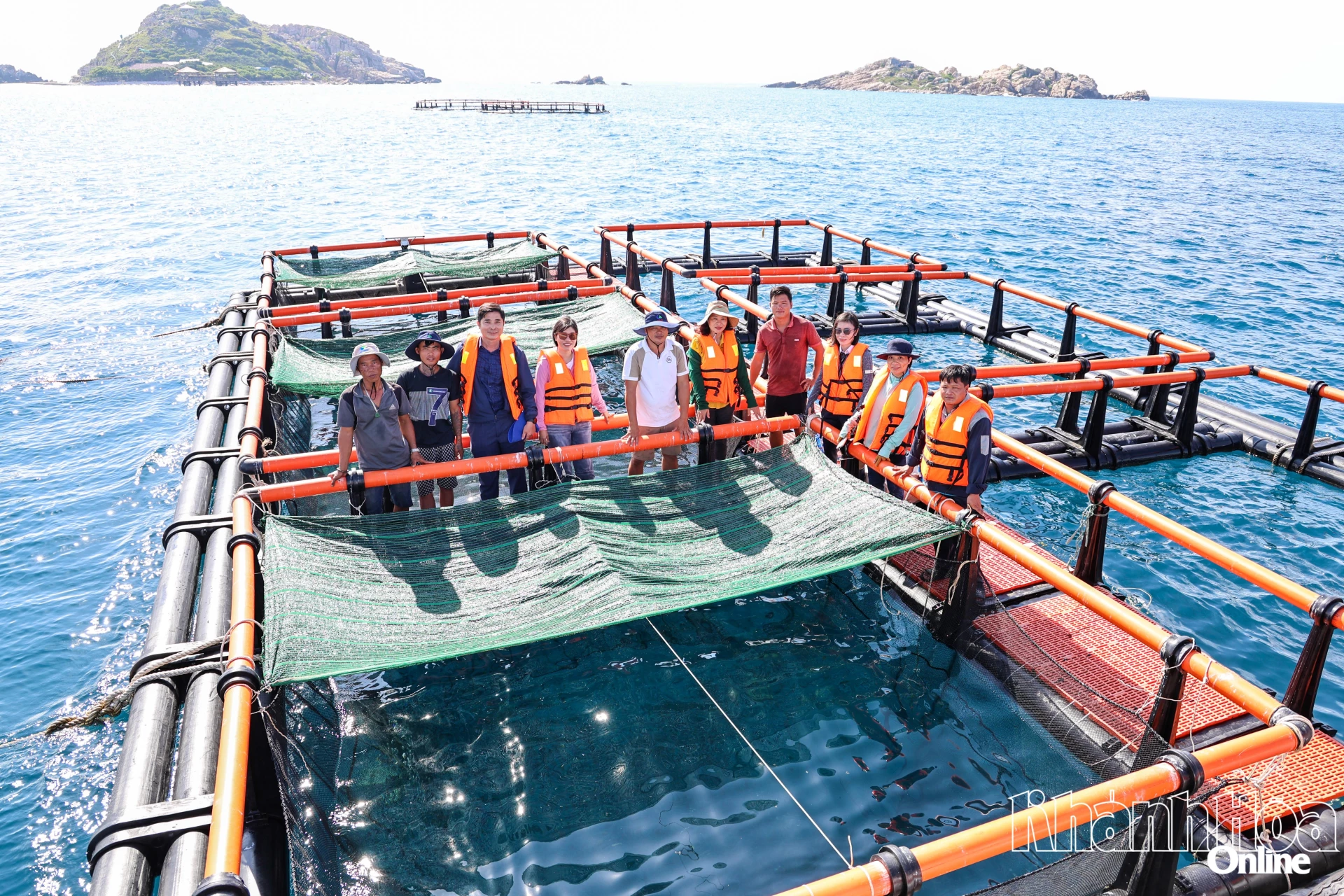 |
| Households participating in the high-tech marine aquaculture development project in the Hon Noi region. |
In addition, the logistics infrastructure is very insufficient. In addition to HDPE cages for fish farming, sea aquaculture areas lack logistical facilities such as cages and rafts allowing fishermen to store food and supplies, as well as to stay and care for their fish. Added to this is the long distance to travel from the coast to remote breeding areas. For example, fishermen in South Cam Ranh must travel between 2.5 and 3 hours to transport food, flevine and supplies to the Hon Noi breeding ground. Excessively high operating costs mean that many aquaculture farmers, despite high yields, still do not generate profits. The lack of specialized transport vehicles and adequate inland waterways to support logistics has a direct impact on the profitability of the model. According to the Ministry of Agriculture and the Environment, it is necessary for financially capable companies to invest in the infrastructure of aquaculture areas at sea. However, there are currently no specific regulations for the allocation of maritime areas to these companies; a legal framework is therefore necessary to serve as the basis for its implementation.
In view of the aforementioned difficulties, the Department of Agriculture and the Environment recently submitted a report and recommendations to the Provincial People’s Committee, asking the Popular Committee of the Bac Cam Ranh District to quickly propose an appropriate location for the construction of an inland navigation terminal (bac-ba) terminal to meet the logistical needs of the aquaculture activities of fishermen. The localities concerned should continue to promote and encourage enrollment in cutting-edge aquaculture. The Union Provincial des coopératives should intensify its efforts to promote and guide the creation of aquaculture cooperatives. At the same time, it should encourage aquaculture companies with significant financial resources, management experience and the ability to apply advanced methods to invest in aquaculture areas at sea and to develop their production there.
Mr. Nguyen Trong Chanh, Deputy Director of the Department of Agriculture and Environment: The results of the models participating in the project not only bring initial economic benefits, but also demonstrate the feasibility of the project in terms of technology and in terms of production organization, thus laying the foundation for reproduction in the next phase. Regarding certain difficulties, the department has reported to the Provincial People’s Committee to instruct the services, local authorities and the units concerned to consult with the fishermen to resolve them gradually.
source : Vietnam