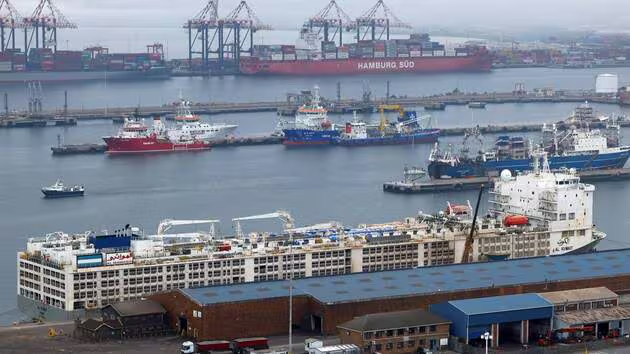
Shipping has been severely disrupted since the outbreak of the war in the Middle East. The Robin Hood association is concerned about the fate of cattle on board ships. About 70,000 animals would be affected, according to the organization.
A slow maritime traffic, even completely frozen as in the Strait of Hormuz.The war in the Middle East is seriously disrupting the movement of ships carrying goods and raw materials.
The Robin Hood association also warns about the situation of live goods
: these animals (cows, sheep, goats) transported by boats, which must join countries such as the United Arab Emirates, Lebanon, Iraq, Israel or Jordan. Last week, the environmental association counted at least 70,000 animals taken hostage in the eastern Mediterranean and in the Red Sea
.
On board sea cattle in South America, Europe or Africa, these animals had to be landed in countries that find themselves in conflict zones. Some ships were able to unload, in Lebanon, Jordan or Israel in particular, others finally opted for countries like Libya to unload.
« Animals on board for more than a month »
But boats are still waiting for a solution. Like the Balha One, a 132-meter-long cargo ship flying the flag of Liberia, currently anchored off the coast of Turkey. Departed from Brazil, the animals have been on board for more than a month, «
says the Robin Hood association.
According to the organization, which identified cattle present in or approaching conflict zones, between 70,000 and 80,000 animals
would still be at sea with many uncertainties on Tuesday, March 10. She points to the case of the Spiridon II, a ship flying the flag of Togo, which left Ukraine for Lebanon with about 3,000 cows on board
. This boat was involved in a deadly cattle stray last year
, the association is concerned.Should vaccination rather than mass slaughter be preferred to manage cattle health crises?
« Deplorable conditions »
This maritime cattle transport is regularly denounced by animal welfare associations. Normally, parking conditions on board are deplorable. In times of war, global epidemic, epizootic disease or the unavailability of the Suez Canal due to an accident (as in March 2021 with the stranding of the Ever Given), they are infernal because of landing refusals and delays
, warns the organization for the protection of the environment and populations.
Livestock ships, large boats often old and poorly equipped, carry thousands of animals on the seas of the globe. According to a 2020 European Commission report, nearly 3 million live animals are exported by boat from the EU every year (including cattle from the port of Sète in France) to countries around the Mediterranean.
These animals can be used for reproduction, fattening, or slaughter once landed. For economic and religious reasons, Middle Eastern countries prefer the slaughter of live cattle, rather than the reception of carcasses and frozen meat.
source : ouest france