
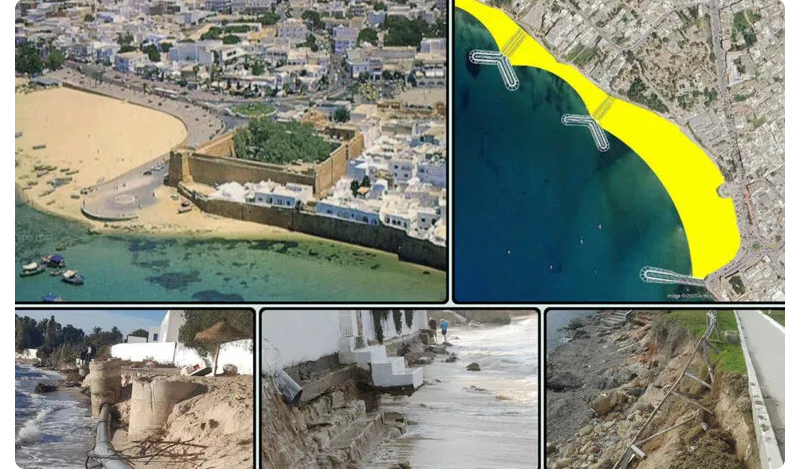
A replenishment operation was carried out in 2023, but ended in failure following the first storm which caused the sea to swallow up the added sand which came from a quarry located in the locality of Borj Hfaiedh, on the outskirts of Hammamet.
In June 2024, following the visit of the President of the Republic, Mr. Kaïs Saïed, to Hammamet, the Coastal Protection and Development Agency (Apal) piloted a second beach replenishment operation with sand from the El Oueslatia quarries (Kairouan Governorate), dumping 15,000 m3 of sand on the beach at a cost of 1 million and 100 thousand dinars, but still without success.
La Presse – A geological phenomenon that results in a gradual loss of materials leading to the retreat of coasts and the lowering of beaches, coastal erosion on the Tunisian coast has continued to increase in recent years with the frequency, speed and magnitude of weather events linked to climate change, posing a threat to equipment and infrastructure.
Moreover, coastal submersion, which frequently affects areas subject to erosion, also increases the risks of natural disasters such as storms, violent thunderstorms, torrential rains, rising sea levels, etc.
Over the past ten years, the effects of climate change have been particularly visible, with three storms with a 20-year return period recorded. Devastating floods also occurred in Nabeul in 2018, paralyzing economic activity for several days.
However, between breaking waves, strong sea currents, rainfall and flooding as well as devastating winds, this phenomenon gradually shaping the coastline has also accelerated in our regions under the effect of human activity – construction of dams, jetties or port areas, extraction of aggregates in rivers, dredging of sediments in ports -: which strongly contributes to the alteration of sedimentary balances.
Disappearance of coastal dunes
This is the case for the Cap Bon coastline, particularly the coastal area of Hammamet and especially the city center beach, known as « Plage Yasmina, » which is suffering from unprecedented erosion, and whose coastal dunes have completely disappeared. These dunes play a central role in the coastal ecosystem, acting as a natural barrier, a reservoir of biodiversity, and a sediment regulator. They constitute an essential dynamic barrier against the sea. Destroying them inevitably exposes the area to the advancing sea.
« The first signs of coastal erosion in Hammamet were observed in 1931, but the phenomenon has accelerated over the past decade to reach more than 5m per year on some coasts, » says Dr. Salem Sahli, president of the Association for Environmental Education (Aere) of Hammamet.
« The main factors involved are, on the one hand, the destruction of coastal dunes for the construction of hotel units and, on the other hand, the development of maritime infrastructure (breakwaters, port/marina). Erosion is also aggravated by the covering of wadi beds with concrete, which has considerably reduced the natural supply of sediment to the beaches, » he adds.
Thus, the advance of the sea, and consequently the retreat of the coastline, have never been so significant.
« Yasmina Beach has receded by more than 10 meters in two years, a rate of 5 meters per year, and experts are not very optimistic about the beach’s future. Nearly three hectares of sand were submerged by the sea between 2012 and 2019, the Nautical Club headquarters was swallowed up in 2020, and the sewage pipes have been exposed for several months; some are damaged and discharge directly into the sea, » Dr. Sahli points out.
« And meanwhile, our decision-makers, a thousand miles away from reality, spend their time bickering and passing the buck. The Municipality accuses the Coastal Protection and Development Agency (Apal), which turns a deaf ear or assures us that studies are underway. As for the National Sanitation Office (Onas), it is conspicuous by its inertia because, although the technical study for the Yasmina beach sanitation network restructuring project was completed more than a year ago, and despite the availability of funding, the project remains at a standstill, » he added.
According to the president of Aere-Hammamet, the authorities have shown no interest in this aspect of the fight against coastal erosion, despite repeated calls from civil society, which works to inform and raise awareness among the public, particularly schoolchildren and young people, about the marine ecosystem in general and coastal erosion in particular. However, understanding and raising awareness of the phenomenon allows for rapid intervention and, above all, the implementation of sustainable solutions capable of addressing the problem or mitigating its effects.
« The Hammamet Environmental Education Association has been raising the alarm on this subject since the early 1990s by multiplying conferences, seminars, round tables, exhibitions, production of educational materials … But nothing has worked. As for the decision-makers, it’s move along, there’s nothing to see here! », he laments.
The chestnut palisade technique as an alternative
Even worse, « There is imminent danger. Maintaining the ONAS (National Sanitation Office) pipes on the beach leads to a continuous worsening of marine pollution, with disastrous health, environmental, and economic consequences for the city of Hammamet. Relocating the wastewater drainage pipes is no longer an option, but an absolute necessity to definitively resolve this scourge, » warns Dr. Sahli.
Undoubtedly, the replenishment of « Yasmina Beach » was undertaken in 2023, but without success: the first storm caused the sea to swallow up the sand, which came from a quarry located in the town of Bord Hfaiedh, on the outskirts of Hammamet. In June 2024, following President Kais Saied’s visit to Hammamet, the Coastal Protection and Development Agency (APAL) led a second replenishment operation using sand from the El Oueslatia quarries (Kairouan Governorate), dumping 15,000 m3 of sand on the beach at a cost of 1,100,000 dinars.
« The new beach replenishment was also a failure, as no prior studies were conducted and the replenishment was undertaken in an improvised manner. It is worth remembering in this regard that artificial beach replenishment cannot be done with just any sand. The sea rejects sand that it does not recognize and gets rid of it like the human body would reject a foreign object, » says the president of Aere-Hammamet.
However, the chestnut paling technique seems to be the solution, according to the activist.
« This technique has been successfully implemented on many beaches in Tunisia. It allows for the restoration of coastal dunes and their stabilization (through vegetation). It has the advantage of being inexpensive and does not disrupt the coastal ecosystem, » he insists.
It is worth recalling that the 4th phase of the Tunisian coastal protection program (Pplt4), co-financed by German cooperation (KfW), includes measures to combat marine erosion on the Beni Khiar – Hammamet section, a length of 29 km.
« The consulting firms working on technical means to address beach erosion from Beni Khiar to Yasmine Hammamet are proposing, in addition to replenishing the Yasmina beach with sand (1,600,000 m3), the construction of a 140 m jetty in front of Sidi Bouhdid and a series of eight (08) stone groynes running along the coastline to Yasmine Hammamet, » mentions Dr. Sahli.
« Without rejecting heavy protections outright and on principle, as they can sometimes be necessary, we at the Hammamet Environmental Education Association (AERE) believe that developing nine (9) structures is excessive and express very strong reservations about validating the technical solutions recommended by the consortium of engineering firms. »
A landscape study is necessary.
In light of this situation, and within the framework of the Tunisian Coastal Protection Program, Aere- Hammamet proposes the following recommendations:
- The social and environmental impact assessment must precede, not follow, the validation of the proposed technical options. It must be carried out by a consulting firm different from the one that designed the feasibility and technical solutions study.
- The need for a more in-depth, complementary environmental analysis beyond hydro-sedimentary modeling: biological consequences, smothering of seagrass beds and marine organisms, details on pollution and biodiversity, quantification of habitat losses, wastewater and stormwater management …
- The need for a landscape study and the implementation of greener landscaping and architectural interventions to better assess the final look of major developments. The coastal landscape is Hammamet’s main tourist attraction. Its degradation jeopardizes the destination’s long-term appeal.
- To combine, as far as possible, heavy defense and nature-based solutions which have the merit of being flexible and reversible alternatives (solutions without regrets).
- Combining replenishment, windbreak construction and vegetation to regenerate and consolidate coastal dunes
« Taking these different points into consideration, the project will benefit from our support and endorsement, as it will have complied with the golden rule that any coastal development project must respect, namely Integrated Coastal Zone Management (ICZM). This position, although critical, is intended to be constructive and aims to guarantee the environmental, social and economic sustainability of our coastline, » concludes Dr. Sahli.
« Nature-based solutions »
It should be noted that the TunSea* association, in partnership with the Coastal Protection and Development Agency (Apal), organised a Ramadan debate on Saturday evening entitled « The sea and the coast: challenges and solutions », in the presence of experts, tourism professionals, representatives of institutions and environmental associations.
« Tunisia must rely on nature-based solutions to protect its coastline » was the main recommendationfrom this meeting, highlighting the crucial role of natural ecosystems in preserving beaches and emphasizing the need to protect seagrass beds, sand dunes and coastal biodiversity, true natural barriers that strengthen the resilience of the coastline against the onslaught of the sea.
The various participants in this debate also « emphasized the collective responsibility of all stakeholders, » recalling that « the promotion of sustainable tourism and the combined efforts of public institutions and civil society are essential to quaranteeing preserved beaches for future generations. »
*TunSea, a Tunisian participatory science platform, works daily to protect the marine environment by involving citizens, fishermen and young scientists in field projects, ranging from biodiversity monitoring to the valorization of marine waste.
source : la presse