
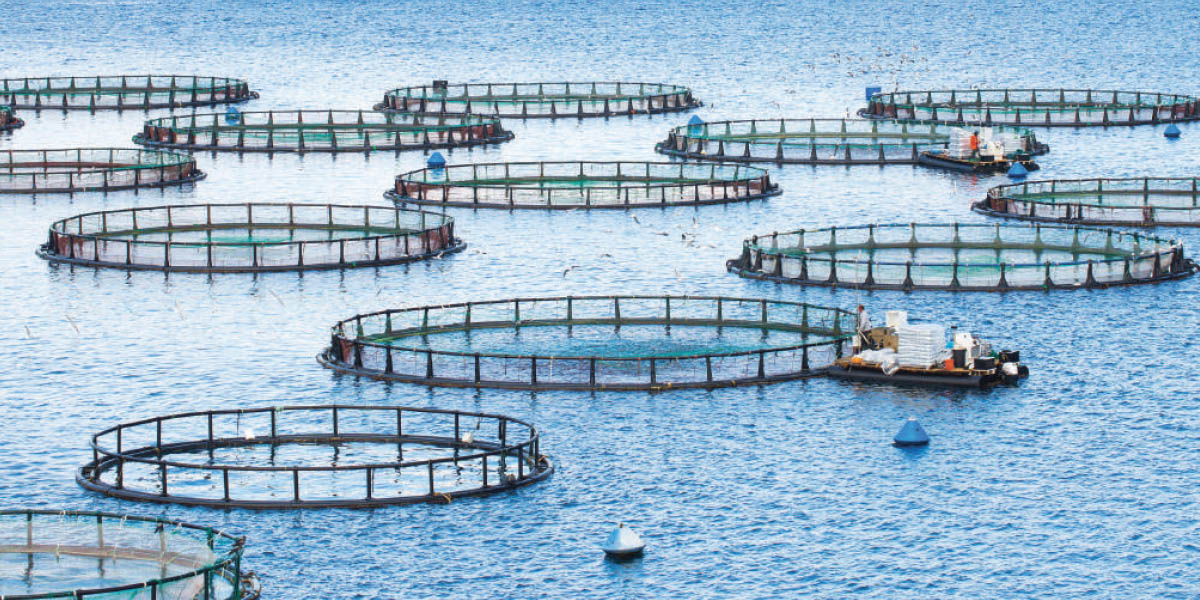
The National Aquaculture Development Agency (ANDA) has launched an environmental assessment of three aquaculture development plans in the Laâyoune-Sakia El Hamra, Marrakech-Safi, and Casablanca-Settat regions. A total of 1.5 million dirhams will be allocated to this project, which will result in the creation of a framework plan for environmental and social management in each region. Concurrently, the Agency is also updating the first national plan in the Dakhla-Oued Eddahab region.
Under the provisions of Law No. 84-21 relating to marine aquaculture, the publication of Aquaculture Management Plans (PAA) by decree is conditional upon the prior completion of a Strategic Environmental Assessment (SEA) according to Article 18 of this law.
In this capacity, and as part of the preparation for the publication of the PAAs of the regions of Laâyoune-Sakia El Hamra, Marrakech-Safi and Casablanca-Settat, the National Agency for Aquaculture Development (ANDA) has launched the implementation of the strategic environmental assessment of these three regional aquaculture development plans.
In total, 1.5 million dirhams will be allocated to this assessment. Beyond the necessary legal compliance, this environmental and social impact assessment (ESIA) is an essential component for meeting donor requirements regarding environmental and social safeguard principles, and a fundamental aspect for ensuring that the PAAs are integrated into social and environmental sustainability at both the strategic and investment levels.
From a technical standpoint, the assessment will lead to the creation of an Environmental and Social Management Framework (ESMF) for each region. This document proposes monitoring indicators to measure changes in biodiversity and water quality near operating areas, in addition to the development of a Stakeholder Engagement Plan (SEP).
Dakhla: Update of the 1st national aquaculture plan.
As a reminder, the implementation of these PAAs, which covered eight coastal regions of the Kingdom, was the subject of calls for expressions of interest launched by ANDA for the selection of projects to be authorized for the exploitation of the identified suitable areas.
It is worth noting that nearly a decade after the launch of the Regional Aquaculture Development and Management Plans (PAA), ANDA has updated the first national aquaculture plan, specifically that of the Dakhla-Oued Eddahab region. This revision is in line with Decree No. 2.23.1032 concerning regional development and management plans, recently published in the Official Bulletin, which clarified the approval and evaluation procedures for aquaculture projects by establishing a new generation legal and regulatory framework.
The study, estimated at 4.7 million dirhams, focuses on the development of this PAA for the Dakhla – Oued Eddahab region, including its strategic environmental assessment, as well as a project for aquaculture structures and its environmental impact study.
An estimated production of over 210,000 tons.
It’s worth noting that aquaculture activity recorded a production of 4,271 tons in 2024, valued at approximately 308 million dirhams, creating over 1,000 direct jobs. Thanks to 324 authorized aquaculture projects, including 122 social projects aimed at young entrepreneurs and artisanal fishing cooperatives, the target production is 210,000 tons, representing an investment of 2.8 billion dirhams and the creation of around 14,000 jobs in the long term.
Aquaculture plans have also identified significant potential, with a total area suitable for aquaculture of approximately 24,000 hectares dedicated to the cultivation of shellfish, fish, and algae. Complementary to fishing, aquaculture, with its regional plans, represents an expected production exceeding 300,000 tons. These plans have mobilized 17 million dirhams and have provided investors and young entrepreneurs with visibility into marine investment opportunities across the various aquaculture sectors.
Reaching 500 million dirhams in revenue by 2027.
Furthermore, in Morocco’s 2025-2027 roadmap for the fisheries sector, aquaculture is identified as a growth driver for diversifying the blue economy. The quantified ambitions aim to increase the revenue of aquaculture farms from the current 41 million dirhams to 500 million dirhams by 2027. In terms of employment, the objective is to reach 8,000 jobs (direct and indirect), compared to 1,100 today.
Aquaculture is expected to contribute an additional 0.5 billion dirhams in added value to the overall fisheries sector. To support this momentum, this area benefits from the largest budget allocation of the four pillars of the strategy, with a total investment of 609 million dirhams over three years. Key projects focus on establishing financial incentives, developing onshore clusters, and actively researching to diversify production (fish farming, shellfish farming, and seaweed farming).
The roadmap also provides for the creation of a dedicated interprofessional body and the strengthening of upstream production, in particular through research on fish feed and the installation of local hatcheries, in order to guarantee the sovereignty and competitiveness of the sector on national and international markets.
source : LES ECO