Proud of the presence of numerous sea turtles on its territory, Gabon is committed to the preservation of the different species. Every day, during the nesting season, NGOs and eco-guards from the National Parks Agency patrol the country’s beaches to protect the eggs and shelter the most threatened ones.
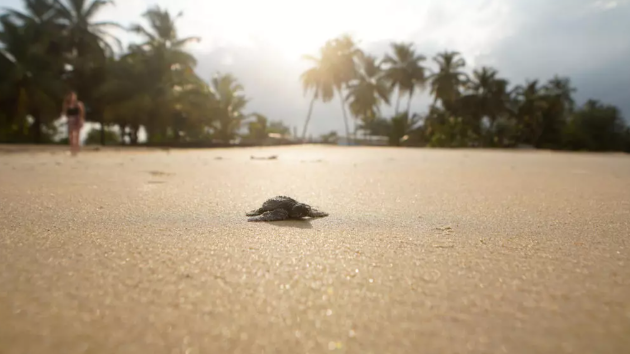
They fit in the palm of your hand. These baby olive ridley sea turtles have just emerged from their nest on a beach in Gabon . They have to cross 10 meters of sand to reach the ocean, a real obstacle course.
Initially, « their chances of survival are minuscule » with a rate of 1 in 1,000, explains François Boussamba, Gabonese turtle expert and director of the NGO Adventures Without Borders, to Agence France-Presse (AFP), while scanning the white sand in search of nests on a beach in Pongara National Park, in western Gabon.
Every day during the nesting season, NGOs and eco-guards from the National Agency of National Parks (ANPN) patrol the country’s beaches to protect the eggs and shelter the most threatened ones.
The beaches of Pongara, 30 minutes by boat from the capital Libreville, are an optimal setting for turtle nesting: wild coast, equatorial climate, wide opening onto the ocean, gentle slopes ideal for the female.
But there are many dangers, from erosion (sea advance) to the multiple predators (domestic animals, crabs and birds, fish) which prevent the eggs from reaching maturity at the end of the 60 days of incubation, emphasizes François Boussamba.
Building baby muscles
In Libreville, every morning around 7 a.m., volunteers from the Projet tortues Tahiti Gabon association patrol the beach and check the nests in the hatchery, a fenced enclosure located nearby, where the most threatened eggs are taken and kept safe until they hatch.
Once born, the baby turtles must be moved to allow them to go to the sea. But there is no question of putting them directly into the water: « They need to build up their muscles so that they can then swim in the ocean, » explains Clémence, a volunteer with the association, while making sure that nothing obstructs their journey to the ocean.
Along its 900 km of coastline, Gabon hosts four species of turtles during the nesting season, from October to April: green, olive ridley, hawksbill and leatherback.
According to the American NGO Wildlife Conservation Society, this Central African country has the highest nesting density on the continent, with an average of 30,000 to 40,000 clutches per year, across all turtle species. Gabon is also the world’s leading nesting country for leatherback turtles, the largest of the seven species of sea turtles (averaging 1.60 m and 500 kg), which is threatened, according to the International Union for Conservation of Nature.

Édouard Borromé Moussavou, deputy director of Pongara National Park, near Libreville, Gabon, February 5, 2026. © Nao Mukadi, AFP
By watching over its eggs, the agents of Pongara allow « the survival of this species », emphasizes Édouard Moussavou, deputy director of the Pongara park.
Trump effect
The presence of numerous sea turtles is a source of pride for Gabon. According to François Boussamba, this shows « that our ecosystem is healthy and thriving. »
Faced with multiple threats – including human activities (industrial fishing, plastic pollution and poaching), in addition to coastal erosion and natural predators – Gabon is not remaining inactive in protecting sea turtles.
Since 2013, its conservation efforts have been financially supported by the United States , notably through programs of the US Fish and Wildlife Service, an American agency in charge of biodiversity.
But since the suspension of subsidies by the administration of US President Donald Trump , « turtle monitoring activities have stopped or slowed down completely, » laments Édouard Moussavou. « There will be less staff, less data, and that’s a real problem for us. »
Unpaid wages

François Boussamba, a leatherback turtle specialist, stands in front of a protected turtle egg-nesting area in Pongara National Park, near Libreville, Gabon, on February 5, 2026. © Nao Mukadi, AFP
Adding to these difficulties are the delays in salary payments to members of the ANPN, which manages the country’s 13 parks, notes Sosthène Ndong Engonga, Secretary General of the National Union of Eco-guards of Gabon. Like other Gabonese civil servants and contract workers, the approximately 580 eco-guards regularly find themselves without pay.
« Even when there is money, we have to make a fuss to get our salaries, » he complains, claiming to have fought with the Treasury in February to obtain payment of arrears.
For these agents essential to the conservation of Gabon’s exceptional biodiversity, the risk is that they will be « forced to abandon everything, » he fears, « because (they have) responsibilities that (they) can no longer bear » without a regular salary.
On a beach in Pongara, 40-year-old Alain Banguiya patrols at night, hoping to see a leatherback turtle emerge from the water to lay its eggs in the sand. An eco-guard since 2015, he hasn’t been paid for two months now, but for him, giving up is out of the question.
« We have a duty to fight to the end, to keep our spirits up. (…) Despite the obstacles, we are staying the course: conservation, » he says proudly.
source : FRANCE 24