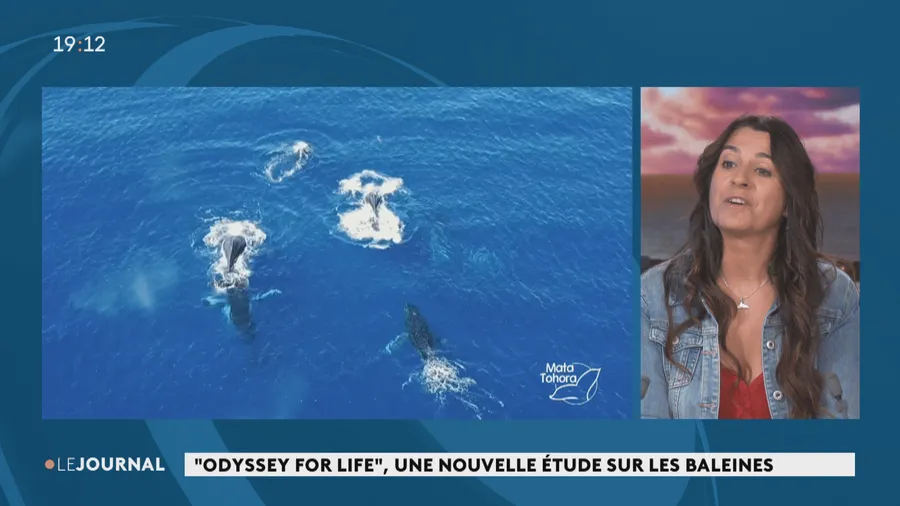
« Odyssey For Life » is an unprecedented scientific program dedicated to the study of the migration of humpback whales between Polynesia and Antarctica. Among the objectives of this project: to map the migratory routes of whales to limit collisions, to understand the behavior of whales between them and between other species or to measure ocean pollution and its impact on the health of humpback whales
Polynesia The 1st: Last year you obtained the country’s authorizations to carry out this project, You collected unpublished data, likely to become a global reference. What did you discover?
Agnès Benet, director and founder of the Mata Tohora association: « In genetics, we are very happy because we have discovered something that has never been referenced in international databases, and that supports certain Polynesian myths in genetics. So we are exactly in the subject of working between hard science and all Polynesian mythology, you will have the revelations soon. We are about to make all the international publications. I lead a team of 24 researchers in different countries. »
P. The 1st: These are results that you are going to present in Scotland, right?
A.B.: « It will be presented in Scotland in April ».
P. The 1st: Had humpback whales never been studied in this way?
A.B.: « Genetically speaking, we had never gone so far in scientific research. And in no database in the world, our results appear. Because we went looking for something had never been looking for until now. »
/outremer%2F2026%2F04%2F01%2F69ccb1232f52f329011463.png)
« A veterinary doctoral thesis is planned with the National Veterinary School of Toulouse, for everything that revolves around the state of health of whales » · ©P.1ère
P. The 1st: You study genetics, acoustics, environmental DNA, ecotoxicology or bacteriology and virology. Who are the scientists who followed you?
A.B.: « We are all volunteers. We only worked on equity for this first research. And precisely, the results that appear ask that we continue research with funding. The scientists are in different countries and each leads a team. In genetics, in ecology, there are also veterinarians. A veterinary doctoral thesis is planned with the National Veterinary School of Toulouse, for everything that revolves around the state of health of whales ».
« We had never gone so far in scientific research »
P. The 1st: This scientific validation, you care! Are you a doctor yourself?
A.B.: « I am a doctor in organic Oceania. And indeed, what is very interesting about this program is to be able to work with empirical and ancestral knowledge, as well as with scientific knowledge with very precise protocols, and validated worldwide ».
P. The 1st: The United Nations conference in Nice announced the creation of the largest protected marine area on the planet, is this an important step forward in your eyes?
A.B.: « This is very important, especially since with the results we have for the concentrations of heavy metals in whales, we will have to really protect our oceans well, to ensure the future of our whales ».
/outremer%2F2026%2F04%2F01%2F69ccb156a6fe7209080717.png)
« A large part of the population no longer has access to whales, with boats, canoes, and this remains a little incomprehensible » · ©P.1ère
P. The 1st: Regarding the regulation on whales, you were one of the first associations to raise awareness among the population of respect for animals, are you satisfied with the evolution of the regulation?
A.B.: « Yes, the regulations have evolved a lot. Speaking of culture, we still see that a large part of the population no longer has access to whales, with boats, canoes, and this remains a little incomprehensible. Because a boat, whatever it is, must respect approach rules, which have become more and more precise and allow whales to be respected. But this part of the population that can no longer access their culture in the water, and on the water… I think there is something to review ».
source : La 1ere France info