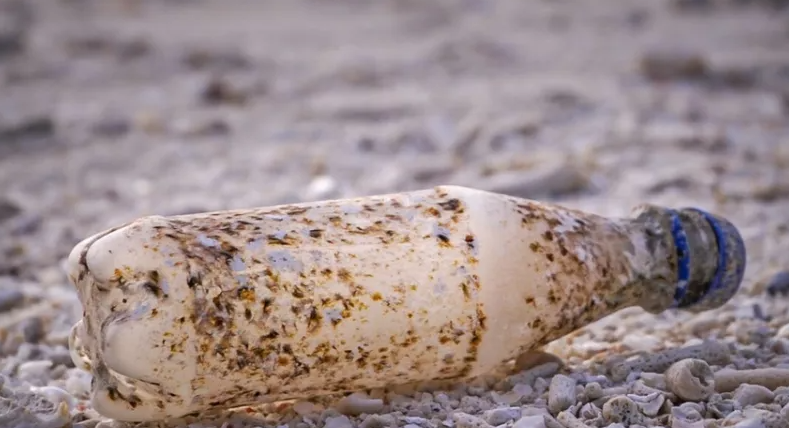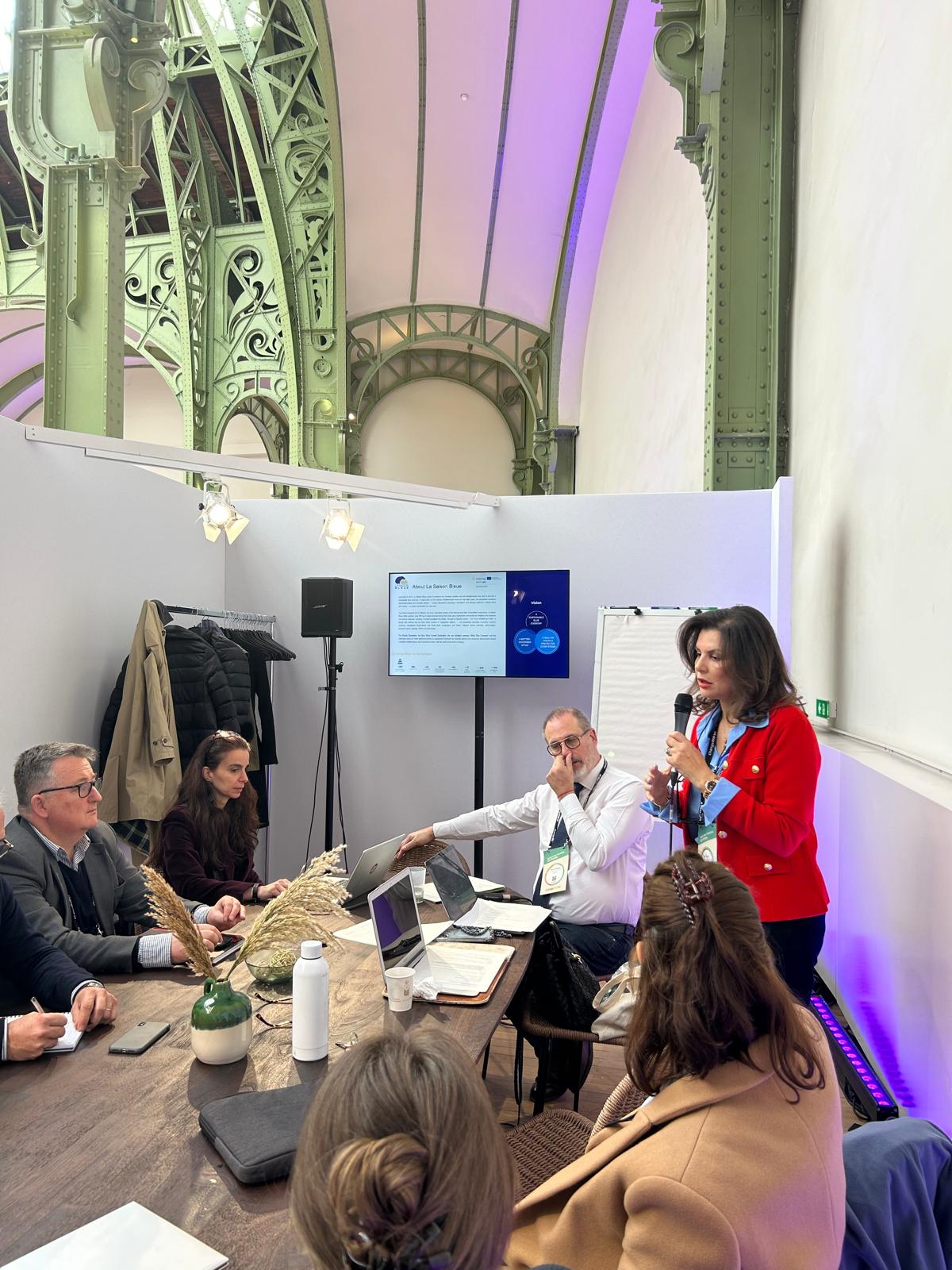
The Mediterranean is at a critical turning point, torn between its exceptional biodiversity and its position as one of the most polluted seas in the world, particularly by plastic waste. How can we effectively finance solutions capable of reversing this trend? On March 31st, during the « Action Group – Mediterranean region as a pilot to address plastic in coastal ecosystems » Workshop held at the Change Now Forum (Grand Palais, Paris), investors, philanthropists, public officials, and blue economy stakeholders gathered to identify the obstacles and levers for investment in tackling plastic pollution in the Mediterranean.
Led by Rym Benzina (Saison Bleue), Philippe Masset (ADEME/CIRCEMED), and Flore Latournerie (French Ministry for Europe and Foreign Affairs), the discussion highlighted the need to clearly distinguish between investment and philanthropy: many ocean-based solutions remain subsidized rather than investable according to traditional financial criteria. Annegien Blokpoel pointed out that the transition from « nice to have » to « need to have » often depends on a regulatory framework and generally takes two to three years after a law comes into effect.
A Paradox: Numerous Solutions, But Few are Investable
Recycling, bioplastics, depollution technologies, circular economy, and social innovation: there is no shortage of initiatives. However, nearly 95% of these projects rely more on public or philanthropic funding than on private investment, with fragile business models and limited scalability. A major disconnect: investors seek returns, while project leaders primarily pursue environmental impact.
Among the promising approaches, industrial recycling in Kenya, supplying granules to committed multinationals, or the production of bioplastics in Mexico from cellulose residues stand out.
The Decisive Role of Regulation
Regulation is a decisive lever. Experience shows that markets truly evolve when constraints are imposed: bans, quotas, standards, or financial penalties. A strong regulatory framework encourages businesses and investors to transform their practices, and the adoption of an international treaty on plastics could create a more predictable and incentivizing environment.
Between Philanthropy and Investment: Clarifying the Boundary
Another major challenge lies in the confusion between philanthropy and investment. Philanthropy aims for impact without direct financial return, while investment demands a risk-adjusted return. To bridge this gap, new models are emerging, such as « blended finance, » combining public, private, and philanthropic capital.
This type of approach helps to reduce risk for investors, support early-stage projects, and facilitate their scaling up. Cyrille Antignac (Water Unite Impact) emphasized the role of philanthropy as a catalyst, absorbing initial risk or providing first-loss guarantees.
Real Opportunities, Driven by Businesses
Despite these challenges, positive signs are emerging. Large companies, particularly in the consumer and hospitality sectors (Michelle Gallant of Accor illustrated the challenges of large-scale implementation), are increasingly committed to reducing plastic. They are thus becoming customers for innovative solutions, market accelerators, and strategic partners for startups.
An Often Underestimated Social Issue
Beyond the environment, plastic management also affects millions of people, particularly in the Global South. The informal waste collection sector represents an essential, but often precarious, source of income. The most relevant solutions are therefore those that integrate a social dimension, with the structuring of value chains, improved working conditions, and the creation of sustainable jobs.
The Mediterranean Challenge: Coordinating Heterogeneous Realities
The Mediterranean perfectly illustrates the complexity of the problem. Northern countries have advanced financial and regulatory resources, while Southern countries face greater economic and institutional constraints. This asymmetry makes it difficult to implement a common strategy, but pollution knows no borders. An effective response therefore requires strengthened cooperation, the sharing of best practices, and financing mechanisms adapted to local realities.
Towards a Shared Vision: The « Mediterranean Dream »
Beyond technical and financial tools, many stakeholders insist on the need to build a collective vision. Imagining a restored Mediterranean, rich in biodiversity, where the circular economy is fully operational, is an essential driver for mobilizing stakeholders. The goal goes beyond simple fundraising. « We need to create a collective dream to bring the fish back to the Mediterranean, » suggests one participant, recalling that 90% of the species have disappeared. This mobilizing vision could catalyze public and private investment.
Participants called for strengthened North-South cooperation in the Mediterranean, the development of hybrid instruments combining subsidies, impact capital, and guarantees, and the preparation of targeted meetings between investors and solution providers to accelerate scaling up.
Conclusion: Turning Intent into Action
The fight against plastic pollution in the Mediterranean does not suffer from a lack of innovation, but from a structuring deficit. To scale up, it is essential to clarify business models, strengthen regulation, mobilize hybrid financing, and coordinate public and private actors. The World Sea Forum-Bizerte, scheduled for September 24 and 25, 2026, was announced as the next step to present the results of the Plastic Med Lab and connect operational solutions with funders.
Names mentioned: Rym Benzina, Philippe Masset, Flore Latournerie, Sophie Biro, Agathe Laurent, Alexis Marant, Cyrille Antignac, Elise Aloy, Céline Schulze, Annegien Blokpoel, Christine De Charette, Nicole Gallant, Karine Marion, Ani Movsessiyan, Gallie Gail, Céleste Del Vecchio.