

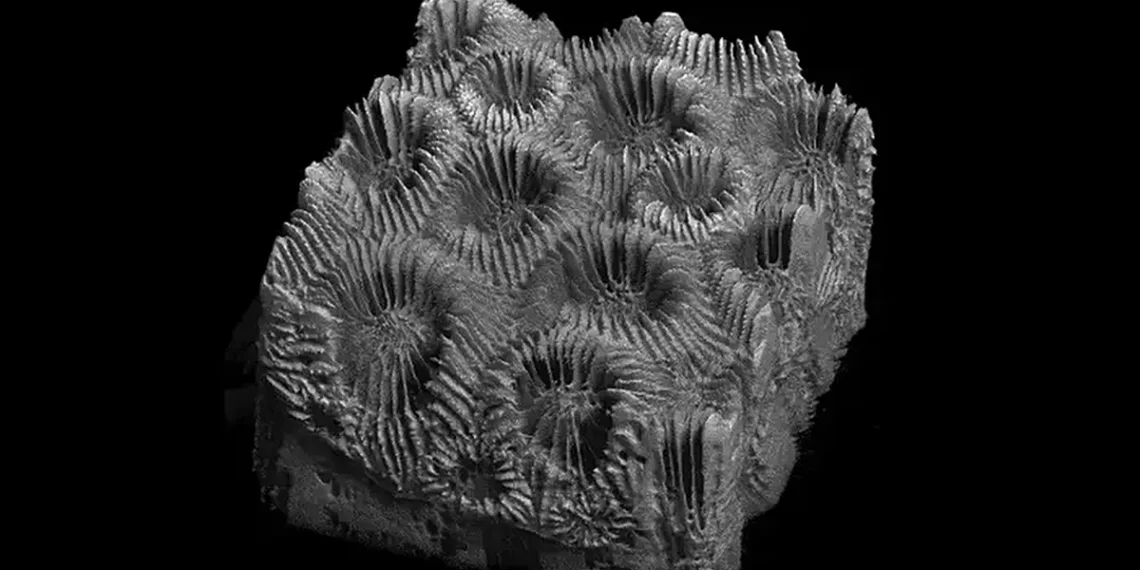
Coral reefs in Florida are besieged. Since 2014, Stony Coral Tissue Loss Disease (SCTLD) has spread rapidly along the Florida Reef Tract and the Caribbean, killing a significant number of reef-building corals and leaving behind dead skeletons where once prosperous reefs were home to diverse marine life. Despite the severity of the crisis, little is known about how these diseases affect the microscopic structure of coral skeletons – the pores, densities and thicknesses that give reefs strength and resilience.
Studying these tiny characteristics has long been a challenge. Traditional methods are slow and often lack subtle structural changes.
To meet this challenge, researchers at Florida Atlantic University used X-ray micro-tomography (micro-CT). This technique generates detailed 3D reconstructions up to microscopic pores, thus revealing non-destructively the internal characteristics of the skeleton, including porosity, thickness and structural orientation. Installed in the FAU High School Owls Imaging Lab, the micro-CT was ideal for coral imaging, whose high mineral content provides a strong contrast to X-rays.
The researchers combined micro-CT imaging with deep learning-based image segmentation, using convolutional neural networks (CNN), a form of artificial intelligence, to automatically distinguish coral skeletons from porous spaces. By analyzing images by patterns and characteristics, this approach is faster and more precise than traditional manual methods.
« Micro-CT gives us a window on the coral skeleton in a way never before possible, » says Alejandra Coronel-Zegarra, first author and doctoral candidate in the Department of Chemistry and Biochemistry at Charles E. FAU’s Schmidt College of Science, which won the 2025 Microscopy and Microanalysis Student Award for its research on SCTLD. By combining it with deep learning, we can automatically detect subtle changes in the skeleton caused by the disease – details that are almost impossible to see manually.
The team focused on two species of hard corals: Montastraea cavernosa (M. cavernosa) and Porites astreoides (P. astreoides). By including both healthy and SCTLD-affected specimens, the researchers created a complete data set to test the performance of several CNN models.
They studied three deep learning models based on U-Net: U-Net, U-Net++, and Attention U-Net, known to capture fine structural details. The models were trained to distinguish the coral skeleton from the pores and tested on four data sets, including healthy and affected M. cavernosa affected by SCTLD, as well as healthy P. astreoides. The researchers evaluated how accurately each model detected subtle skeletal differences using standard metrics and statistical analysis.
Published in the Journal of Structural Biology, the results are striking. The three models performed exceptionally well, reaching more than 98% precision to distinguish the skeleton from the pores.
« Without high-resolution 3D information, scientists cannot fully understand how the disease, ocean warming and other stressors compromise the survival of reefs, » says Vivian Merk, Ph.D., corresponding author and assistant professor in the Department of Chemistry and Biochemistry at Charles E. Schmidt College of Science of the FAU and the Department of Oceanography and Mechanical Engineering of the College of Engineering and Computer Science. Our analyses provide a clearer quantitative picture of how environmental stressors remodeled coral skeletons at the microscopic level. By revealing these hidden changes in the porosity, density and thickness of the skeleton, we can see exactly how diseases such as Stony Coral Tissue Loss Disease alter the physical integrity of corals.
The results showed that Attention U-Net was the most efficient, offering great accuracy while working faster and on a range of coral species. It achieved complete image segmentation in just seven hours, compared to 15 hours for U-Net and 17 hours for U-Net++, making it particularly useful for processing large sets of high-resolution micro-CT data.
Using these results, the researchers created detailed 3D maps of coral skeletons. The analysis revealed clear differences between healthy corals and those affected by the disease, showing how changes in pore structure can compromise skeleton integrity. Differences between species also appeared, highlighting how the shape of the coral and its vulnerability to disease are closely related at the microscopic level.
“Beyond its immediate relevance to coral health, our research demonstrates the transformative potential of the combination of micro-CT and deep learning, and opens up new possibilities for analyzing other biological materials, engineered composites and even geological samples,” Merk explains. This knowledge helps us identify the most at-risk reefs and develop more targeted protection and restoration strategies, strengthening the long-term resilience of Florida’s coral ecosystems.
The co-authors of the study are Jamie Knaub, assistant to the Owls Imaging Lab of the FAU Lab Schools and PhD candidate in the FAU Department of Biology within the Charles E. Schmidt College of Science; and Abhijit Pandya, Ph.D., professor in the Department of Electrical and Computer Engineering and the Department of Biomedical Engineering within the College of Engineering and Computer Science of the FAU.
source : enerzine

