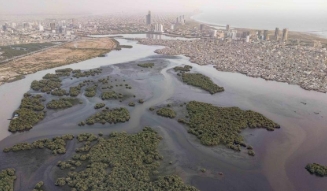
In Karachi, rampant urban and economic development is severely impacting the local ecosystem, particularly the mangroves, the city’s lungs and natural barrier. These have been shrinking for two decades due to land grabbing, mega real estate projects, and industrial and domestic pollution.
The sun has barely risen over Rehri Goth, a fishing village on the Pakistani coast near Karachi. A boat leaves the harbor. It’s low tide, and in the morning mist, a black, muddy land dotted with plastic appears beneath the foam. On the coast, a canal choked with garbage dumps foul-smelling water into the sea. The brightly colored wooden boat cuts through the brackish water. On board is Almas Kasmani, 23, an environmental activist and founder of the social enterprise Salt Water Marina. « There’s so much pollution that there are no more small fish, » laments the young woman, her body covered in plastic appearing beneath the foam. On the coast, a canal choked with garbage dumps foul-smelling water into the sea. The brightly colored wooden boat cuts through the brackish water. On board is Almas Kasmani, 23, an
environmental activist and founder of the social enterprise Salt Water Marina. “There’s so much pollution that there are no more small fish,” laments this fisherman’s daughter. “When I was little, there were so many that we could even catch them with our dupattas. But now, the fishermen have to go very far, and neither the mangroves nor the fish survive here.” The megalopolis of nearly 20 million inhabitants lacks a proper wastewater treatment system. On one side of the boat, factory chimneys and export platforms, omnipresent in this industrial zone of the country’s economic capital, pass by. On the other, mangroves stretch as far as the eye can see.
Reforestation and illegal logging
These semi-aquatic plants, typical of the Indus Delta ecosystem, cover approximately 600,000 hectares in Sindh, the region where the city is located. They depend almost entirely on the river’s freshwater flow and, to a lesser extent, on domestic and industrial wastewater from Karachi. As the boat moves away from the coast, the water clears and the vessel winds through the narrow corridors formed by the mangrove roots. Almas lists all the species that inhabit these forests: dolphins, golden jackals, migratory birds, crustaceans, and fish. Suddenly, a huge ferry appears from behind the trees. He comes to resupply at Qasim port, the country’s second largest port, built in the middle of the mangroves in the 1970s. Almas points to the collapsed banks: « We have many mangrove islands here, but some are disappearing because of the passage of boats, which accelerates erosion. »
Added to this are untreated industrial waste, heavy metals, hydrocarbons, and nutrients, which threaten this ecosystem essential to the availability of plankton and fish, as well as illegal logging that fuels coastal factories with cheap energy. Pakistan, whose contribution to global emissions is minimal, is bearing the brunt of climate change, which is causing extreme heat waves, devastating floods, and rapid glacial melt, while industrial pollution and the lack of effective waste management are further degrading air, water, and soil quality. Faced with this situation, Almas has become a self-appointed guardian of the mangroves. Since founding her organization, Salt Water Marina, two years ago, she has been leading awareness campaigns and mangrove reforestation efforts. She has already replanted 6,000 mangrove trees and has the ambitious goal of reaching 10 million.
“This is about the very survival of our community,” the activist asserts, as she and her team land several young mangrove seedlings on an island ravaged by erosion. “At first, people said that planting two
or three trees wouldn’t make a forest. But now, the project is gaining momentum, and young people [fishermen and city dwellers alike] are starting to take an interest.” At the governmental level, however, much has been done in recent decades to protect these vital forests. The Sindh Forest Department, under the provincial Ministry of the Environment, has pursued an ambitious conservation policy in the Indus Delta since 1958, followed by extensive replanting programs starting in the late 1980s. “This work has involved
local communities: collecting seeds, creating nurseries, planting, and protecting the forests through a community monitoring system,” explains Riaz Waggan, director of the Sindh Forest Department. According to a satellite analysis published in 2022, the area of mangroves almost tripled between 1986 and 2020.
Yet, in Karachi, the Sindh Forest Department seems largely powerless to protect these ecosystems, a significant portion of which falls under the land management of Qasim Port. Approximately 200 hectares of mangrove forests were lost along the Karachi coastline between 2010 and 2022, partly due to illegal logging and a lack of allocated resources. Lacking sufficient public funding, the Sindh Forest Department partnered with the Pakistani private investor Indus Delta Capital to launch Delta Blue Carbon, which is being touted as the world’s largest mangrove restoration project, monetizing the carbon sequestration capacity of mangroves. These forests can store four times more carbon than tropical or temperate forests.
“Carbon6 financing allows us to cover the salaries of our forest rangers, recruited from local communities, and to expand forest cover,” explains Riaz Waggan. The partner plans to rehabilitate 225,000 hectares of forest for the first phase of the project. An initial tranche of 3.1 million tons of carbon credits, worth $40 million, was marketed starting in 2022. “Part
of the revenue is earmarked for local communities, for protection and rehabilitation… even though investors obviously have their own interests,” the official clarifies. Yet, despite significant publicity, local stakeholders believe that the project’s actual benefits for the communities remain very limited.
Insatiable appetite for real estate
In Karachi, these conservation and rehabilitation programs pale in comparison to the rapid expansion of the megalopolis, which attracts migrants from all corners of the country and whets the appetite of real estate developers.7 For Hassan Bakshi, president of the Pakistan Association of Developers and Builders, demographic pressure makes coastal construction inevitable. But these immense real estate projects primarily target an affluent clientele. On the construction site of the « HMR Waterfront, » sprawling across an upscale peninsula of the megalopolis, a slogan is displayed everywhere: « Where luxury meets the coast. » Built on more than 13 hectares reclaimed from the sea, the project includes 18 towers designed to house approximately 5,000 families, as well as offices and a 5-star hotel. Dozens of apartments
costing between €110,000 and €170,000 have already been sold, notably to Pakistanis in the diaspora in the United States.8
In his office overlooking the sea, Hasnain Pardesi, the project’s managing director, smokes a cigarette, seated in a large leather armchair. In the distance, mangroves are visible. « I traveled a lot, I saw skylines all over the world… except here, » explains the 38-year-old businessman. « Dubai was built by Pakistanis. Why can’t we build our own skyline? » Unlike Dubai, located on a semi-enclosed sea, the Karachi site faces the open sea. « It remains a challenge, » acknowledges the developer. « We studied the waves, their height, their speed, and built a breakwater to prevent the water from surging upstream. » An artificial white sand beach, an entertainment zone, jet skis, swimming pools, food trucks: all the symbols of wealth are there, while more than 60% of Karachi’s population lives in slums.
“This is typical of the housing crisis in the Global South, a narrative of extreme inequality exacerbated by climate change,” observes Nausheen Anwar, professor of urban planning at the Institute of Business Administration (IBA) in Karachi and head of urban resilience at the International Institute for Environment and Development (IIED) in London. “People are investing in skyscrapers, gated communities, shopping malls… projects geared towards consumption, not production.” HMR Waterfront has obtained all the necessary environmental certifications, assures Saad Dhedhi, the project’s sales director. A water treatment plant is even planned to recycle wastewater and irrigate the green spaces. But, almost as an aside, the businessman adds: “We’re close to the Korangi factories… Lots of pollution, chemical discharges… I wouldn’t let my children play in the water here every day.” « Spanning over 3,400 hectares, located near mangroves and densely populated areas of Karachi, Korangi is home to hundreds of industrial units in the textile, chemical, pharmaceutical and metallurgical sectors, and employs thousands of workers.
Karachi has no capacity to cope with natural disasters
Masood Lohar, a prominent environmental activist in Karachi, has consistently denounced these projects. “The environmental issue generates little interest. People are aware of the problems, but real estate greed is stronger. The Pakistani elite is sucking its own blood. An elite composed of military personnel, large landowners, politicians, and real estate tycoons who hold dual citizenship [particularly with the United Kingdom, the United States, or Canada, editor’s note] consider Pakistan their economic colony!”
For this former UN biodiversity expert, Karachi has no capacity to cope with natural disasters (cyclones, tsunamis, floods, or earthquakes), and the city is on the verge of collapse: its infrastructure cannot keep pace with uncontrolled urban growth. In response to the authorities’ inaction, the activist launched a bold project: creating an urban jungle, the Clifton Urban Forest, in the heart of the city, on a former landfill. « I started planting mangroves in 2022. Today, we have hundreds of thousands of trees. We have artificially recreated a lagoon and reintroduced species that had become rare in Karachi. The lagoon is once again producing fish and attracting nesting and migratory birds, » he explains, gesturing to the expanse of water, into which a stray dog ventures to cool off. Behind the trees planted by Masood, the silhouette of skyscrapers under construction is visible.
On these 90 hectares of coastline in the heart of the city, the pressure on land is immense. “They tried to force me to give up, making my life impossible. I’m still here because without urban forests, there is no hope,” adds the man, his eyes weary, who confides that he doesn’t want to make public the details of the pressure he has endured, fearing reprisals. Some activists have indeed paid with their lives, like Abdul Ghani and Haji Abu Bakar, members of a fishermen’s association in Karachi, killed in 2011 after opposing the illegal logging of mangroves; or Perveen Rehman, a social worker known for her investigations into land grabbing, shot dead in 2013.
Nature under pressure
The rampant corruption in the construction industry is frequently denounced. “If you don’t have a permit, you pay to build while the authorities turn a blind eye,” laments Hassan Bakshi. “Hundreds of thousands of buildings are constructed without regulatory authorization, without consultants, or qualified architects.” He maintains, however, that some developers in his association are beginning to integrate environmental protection into their projects. This is the case with TPL, which developed the Mangrove Diversity Park, a nature reserve inaugurated
last September, in the immediate vicinity of a luxury real estate project under construction on the edge of the mangroves, called “Mangrove.” Behind the urban din, wooden walkways wind between the trees. Information panels detail the wildlife and the role of the roots in protecting the coastline. The objective: to raise public awareness of the importance of mangroves, while regulating the area around the residential complex and preventing the site from turning into an open-air dump.
For Tariq Qaiser, the architect who designed the park, the goal is to show how to enjoy nature without destroying it. At low tide, people should also see the dirt and pollution, so they can demand that the authorities install wastewater treatment plants and create more protected areas. However, this staged presentation of nature doesn’t convince everyone. According to Abira Ashfaq, the initiative is akin to greenwashing. « Today, they’re trying to sell an artificial, encapsulated version of nature. But we can’t put nature under pressure indefinitely without consequences: it will be the collapse of the Anthropocene, » she warns. She believes the situation resembles the syndrome of the frog placed in slowly heating water: the change is so gradual that we eventually become accustomed to it.
1. Fabric worn by women in the Indian subcontinent.
2. In Karachi, of the 472 million gallons (1 gallon equals 4.5 liters) of wastewater produced daily, barely 55 million are treated. The rest is discharged directly into the Arabian Sea.
3. Together, Karachi’s two main ports handle approximately 95% of Pakistan’s maritime foreign trade.
4. Fresh water reduces the salinity of the water and helps mangroves thrive. Of the four mangrove species found in Karachi, the most widespread, Avicennia marina, is distinguished by its high tolerance to industrial pollution and wastewater.
5. The protection of mangroves, which is largely due to the environmentalist Tahir Qureshi, nicknamed « the father of mangroves », constitutes an exception in a country where environmental governance is limited.
6. Financial instrument used by companies to offset part of the emissions from their activities or strengthen their environmental commitment, by supporting greenhouse gas absorption projects.
7. According to the State Bank of Pakistan, in 2021, the real estate sector represented approximately 2% of the country’s GDP. However, the World Bank estimates that between 60% and 70% of the country’s net wealth is held in the form of real estate assets.
8. According to the Bureau of Statistics of Pakistan, the average monthly salary is around 120 euros.
9. “UN habitat helps Pakistan to lower greenhouse gas emissions in slums”, UN Habitat, April 19, 2022.
10. In both cases, the investigations, sometimes complex and involving numerous actors, did not result in convictions. The exact responsibilities remain debated, implicating criminal groups, local politicians, and land mafias.