
Raising the islands, encircling the city, relocating it, closing the lagoon… In a study published Thursday, climate change experts review the four projects likely to save the city of the Doges from the coming submersion.
Venice is to cities what the polar bear is to animals: a symbol of climate change. A charismatic and fascinating figure, hit hard by rising global temperatures, melting ice and rising sea levels, and whose survival is now threatened.
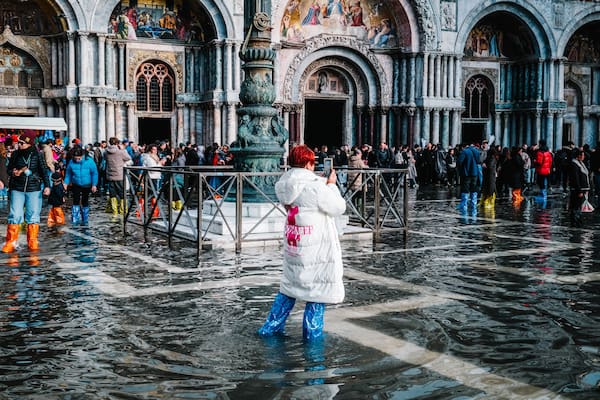
The high tides (or acqua alta, as they say there) that regularly flood Venice in winter have become increasingly frequent over the last 150 years, and this is just the beginning. By 2100, optimistic climate scenarios (with a decrease in CO2 emissions) project a rise in sea level of 42 centimeters, while a pessimistic scenario (with emissions continuing to rise) would see it increase to 81 centimeters. This would be enough to flood 15 to 70% of the city center daily when the tides are at their highest, if no protective measures are put in place.
Mobile barriers already protect Venice during exceptional tides. But other large-scale projects must be conceived and implemented immediately, warns an international team of researchers. In an article published Thursday in the journal Scientific Reports, they propose four strategies to try to protect Venice in the long term, each choice having its own economic, ecological, and social consequences. Currently, Venice only has a system of mobile floodgates installed at the three entrances to its lagoon: the « Mosen » system
(for Modulo Sperimentale Elettromeccanico), activated when the sea level exceeds 110 centimeters. The bright yellow floodgates, 18 to 30 meters wide and placed on the bottom of the lagoon, then pivot on their hinges to rise and block the passage of water. The lagoon is protected from currents that would threaten to flood the city.
Fully operational since 2022, the system has proven its immediate effectiveness in the event of a high tide. But « it will probably show its limitations during this century, » the researchers believe, because sea levels will continue to rise and current policies to reduce greenhouse gases are insufficient. The study estimates that « the number of days per year on which it needs to be activated will increase, and this will have serious impacts on the lagoon ecosystem »: the more the mobile dikes are closed, the less water circulates, with negative effects on sedimentation, salt marshes, etc. Fifteen experts (Italian, German, French, Dutch, Greek) have thus worked on the subject to start from scratch, led by Piero Lionello, an environmental scientist at the University of Salento in Lecce, in southern Italy.
“Piero Lionello works on everything related to coastal risks due to sea level rise, and he has been studying the emblematic case of Venice for a long time,” explains Goneri Le Cozannet, co-author of the study and an engineer at the Bureau of Geological and Mining Research.
« Sea level rise, and he’s been studying the emblematic case of Venice for a long time, » explains Gonéri Le Cozannet. Co-author of the study, this engineer at the French Geological Survey (BRGM) details the team and the genesis of the work: « Lionello had written a two-page summary on Venice in the IPCC report in 2022, with Marjolijn Haasnoot and myself, who specialize in climate adaptation. Subsequently, he sought out specialists on Venice, biodiversity experts, geographers, coastal engineers, economists, sociologists, and decision scientists. The goal is to consider the possible options. Then to explore which ones are acceptable, which ones are not, and so on. »
To start thinking about the future now, the fifteen experts suggest that public authorities adopt long-term protection scenarios for Venice: “Large-scale interventions, such as the construction of permanent barriers, ring dikes, or major structural reinforcements, require thirty to fifty years to implement, so the effective window for initiating a transition to alternative strategies is approaching. […] Sound planning will be essential to ensure that the new strategy becomes operational before the current one reaches its limits.”
Raise the islands
The first idea would allow for a few years of peace and quiet by raising the elevation of Venice and its adjacent inhabited islands (Giudecca, Murano, Burano, Mazzorbo, and Torcello). By injecting seawater into the saline aquifers beneath the lagoon, at depths of between 600 and 1,000 meters, the islands in the center of the lagoon should gain 30 centimeters in altitude within ten years, or even 50 if the aquifers are pumped even deeper.
This is a project that Pietro Teatini, co-author of the study and professor of hydrology and hydraulic engineering at the University of Padua, near Venice, has been nurturing for decades. Seeing the city of the Doges drowning is a constant source of frustration for him: « We’re going to have to start doing something very soon, » he already stated last year on CNN.
Taking up an idea originally put forward by Giuseppe Gambolati, his old professor who is now retired, Teatini examined the project in depth
With 300 to 400 million euros to carry out these injections, as estimated by the Scientific Reports study, we could continue with the removable barriers of the Mose system until the sea has risen by 1.25 meters.
To encircle the city
For more sustainable solutions to be implemented by 2100, scientists are considering a « ring dike » project—that is, « dikes that would isolate the city center from the rest of the lagoon, which would remain connected to the sea. » This is the most environmentally friendly solution: it would allow the MOSE project to be abandoned without interrupting underwater flows and exchanges. However, on the downside, the dike would spoil the city’s romantic views by erecting a barrier in the water. Experts believe this solution « alters the traditional landscape and weakens the physical and cultural connection between the city and its lagoon, » and it would have a significant impact on tourism. Researchers have calculated that the dike could withstand a sea level rise of between 2 and 6 meters, at an estimated cost of between 500 million and 4.5 billion euros, depending on the length and height of the wall. And the public and commercial transport system would need to be completely overhauled, and the port relocated.
Close the lagoon
The construction of permanent dams at the river mouths would prevent any seawater from entering… and would effectively transform the lagoon into a large lake, like the IJsselmeer in the Netherlands, artificially created in 1932 to protect the land from flooding. The city would be protected, and the landscape would remain unchanged. But the ecosystem would be profoundly disrupted, with salt water gradually turning into fresh water and “inevitable losses of living species.” Estimated cost: €540 million.
But to be effective for longer, it will also be necessary to raise the islands that enclose the lagoon, such as the Lido (4.8 billion euros), and the dikes that separate the lagoon from the polders inland (up to 20 billion euros). And the water quality in the future lake would need to be closely monitored. Researchers believe this solution would offer protection against a sea level rise of 2 to 10 meters… or even more if these dikes are replaced by “super embankments,” a structure 30 times wider than it is high, as is being considered in the lowest-lying districts of Tokyo, at a cost exceeding 30 billion euros.
Relocate the city
Later still, when the sea level has risen by 4 to 10 meters – after the year 2300 – we will have to resign ourselves to stopping the construction of ever-higher dams and consider a radical decision: relocation. The latest solution detailed by the team of experts is that of « planned relocation »: « dismantling the buildings and rebuilding them in a new, higher location. » Historical monuments would be rebuilt exactly as they were. Private homes, offices, and commercial buildings, not necessarily. « The flooded remains would gradually deteriorate and could be visited for a limited time by boat (and submarine), » the scientists indicate. It’s difficult to imagine, to quantify, to anticipate, because it’s unprecedented. The scientific study explains that we can only extrapolate from past experiences: “This complex and unprecedented operation (already applied on a smaller scale, for example to the temples of Abu Simbel in Egypt) would not prevent the loss of the cultural, historical, and architectural heritage of the original city. Scaling up previous projects of this type suggests a cost of between 1 and 10 billion euros, but this amount could be multiplied tenfold in the case of Venice.” And if compensation for expropriated residents is required, an additional budget of 5 to 6.5 billion euros will be needed.
“This study is not a simple cost-benefit analysis,” its authors emphasize. “That would be neither feasible nor appropriate, given the irreplaceable nature of Venice’s cultural heritage and all the dimensions that cannot be expressed in monetary terms (or at least, that would be highly debatable).” It is necessary to consider not only the security but also the well-being of the population, economic prosperity, and the preservation of heritage, traditions, and regional culture, particularly those linked to life in the lagoon.
None of the four scenarios is ideal, and they are not mutually exclusive: several solutions can be implemented in the long term… provided that we start preparing for the aftermath very quickly. “The fact that there is a problem with rising sea levels is taken very seriously – proof of this is the MOSE barrier, which was a 5 billion euro investment,” observes Gonéri Le Cozannet. “But what is less well understood is the timeframe beyond which MOSE will no longer function, or will pose such problems in the lagoon and ecosystems that a change of strategy will be necessary.” Convinced that decision-makers are taking the climate issue seriously, the engineer nevertheless laments a lack of foresight, an inability to project beyond the immediate future, which is becoming problematic. “There is a lack of long-term strategic vision.” Decision-makers simply need to realize that sea level rise will continue throughout the century… It’s not just in Venice, but everywhere,” the researcher emphasizes, highlighting the difficulty public authorities have in seeing beyond 2100. “Our work is often misunderstood because the timescales are very different from those we’re used to. But we need to ask ourselves, ‘When I launch an adaptation project, how long is this commitment?’ Then we realize it’s for a very, very long time.”
Cozannet remains optimistic nonetheless: « There will come a time when people will seriously consider the scenarios we’ve put on the table. Or perhaps other ideas, but we’ve still covered a fairly broad range of what’s feasible. In any case, in the end, there are only two options for Venice: either we back down, or we protect it. »