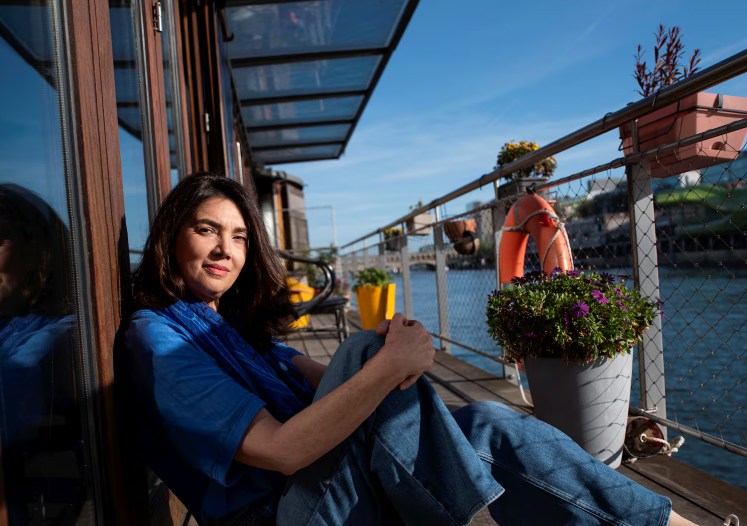
When the Ocean wakes up. Investigation in the Heart of the Blue Planet, is a two-voice book on the state of the ocean and what it announces for our future. That of Olivier Poivre d’Arvor, ambassador for the poles and oceans, and that of the oceanographer Marina Lévy, director of the Ocean Institute of the Sorbonne University Alliance and research director at the CNRS. At the same time scientific essay, geopolitical reflection, personal story and advocacy, it shows that the ocean is not only a victim of climate change, but also and above all a return power, capable of upsetting our balance.
Le Point: What exactly should we hear behind this title « When the Ocean will wake up« ?
Marina Lévy: The ocean, our miraculous provider of essential services, is in the process of getting out of control. The first symptoms are already visible: sea level rise, more frequent marine heat waves, more intense tropical cyclones, to name a few manifestations related to climate change. Because the ocean is also overexploited, polluted, mistreated. This title is a way of reminding us that the ocean is not just a simple decor. It is one of the great regulators of the Earth’s balance that we are destabilizing, to the point of bringing it out of this long state of stability from which our societies have benefited for millennia, as if it were awakening.
What are the most worrying symptoms of these climate disturbances?
The slowdown in the AMOC, this large Atlantic oceanic circulation that redistributes heat from the tropics to the poles, is expected to increase in the coming decades. This subject is so hot that it is through him that our investigation begins. This phenomenon has only been directly measured for about twenty years. It’s too short to set a robust trend. On the other hand, indirect reconstructions over longer periods suggest that this slowdown is already underway. The consequences could be major: climate change in Europe, increased sea level rise on the east coast of the United States, or disruption of monsoon regimes, with direct impacts on agriculture. It remains to be seen when these effects will be felt; there are still many uncertainties, and this very uncertainty is worrying.
You also mention the loss of oxygen in the ocean, a major topic and yet very little present in the public debate.
Fish need oxygen dissolved in water to breathe, which is what their gills are used for.
However, the warmer the water heats, the less oxygen it can contain. Some regions of the ocean are becoming less and less habitable for many marine species. This has a direct impact on fishing activities: in our book, we meet researchers in India to understand that shrimp stalls in the markets are empty because oxygen-poor waters extend along the coasts. Spectacular phenomena are also observed elsewhere, such as these massive strandings of thousands of dead fish, victims of asphyxia. Indeed, even fish need oxygen.
Why is the oceanic carbon sink essential?
The ocean absorbs about a quarter of the CO2 we emit, which mitigates global warming. In some regions, especially in the Southern Ocean, cold surface waters sink deep, carrying this CO2 with them. But this capacity decreases with increasing temperatures: the hotter the water, the less it can effectively dissolve CO2. Today, we know that the efficiency of this carbon sink is decreasing; the question is to what extent and at what speed.
Why is it so difficult to measure?
CO2 exchanges between the ocean and the atmosphere vary constantly: according to regions, seasons, winds, currents and biological activity. Off South Africa, the ocean absorbs and releases CO2 in turn. Understanding these dynamics at scale requires a massive amount of data. However, paradoxically, observations are now decreasing in a worrying way, in particular due to the reduction in dedicated funding.
You write that the most serious disorders are often invisible. Is this one of the major reasons for our collective inertia?
We tend to assess risks by what we see, what affects us directly. The rise in water temperature, the loss of oxygen or the upheavals of marine species that live underwater, away from our eyes… all this remains very abstract for many of us. And yet, these phenomena have direct consequences on our economy, our food security and even our health. There is also a form of psychological distance. Those who live far from the coast may feel that the ocean does not really concern them. I am often told, jokingly: « Oh well, you are an oceanographer and you work in Paris? « As if you had to be at the water’s edge to think about the ocean.
You mention the Paul Watson paradox, who managed to alert to the collapse of phytoplankton with simple formulas and erroneous data. Isn’t it infuriating for a scientist?
Yes, I tell this intervention by Paul Watson, who nevertheless relies on data published in a scientific article. But, in oceanic science, no article constitutes a definitive truth: it is the confrontation of studies and approaches that makes it possible to build a consensus. Only experts have the ability to assess the degree of confidence in a result.
All the difficulty is there: how to remain rigorous, faithful to validated results, while finding forms of communication that speak to the greatest number? This is precisely the challenge of the Starfish barometer, a readable and scientifically sound tool for monitoring the state of the ocean’s health for decades to come.
You have been affected by the pressures and restrictions that affect American ocean and climate research.
What shocked you the most?
The fact that researchers working on climate no longer have the right to use the words « climate change », that we must speak of « environmental variability » or « agricultural losses » to replace the expression « collapse of biodiversity ». It is a very violent situation, and almost unreal seen from Europe. This reflects a focus on short-term interests at the expense of major longer-term issues, even though the United States is already heavily affected by global warming and the impacts are accelerating.