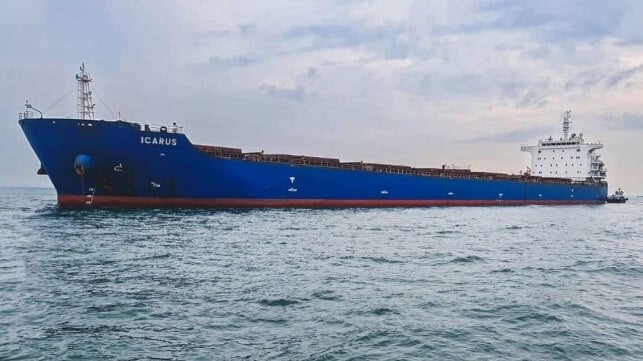
While the ceasefire has been extended, 20,000 sailors are still stuck in this gigantic maritime funnel, including about fifty French. Between the fear of missiles and the hunger that sets in, franceinfo tells you about their daily life from the inside.
« Sepah Navy, Sepah Navy! This is the Sanmar Herald patrol boat! You’re shooting at me! Let me turn around! « Captured on maritime frequencies, Saturday, April 18, the audio exchange (New window) is chilling: we hear the impotence of the captain of an Indian tanker, begging the Iranian forces not to target his crew, trapped in the Strait of Hormuz. « You gave me permission to leave. My name is the second on your list! « , he screams in distress.
A few hours later, new incident: a ship of the French shipowner CMA CGM has just suffered « pre-emptive shots ». The crew is safe and sound, but « very, very shocked », an employee of the shipping carrier blows to franceinfo. A new tragedy was narrowly avoided on Wednesday, when a Liberian flag-flagged container was in turn targeted by Iranian fire off the coast of Oman.
It has been more than fifty days since the Strait of Hormuz, through which 20% of the planet’s oil and natural gas transits (New Window), has become a kind of front line. The boats became targets, and the flight crews of collateral victims. Since the beginning of the Israeli-American coalition strikes on February 28, ten sailors have already lost their lives (New window), according to the count of the International Maritime Organization (IMO), which also lists nearly thirty incidents.
« I’m afraid for them »
While the ceasefire between the United States and Iran was extended on Tuesday, the IMO estimates that more than 20,000 sailors are still present in Gulf waters. Among them, « fifty » are of French nationality, says Emmanuel Chalard, Secretary General of the Federation of Merchant Navy Officers (FOMM-CGT). They are currently on board a cable operator belonging to the shipowner Louis-Dreyfus or on one of the two CMA CGM taners, he says.
« The truth? It is frankly extremely complicated to hear from them, regrets the union leader. In addition to the danger they run in the area, they now have no visibility into what will happen to them in the coming weeks. It’s very worrying. Shipowners are asked to bring people who are trained in war theaters on these ships. «
An employee of a famous French shipowner is also enraged: « Colleagues are shot like rabbits, while they are only doing their job. Every day, I fear for them. It’s unsustainable as a situation. On Saturday, when I learned that a CMA CGM container carrier had been targeted, I thought to myself: ‘Hey, it must have ended badly…' »
« The drones flew over us. We heard a lot of detonations, interceptions, says anonymously to Le Monde(New Window) a French sailor who has just spent three weeks in the area. What was quite surprising was that, from where we were, we were told that we were safe, that we risked absolutely nothing. The difference between what he [the employer] told us and the reality was staggering. «
Dismayed sailors and overwhelmed support services
Anchored at sea or at docked in the region’s ports, several hundred boats are still stopped in the Strait of Hormuz, as if isolated from the rest of the world. For almost two months, the map of Marine Traffic (New window), which allows you to scrutinize maritime traffic live, looks like a gigantic anthill of light points that do not move a mile.
/2026/04/21/69e795c0cef92878491335.jpg)
The largest shipowners have their own crisis unit to best support their sailors. For others, telephone assistance services are set up from the mainland. The email box and emergency WhatsApp of the International Federation of Transport Workers (ITF) are literally flooded with messages from crews. « We are completely overwhelmed, it falls day and night, » says Mohamed Arrachedi, coordinator of the platform, in charge of the Arab world and Iran. « I get calls at three or four in the morning. They call me as soon as they have access to the internet. «
Since the beginning of the war, « we have already been solicited between 1,800 and 2,000 times by sailors. Filipinos, Georgians, Ukrainians, Egyptians, Ethiopians… », he lists.
On Sunday, he stayed on the phone for forty-five minutes with two Burmese sailors who have not received a penny of salary for ten months. Their boat was to leave from Oman, and cross the Strait of Hormuz, towards Iran. « I still hear their voice, they were really, really afraid to leave, » recalls Mohamed Arrachedi. I tried to reach their shipowner on the phone: no answer. Then by email: no answer either. «
The emails received cast a harsh light on a disrupted daily newspaper. Some sailors say they sleep dressed, « just in case ». Instead, they lie down in the corridors, as far away from the windows as possible, and please turn off the lights to avoid being spotted. On board, the slightest noise can make you think of a missile.
Moreover, messages are sometimes accompanied by videos, such as material evidence that is slipped into a folder. It distinguishes the buzzing of drones, the humming of combat aircraft or the crackling of flames after an explosion.
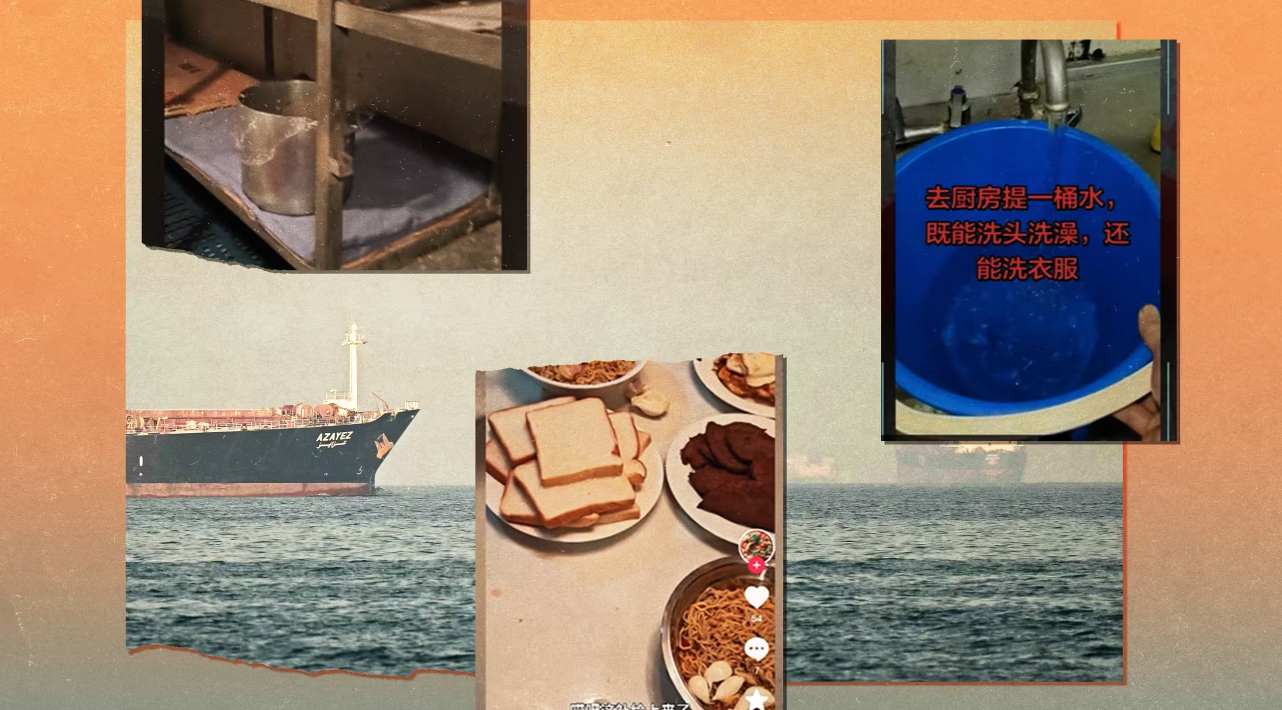
« We have 167 tons of water left »
More and more sailors are also concerned about the lack of supplies on board. « Some boats have been immobilized for weeks, and they had not foreseen this scenario. The reserves are empty, « says Mohamed Arrachedi. Sailors say they are forced to fish to have something to eat.
Even more critical: save fresh water. On images that France Télévisions has obtained, crews film themselves, meticulously keeping the accounts: « If we do the math, we have 167 tons of water available. Yesterday, only 3 tons were used. We watch it very closely, every day. »
Hair in the wind, the Greek sailor Vaggelis Dimakis also gave an overview of his daily life at sea for several days. Like a logbook, he filmed himself from the deck of his oil tanker, before publishing the videos on his TikTok account. « There, we are going through the worst place for a ship: off the coast of Iran. We are passing the Strait of Hormuz, « describes the engineer, in one of the contents that franceinfo was able to consult.
/2026/04/21/69e792557855e091850916.jpg)
« In addition to rockets, missiles and drones, we have to deal with a lot of things. We must ration our consumption of water, food and fuel, « he says in another video. Is this the sign of the tension that reigns there? His videos had become inaccessible on Tuesday, and his account untraceable. Contacted, the Greek sailor did not respond to our requests.