

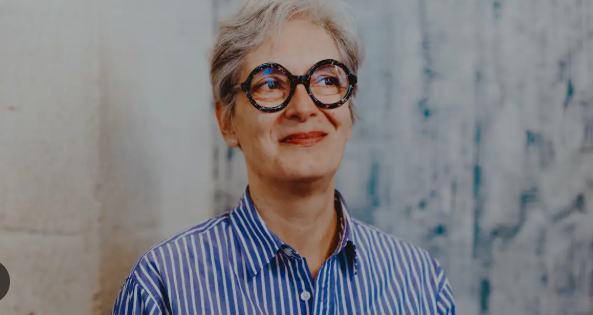
What are the sperm whales thinking about at the bottom of the sea? Are orcas capable of anger? And dolphins, can they love? Fabienne Delfour, 58, is an ethologist, specialized in the behavior of cetaceans, and for more than thirty years she has been trying to make links between « human and non-human animals ». « Animals live their lives in the first person, with their own experience of the world, » she poses immediately, seated in a cafe in the 8th arrondissement of Paris, where she is passing through to talk about her latest book La Sensibility du cachalot.
Behind her large round glasses, she tells the story of a life’s work: demonstrating that marine mammals feel emotions. She is sure of it, and she proves it scientifically: animals reason, learn, sometimes make war, defend each other within a group. And even each other, when the males are too pressing.
« I have seen elderly females [cetaceans] divert the attention of sexually overly insistent males towards one of them, » she writes.
This is his whole ambition: to understand animal sensitivity and show it to the public in the hope of arousing wonder. From here, she says, the desire to protect the living comes, which collapses as human activities nibble on the very conditions of life on Earth.
Fabienne Delfour, a temporary teacher at the National Veterinary School of Toulouse and associate researcher at the Institute of Language, Communication and the Brain of Aix-Marseille University, is also an expert with the International Union for Conservation of Nature. So much for the pedigree.
However, the beginnings were hard. « When I decided to study marine mammals, no one saw the point. Then, there was the Grand Bleu phenomenon, which discredited my work. I was told that I was in love with dolphins, it had become the cute animal. «
Not to mention that science and the sea, worlds of men, are hardly interested in animal emotions, which have been ridiculed. « Every time I got on a boat, the captain asked me where the director of the mission was. «
Today, finally, empathy is the norm in ethology. And the new generation of researchers is emerging. « I admire these young women who know how to say no. Who refuse what has been imposed on us, « she praises.
His vocation comes from an opportunity. After a master’s degree in natural sciences, Fabienne Delfour is looking for a graduation internship with elephants. « No researcher answered me. So, I turned to my plan B, marine mammals. Only Canadian bio-acousticist John K. Ford, a specialist in orcs, agreed to receive me, « she recalls.
The expert had the particularity of working in a natural environment and in a zoological park, an approach that Fabienne Delfour will reproduce by studying the dolphins of the Asterix Park.
Thus, in the early 1990s, the young scientist flew to British Columbia where, locked in the « dark and icy » offices of the Vancouver Aquarium, she tirelessly listened to cetacean vocalizations.
But the main thing is elsewhere: she longs to see the animals, to go to contact. At the turn of a first mission not far from Vancouver Island, she discovers the turbulence of the field: bad weather at sea, technology that crashes, injuries… What does it matter, passion will not leave her.
Back in France, she passed her doctorate in cognitive ethology in Toulouse, then went back to sea. Hawaii, the Bahamas, Reunion Island… She immersed herself in the blue of the oceans and let the animals come to meet her.
“Cetaceans also learn from us. When we approach them, they observe us. I refuse that they associate me with a disorder. «
Because the dangers already weigh heavily on oceanic fauna: global warming, plastic pollution, mass tourism – with the rise of tour operators, who pay little attention to animal welfare.
« Thirty years ago, our boat of scientists was the only one to approach cetacans. Today, we are queuing. Tourists follow them on the trail, swim alongside them. What would you feel in their place? «
Already small, Fabienne Delfour marvels at the living things that surround her. She slips into her dog’s niche to see the world through her eyes. « I imagined myself in his place and it fascinated me. «
Her childhood takes place in the countryside, in the Lot, between the fields she travels by bike, from dawn, to observe birds, and the family vegetable garden she cherishes.
« In my house, there was Penelope, a dwarf hen, and the rabbit Mimosa. I keep a very happy memory of that life, in contact with animals. »
Her mother, a teacher, pushes her to always give herself a chance, whatever her plans. « I saw his strength when my military father died in the accident of his volunteer fire truck. I know what I owe him. Her brother, Laurent, was 1 year old, she was only 4.
If today it slows down the pace – less aircraft, less meat, more second-hand – it also pleads for tempering scientific productivity, to « take the time to refine our questions, interact with other disciplines and not reduce the animal to a statistic ».
His commitment and integrity earn him praise from his colleagues and friends. « Fabienne has always conducted her research with remarkable tenacity, » says Raphaël Chalmeau, who has known her since the doctoral benches, and underlines the visionary nature of her work.
« She’s a fighter, » also notes John Jackson, a documentary film director, who saw her endure particularly difficult sea conditions during the Sardine Run.
The migration of these small fish, in South Africa, is a spectacle in its own right where birds, penguins, dolphins, whales and sharks come to feast by the thousands. « His rigor is essential for the narration of our films. It makes accessible complicated concepts that are far from the general public, « he continues.
But how to return to the tohu-bohu of human lives when we live the adventure offshore?
« I tended to idealize missions, a cocoon where we are between passionate people. Then, I understood that I also needed to go home to Toulouse, to meet my family and friends, « she admits.
There, she strolls along the Garonne, reads a lot, like this book, L’Invention de la mer, by Laure Limongi, which particularly marked her. She also likes photography, painting.
She has no children, lives alone « but is not alone ». She does not claim spirituality, but the concern for the other, human and non-human. Not inserted, she is still on the left, deplores that the environment does not irrigate all parties and strongly believes in the powers of art to defend the « bushy vision » of the living.