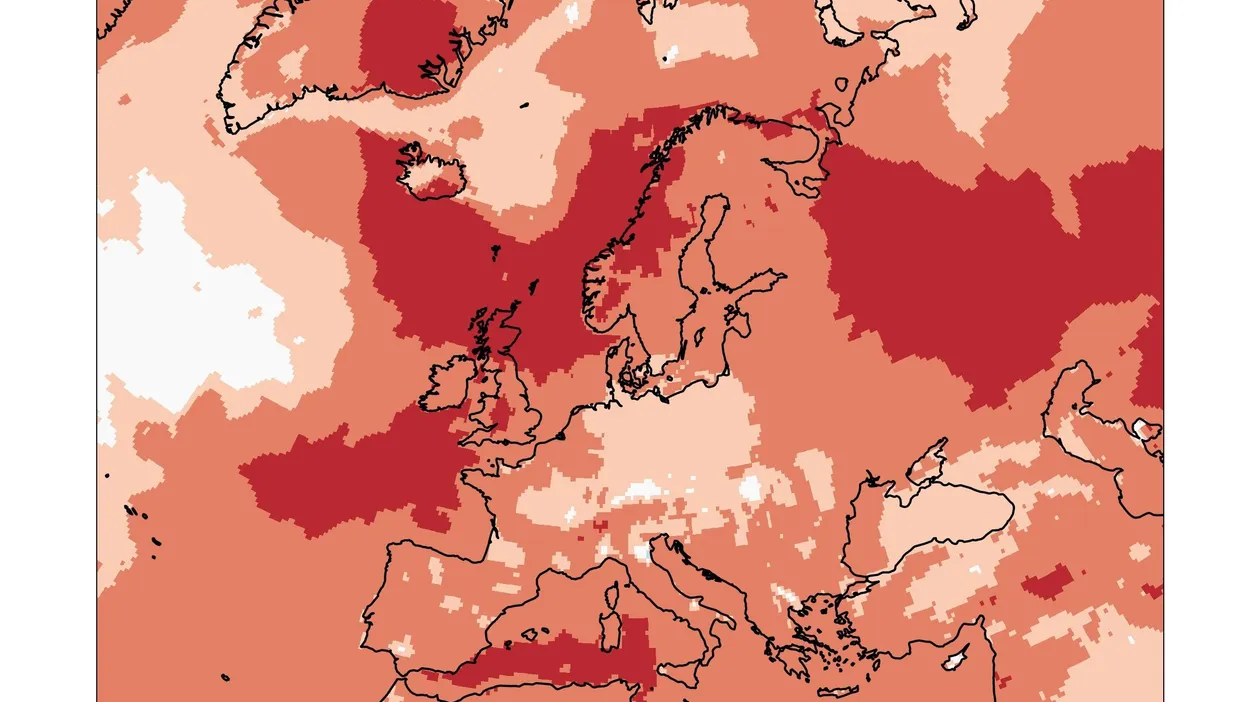
In 2025, at least 95% of Europe was faced with strong positive temperature anomalies. Between heat wave, melting ice, strengthening of extreme weather events and loss of biodiversity, we take stock of the climate in Europe in 2025.
Today, the conclusions of the State of the Climate in Europe (ESOTC) 2025 report, developed by the European Centre for Medium-Term Weather Forecasts (CEPMMT), working with the Copernicus Climate Change Service, and the World Meteorological Organization (WMO) are published. The report brings together the work of a hundred scientists and provides an overview of the main changes in the climate indicators of the world’s fastest warming continent: Europe.
If we carry out a global study, the air temperature has increased by 1.4 °C since the pre-industrial era. An increase that may seem anecdotal to many people but the reality is quite different. When we talk about global warming, we must differentiate the different scales.
For example, during the year 2025, subarctic Fennoscandie, i.e. the region of the world that partly includes sub-barctic Norway, Sweden and Finland, experienced the worst heat wave ever recorded. Temperatures exceeded 30 °C for 21 consecutive days and this even inside the Arctic Circle.
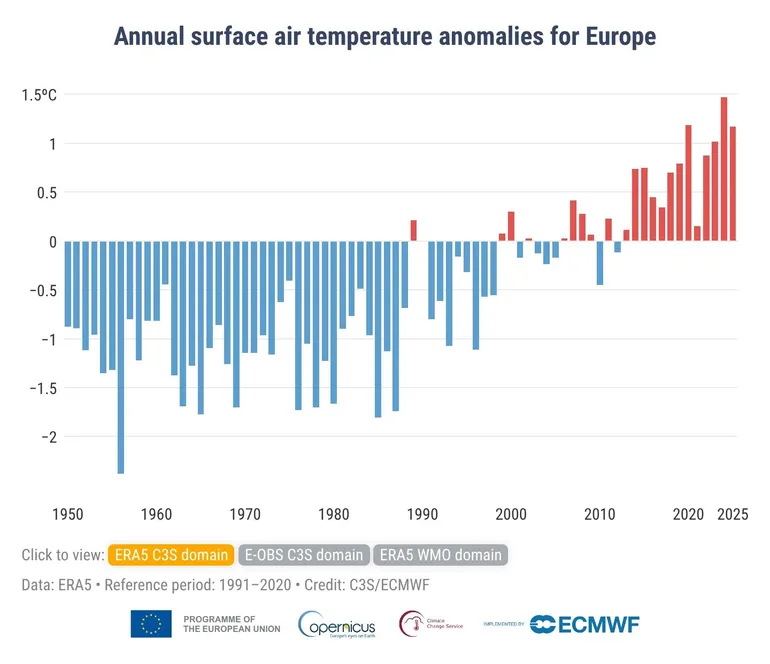
Annual average of temperature anomalies in Europe © Domains: European domain C3S, Data: ERA5. Credit: C3S/ECMWF
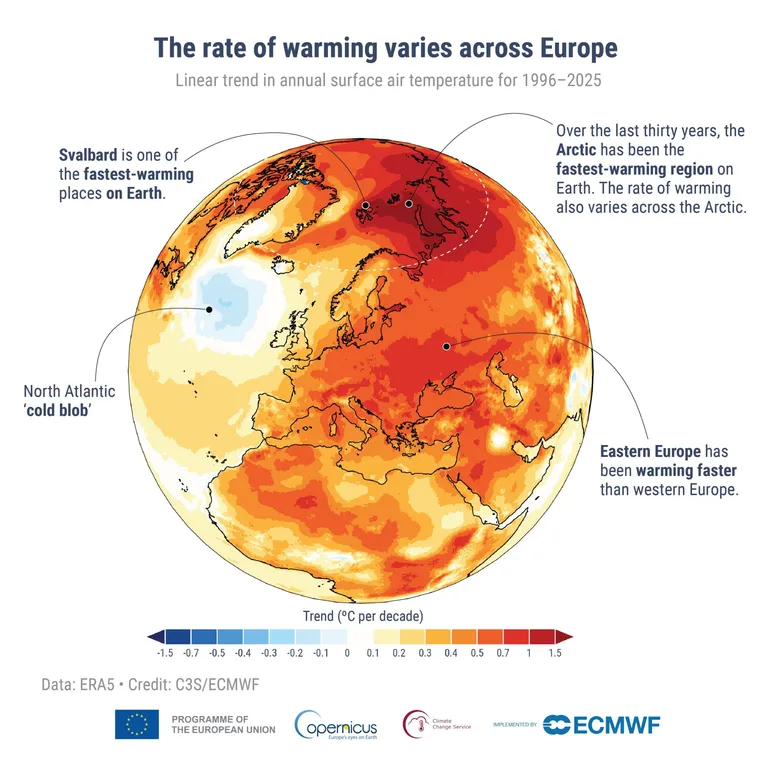
Indeed, on a global scale, not all regions are warming in the same way. Europe is one of the fastest warming regions in the world with the Arctic. Since the pre-industrial era, the surface air temperature has increased by 2.4 °C and 3.2 °C respectively.
Who says global warming, says rising temperatures. Be careful, it is not only in summer that we can see these developments, with the famous heat wave days for example. This observation is also visible in winter during the cold season. Since 1950, the area of Europe experiencing days below zero has been reduced. A significant impact for snow levels or glacier mass.
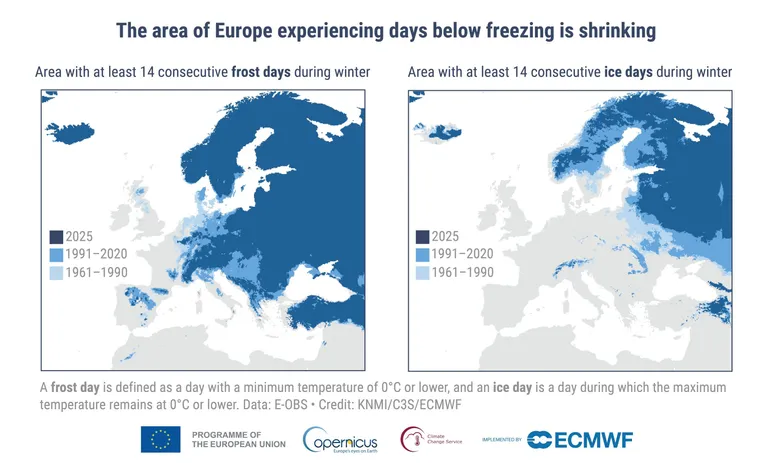
(Right) Area of Europe that has experienced at least 14 consecutive days with a minimum temperature below 0 °C. (Left) Area of Europe that has experienced at least 14 consecutive days with a maximum temperature below 0 °C. © Data: E-OBS. Credit: KNMI/C3S/ECMWF
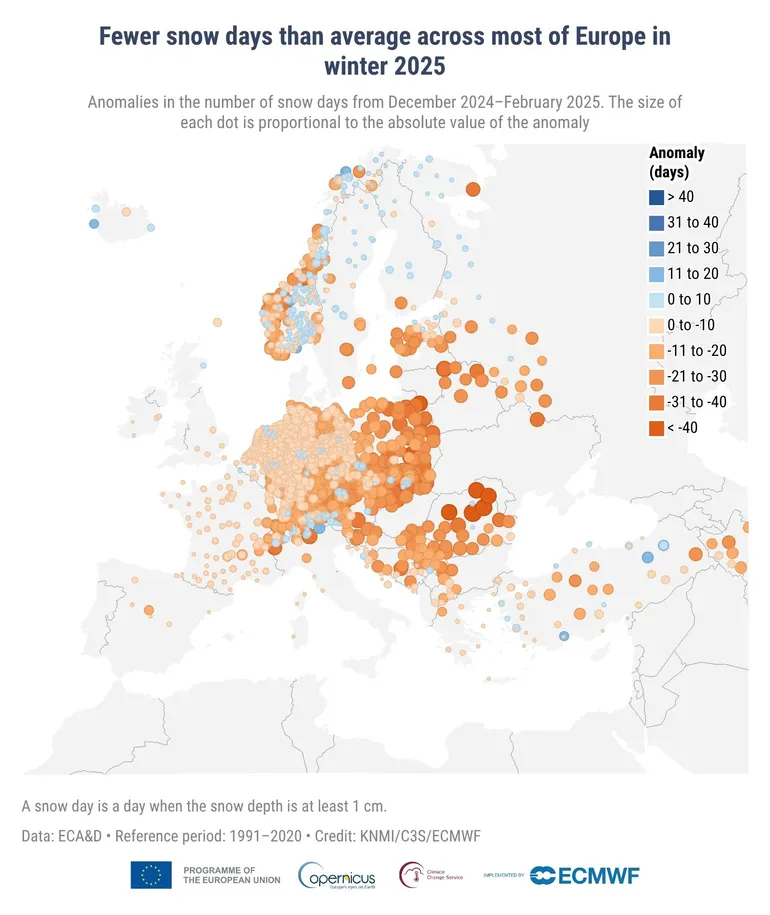
The symbolic mark of 0 °C is less often crossed than in the past. As the temperatures are not cool enough, no snowfall can take place. The observation is clear, during the winter of 2024/2025, the anomaly in the number of days of snow was negative. This means that there have been fewer days of snow than there is on average, and this, over a large part of Europe.
Temperature increases in the air yes, but in the seas and oceans too
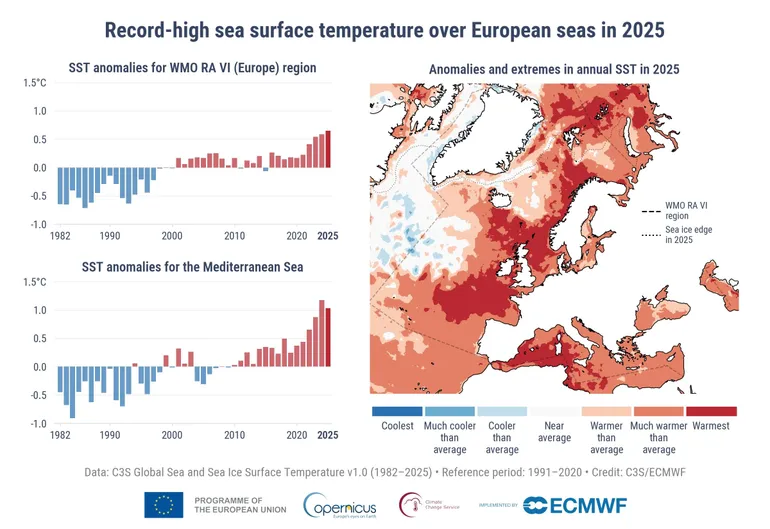
Average annual sea surface temperature anomalies for the period 1982-2025 © Data: C3S Global Sea and Sea Ice Surface Temperature v1.0. Credit: DMI/C3S/ECMWF.
It is not only on earth that heat waves can occur. In the seas and oceans, the same observation can be made in recent years. In 2025, at least 86% of marine regions have suffered strong heat waves, which has a direct impact on global climate change.
On this same scale, the surface temperature of the sea has warmed by 0.6 °C since 1980. In Europe, it is already 1.1 °C in 30 years. Indirectly, if the sea temperature increases then the sea level also rises, because the water expands. In 25 years, sea levels have increased by an average of 3.7 mm.
Glaciers that have been losing mass for many years, which also contribute to rising sea levels
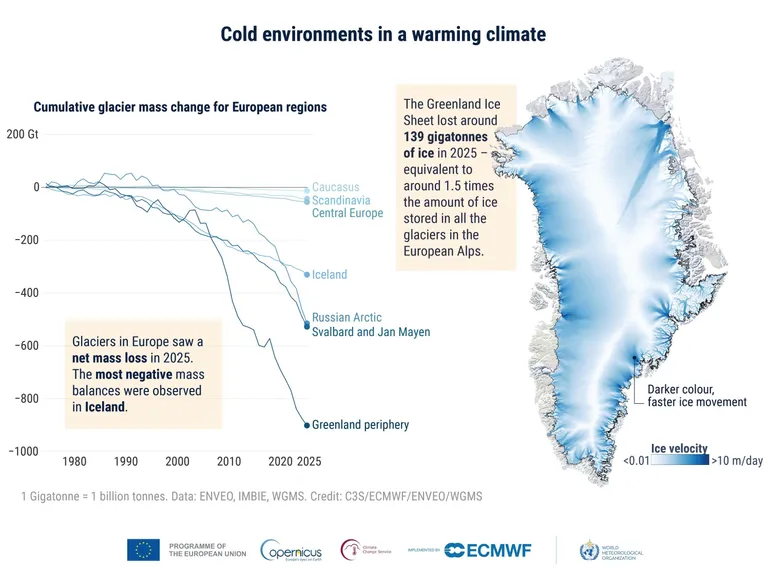
Modification of the masses of the various glaciers in Europe © Data: ENVEO, IMBIE, WGMS. Credit: C3S/ECMWF/ENVEO/WGMS
In all regions of Europe, glaciers have lost a considerable mass of ice. Iceland rises to the second largest ice loss ever recorded. Snow cover was 31% lower than normal, which represents a loss of 139 gigatons of ice.
If we take height and look at a more global scale, glaciers have lost a total mass of 9580 gigatons of ice and about 10% of these losses are observed in Europe.
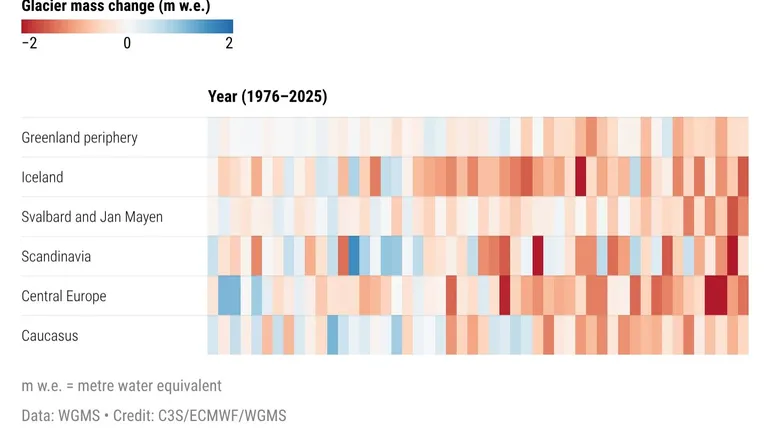
Climatic bands of annual variations in glacial mass for the hydrological years from 1976 to 2025. © Data: WGMS. Credit: C3S/ECMWF/WGMS
The climatic bands of the annual variations in glacial mass represent in red the years of mass loss and in blue the years in which the mass has increased. We notice that for more than 20 years all glaciers have been losing mass almost every year, which is becoming very worrying for the health of the land and the climate.
Extreme phenomena that are getting stronger year by year
We often evoke the expression « seasonal normals » in our articles and weather reports. This allows you to know the current situation and to compare what a normal climatic situation should be. But these figures and data also represent a real indicator of the state of the climate. They allow scientists to measure a disruption of different weather parameters such as temperature, precipitation and other phenomena directly related to it such as forest fires, storms or floods.
Let’s start with the floods. If we parallel the melting of glaciers or snow with the warming of the oceans, then the sea level will continue to rise. Some coastal areas are increasingly affected by this risk of wave/submersion or even flooding during high tides or during periods of strong wind.
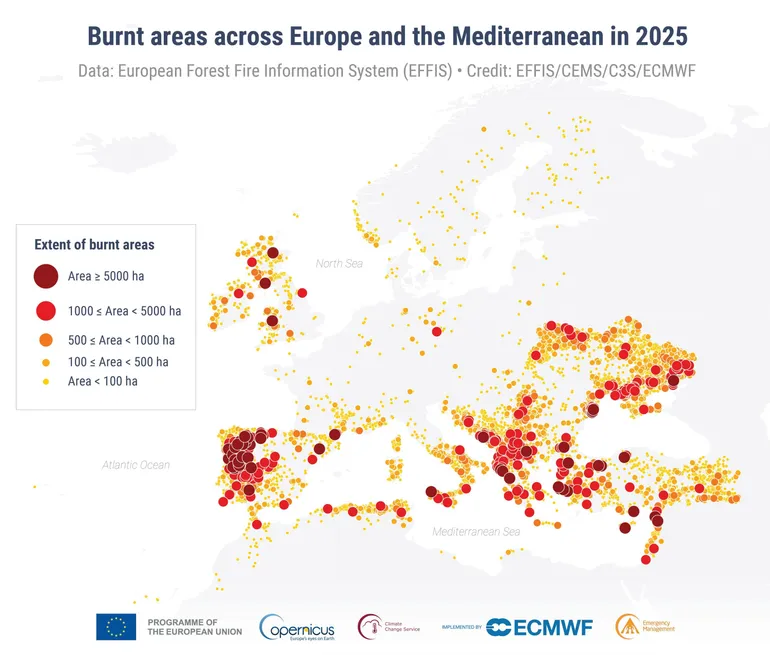
Distribution and extent of burned areas in Europe and the Mediterranean in 2025 © Data: European Forest Fire Information System (EFFIS). Credit: EFFIS/CEMS/C3S/ECMWF
With regard to forest fires now, hot and dry conditions have contributed to a record activity of the latter in Europe in 2025. In total, a record area of about 1,034,000 hectares burned in Europe. Spain was the most affected country, but other European countries also had to face these natural disasters. One more danger for biodiversity and the amplification of climate change with the release of a very large amount of carbon into the atmosphere.
An impact on biodiversity and populations
This assessment, which therefore shows the climate of the year 2025, is not without consequences. Climate change is indeed in place and is constantly being talked about. This is one of the major causes responsible for the degradation of biodiversity, which is essential for a sustainable future. Many policies are aware of this very close relationship between climate and biodiversity and propose solutions to limit this harmful impact of climate change.
source : RTBF