As research on marine plants is taking off, a molecule is attracting growing interest, especially among manufacturers looking for an alternative to petrochemicals. Report in the bay of Roscoff and in Landerneau, Finistère.
Imagine a capsule coffee maker without capsules. No more need for aluminum or plastic, ground coffee pods would be coated with a thin vegetable and biodegradable membrane. Imagine more sips of water that you could handle and slip into your pockets. It would be enough to swallow these small translucent and edible liquid bags to quench your thirst. Futuristic? In reality, all this already exists, on a small scale, thanks to a molecule unknown to the general public and yet omnipresent in our daily lives: alginate.
Taken from brown algae, which live off the coast of temperate and polar regions, the molecule has been exploited for almost a century for its gelling or thickening properties. It is found in our toothpaste, yogurts or ice creams, in our dental impression molds, beauty masks or medicines. And because it is bio-based and biodegradable, alginate is on the rise. It is a growing success with industrialists looking for an alternative to petrochemical products. It is also at the heart of a multitude of scientific publications, which explore its potential in agri-food or pharmaceuticals. Because she is far from having delivered all her secrets.
Under a radiant spring sun, Daniel Glidic returns to the small port of Roscoff, on the north coast of Finistère. His 9-meter boat, whose bright blue shines between sky and sea, is loaded with brown algae. About ten tons. This season, they are Laminaria hyperborea. Their silhouette may resemble a plant; however, there are no leaves, stems, or roots. Instead, we distinguish long flat blades (hence the nickname « laminars »), a thick and rough stipe (which acts as a stem), then crampons that grip the seabed up to 35 meters. The algae, which grows naturally near the Breton coast, does not need to draw nutrients from the soil, since it has everything available in the water. In May, the fishing for Laminaria hyperborea will give way to that of Laminaria digitata, which is recognized by its thinner, more flexible and short stipe, and which flourishes up to 7 meters deep.
A profession without a replacement
France has only 30 goémoniers in Brittany, these fishermen specialized in the collection of seaweed, including three in Roscoff, all Glidic. A profession that was passed on from father to son, but there is no more replacement. Young people have opted for other professions. « So much the better, it has become too difficult! » say Daniel and his cousin Jean-Marie in chorus. We do hours, hours, hours… And on weekends, we devote it to mechanics, because there is always something to fix! «
« Le Mercure », Daniel Glidic’s goémonier, arrives at the port of Roscoff (Finistère) with its shipment of algae « Laminaria hyperborea », on April 16, 2026. FLORENCE JOUBERT FOR « LE MONDE »
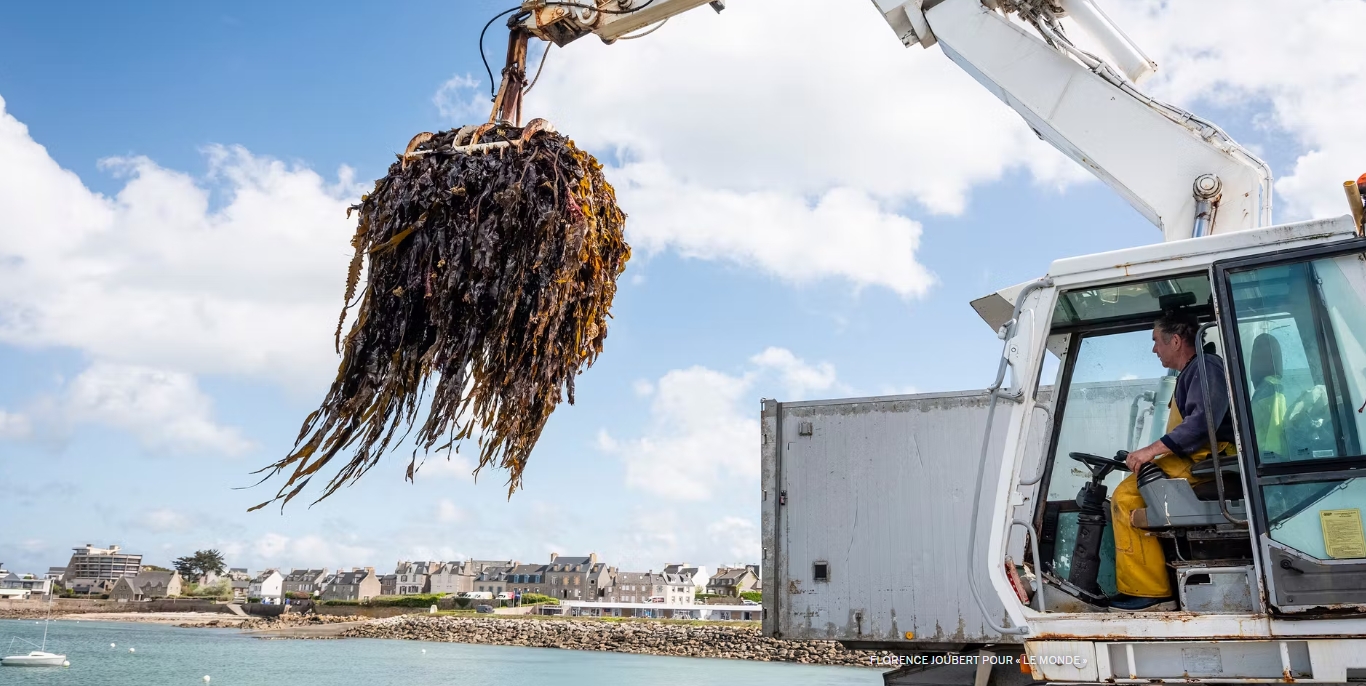
Difficult to hang up, however. The two retirees left this morning at the sea at about 8 a.m., raked the funds with their metal comb, then had to wait for a favorable tide to return to the port with their cargo. It is past 5 p.m. when the crane begins unloading, directly on the wack, in a truck intended for processing plants. The algae dance by shovels in the sky. Some slide and twist like elastics on the bitumen. They leave the fingers that pick them up sticky. They are dripping with alginate.
The molecule, which represents more than 30% of the dry matter of the algae, is a polysaccharide, a complex sugar. « A pearl necklace, » scientists say nicely. A string of several (« poly ») simple sugars (« saccharides »). In this case, an alginate necklace has only two types of beads, say two colors: mannuronic acid (M) and guluronic acid (G). The richer it is in rows of M pearls, the more flexibility and thickening properties it gives. The more the rows of G-pearls dominate, the more rigidity and a gelling character they bring. The latter are the most coveted by industrialists.
« The strongest biodiversity in Europe »
Polysaccharides are among the most abundant macromolecules on Earth and in the oceans. They help structure the wall of plants, store energy and can be involved in pathogen recognition mechanisms. « In brown algae, these complex sugars make it possible to resist currents and retain water at low tides, » says Catherine Leblanc, from her office with a view of the waves. The research director at the CNRS leads one of the two laboratories of the Roscoff Biological Station, a mecca of algae research, which celebrated its one hundred and fiftieth anniversary in 2022 and has more than 200 scientists. This is where the first genome of a brown algae was sequenced, a work published in 2010 by Mark Cock and his colleagues in the journal Nature.
It must be said that the resort, with its feet in the water, benefits from a privileged environment. « Roscoff Bay has about 600 species of large marine algae, it is the strongest biodiversity in Europe, » says his fellow marine biologist Philippe Potin, a major specialist in macroalgae. To give an order of magnitude, 12,000 species have been described to date on the planet and it is estimated that there are surely still as many to discover. «
Robert Larocque, on the other hand, left Quebec in 2012 to join the station as a research assistant. « There is no equivalent in the world, I found a pearl! On the beaches or near the coasts, they are there, indeed, all available, green, red or brown algae. « We often amalgamate them, while they are three groups that have nothing to do with it. In terms of evolution, brown algae are as far from green algae as bacteria can be from mice! They are also the furthest from other algae. And the only ones to produce alginate.
Principle of the « egg box »
This necklace is not just a coquetry. For the living organism, its color is important. It allows him to survive the vagaries of his environment. « When there are about ten G-pearls in a row, the alginate molecule very strongly traps the calcium drawn from seawater. This is what allows the freezing. Calcium establishes ionic bonds and strengthens the links between pearls, « says Bernard Kloareg, former director of the Roscoff station and professor emeritus at Sorbonne University, who devoted his career to these marine plants.
Laminaria thus adapt by modulating the color of their pearls according to the needs. « They know how to go from M to G to control the cohesion forces of their extracellular matrix. When there are many waves for example, crampons and stipes have a higher guluronic acid content, « says Bernard Kloareg. Scientists speak of « egg boxes », where alginate necklaces would draw the perimeter of the alveoli and where calcium, trapped in the sinuosities of the collars, would be eggs. It is therefore understood that extracting alginate from the middle of these solidly entangled molecules to each other is not easy.
At the JRS Marine Products plant in Landerneau, near Brest (Finistère), the trucks unload their tons of fresh algae. With the acquisition, in 2023, of the Algaia plant in Lannilis, a little further north, it is one of the two production sites of the German group J. Rettenmaier & Söhne (JRS), specialist in fiber processing. « We produce 2,000 to 3,000 tons of alginate, » says Arnaud Delafon, who runs the two factories. The market is very fluctuating, but it amounts to about 60,000 tons of alginate worldwide. China is the first producer, Norway the second. We are tied with Japan, in third position. «
Charlotte and helmet on the head, overshoes, overblouse. Once everyone is equipped, François De Borggraef, process engineering engineer and passionate popularizer, zigzags the visitor between the tanks. The extraction process is drastic. We slice Laminaria hyperborea, to separate the stipe, strong in G pearls, from the blades, with M pearls. Each will produce different types of alginate. We grind the algae and immerse them in an acidified bath. Alginate becomes alginic acid, which no longer fixes calcium, the bonds loosen. Then the molecule macerates in an alkaline medium, where it becomes sodium alginate, soluble in water. Finally, back in an acid bath that causes the precipitation of alginic acid flocs. A cottony foam rises to the surface. It is pressed, wrung out, dried, sifted. A tinted powder would be obtained if, during the process, the bleach molecule was not watered to satisfy customers who want a clearer product.
« In the world, the main application of alginate is textile printing. It is mixed with ink to increase the viscosity, explains Fabien Canivet, head of commercial development at the Algaia research and development center in Saint-Lô. Then come the food applications, for its gelling or thickening properties. Like agar-agar, derived from red algae, or pectin, produced from apples, coins and citrus fruits, better known to individuals. The food additives produced, rated from E400 (alginic acid) to E404 (calcium alginate), are authorized in the European Union.
In a 2017 study, a group of experts from the European Food Safety Authority concluded that there was « no safety problem » for the declared uses of alginic acid and its salts (E 400-E 404) as food additives. In 2018, the same conclusion for propylene glycol alginate (E405).
« These additives are, however, part of the markers of food ultraprocessing, » cautiously remarks Mathilde Touvier, director of the nutritional epidemiology research team at the National Institute of Health and Medical Research. Out of a population of more than 100,000 people, the NutriNet-Santé cohort on which we work, only 15% consume these additives. We have not seen any association with risks of diabetes, cardiovascular disease or cancer, unlike carrageenans, texture agents extracted from red algae and consumed by 78% of the cohort. This does not mean that they are safe for health, because the sample is very small, but we have not detected alarming signals. «
It is impossible to mention all the applications of alginate, in pharmaceutical, cosmetics or agri-food. In Gaviscon, the molecule forms a viscous gel in the stomach and blocks gastric reflux. In Coalgan dressings, it slows down the flow of blood and helps with healing. In the future, it could encapsulate more drugs or help reconstitute organs in 3D printing. In Switzerland, the Migros group has made invisible coffee capsules, called CoffeeB. In London, Notpla develops food, biodegradable and even edible packaging, such as Ooho water bubbles. Frenchman Pierre-Yves Paslier, who co-founded the start-up, aims to reduce the footprint of plastic around the world, while concern grows about the environmental and health impact of microplastics.
» More environmentally responsible and more effective process »
With such a palette of use, one might think that we have done the round of alginate. This is not the set. And to understand it, you have to go back to the long pearl necklace. Immersed in acid baths, it is subjected to a severe test, broken into a thousand pieces randomly. We have long lacked tools for a finer approach. « Algae polysaccharides have a chemical structure totally different from the polysaccharides of terrestrial plants, » explains Gurvan Michel, a biochemist at the Roscoff Biological Station. This means that the tools developed for plants are inactive on algae. Forty years ago, we had almost nothing to work on these polymers. «
Scientists then turned to the marine bacteria that live on the surface of marine plants. « Weeds accumulate carbon in their tissues through photosynthesis, especially in the form of sugars. Some herbivores, such as sea urchins, can eat algae, but it is the bacteria that, by degrading them, make most of this carbon accessible to the ecosystem, « explains microbiologist François Thomas, also based at the resort. And to do this, some marine bacteria have enzymes, proteins capable of cutting the alginate collar as they please. « The bacterium Zobellia galactanivorans, isolated in Roscoff in the 1990s, has an enzymatic arsenal that allows it to completely degrade this polysaccharide. «
Concretely, we identify the genes that allow the bacterium to produce the desired enzyme, then they are implanted in a bacterium that serves as a protein « factory ». This results in a collection of « molecular scissors », which only tackle a very specific part. « These enzymes are tools that nature has evolved to obtain a very specific reaction, » analyzes Gurvan Michel. They work in water, at room temperature. It is a more eco-responsible and more effective process than chemical, polluting and energy-intensive methods, which cut luck in the chains. « Perhaps one day the enzymes will be able to produce alginate using less solvents, » suggests François Thomas.
By looking at marine bacteria, Gurvan Michel made another discovery. In 2006, in the waters of the Landerneau plant, he met Mariniflexile fucanivorans. Its enzymes are capable of cutting another polysaccharide of brown algae, fucan. « This time, it’s a necklace with 25 or 30 colors of pearls and which has multiple ramifications! « , exclaims Robert Larocque. The molecule, less present in algae than alginate, and very little exploited, is however of major interest. « It is a sulfated polysaccharide, which looks furiously like the polysaccharides that we animals, humans, have in our extracellular matrix, » reveals Gurvan Michel. Like heparin, widely used for its multiple properties: anticoagulant, healing, anti-inflammatory. Sulfated polysaccharides of brown algae are therefore « biomimetics » of animal polysaccharides: they can act in an extremely interesting way on human and animal cells. «
Qualities that vary
But go find a pair of scissors in the bundle of a bacterium: it is targeting a single protein, when the body produces an average of 5,000. So Gurvan Michel coordinated the sequencing of Mariniflexile fucanivorans, identified about twenty genes related to this enzymatic activity that he tested in turn by cloning them into other bacteria. The details are the subject of a scientific article in the progress. As for the trio Bernard Kloareg, Robert Larocque and Gurvan Michel, he founded, in 2021, the start-up AberActives to explore the applications of fucans and oligosaccharides, these small pieces of alginate finely cut by enzymes. The biotech announced, at the end of 2025, that it had raised 1 million euros.
In Roscoff, the songs of the seagulls mix with the hubbub of the terraces. The golden hour sounds the end of the activities and the rush at the popular Café Ty Pierre. Daniel Glidic washes the empty hold of his boat with high water. It is not certain to leave in the next few days. The goémonier is often stuck at the dock, according to capricious weather, but especially a number of fishing days authorized proportional to the state of the resource. However, brown algae forests are regressing and are threatened all over the world. « Alginate is becoming a rare commodity on the global market, » warns Finn Lillelund Aachmann, professor at the Norwegian University of Science and Technology, director of the Norwegian algae biorefinery platform.
The « Mercure » (in blue) and « Eliani » (in black) goémoniers on the unloading dock, in the port of Roscoff (Finistère), on April 16, 2026. FLORENCE JOUBERT FOR « LE MONDE »
So Finn Lillelund Aachmann’s team explores another track: mimic the performance of algae and play with the pearls of the alginate necklace. « All brown algae do not produce a polysaccharide of the same quality, » says biologist Philippe Potin. The best are wild algae, which accumulate it over several years. The collars of farmed algae, such as Saccharina latissima and Alaria esculenta grown in Norway and France, are therefore much less popular. But this could change if we could add G beads to them.
Luckily, mannuronic acid and guluronic acid are epimers, the two molecules differ only in the orientation of a carbon atom. Norwegian scientists have therefore succeeded, thanks to an already known enzyme, in modifying this orientation in the laboratory. And to change, at the same time, the color of the pearls of cultivated algae. “The results of this study are encouraging. In the future, Norwegian alginate could also come from cultivated algae, « says Finn Lillelund Aachmann. It remains to be mastered, on a large scale and at low cost, this art of transforming lower quality polysaccharides into gold. « The Grail, » says Philippe Potin. Or, perhaps, the rare pearl?