


The proliferation of plastic waste in the tourism sector is putting increasing pressure on many Vietnamese localities.
In the absence of rapid and effective measures, this environmental pressure will continue to increase, directly affecting the quality of destinations as well as the sustainability of tourism.
Many difficulties persist
During the recent leave, the family of Bùi Duy Hai, originally from Hanoi, chose Ha Long, in the province of Quang Ninh (North), as a destination for a short stay. After visiting the bay and taking advantage of tourist services, the family stopped to rest near the pier. There, he noticed that small bottles of water, practical and easy to transport, were thrown along the alleys. From there comes a large amount of waste: plastic bottles, cups, nylon bags and single-use packaging, which present a high risk of environmental pollution.
The proper collection, sorting and treatment of this waste to reduce environmental pressure is becoming an urgent requirement. According to a study on plastic pollution in tourism conducted by the United Nations Development Programme (UNDP) in Vietnam, the challenges related to the management of tourist plastic waste concern the implementation of policies, infrastructure, data and consumer behavior. The report indicates that plastic waste currently accounts for about 12% of the total volume of household solid waste. It should be noted that, by 2030, the amount of plastic waste generated by tourists could reach 349,400 tons.
Associate Professor Dr. Pham Trung Luong, tourism expert at UNDP Vietnam, stresses that the main limitation lies in the fact that tourism is not yet managed as a specific source of waste production.
Existing legal texts do not provide for binding obligations on plastic-free tourism, essentially limited to commitments or incentives. This is not yet a mandatory condition for accommodation establishments, restaurants, tourist sites and travel agencies. In addition, many initiatives to reduce plastic waste remain punctual, dependent on communication campaigns or short-term projects, without sustainability mechanisms.
Another problem lies in sorting at the source and final processing. The majority of plastic waste from tourism activities is collected via existing systems and ends up mainly in landfills or incinerated. In several tourist sites, although sorting is in place, local collection systems still operate in a mixed way, resulting in the mixing of sorted waste. In island or isolated areas, the cost of transporting waste is high, while support mechanisms remain insufficient, which reduces the effectiveness of reduction efforts at the source.
According to a recent UNDP survey in Ninh Binh province, 67% of tourists surveyed say they have observed abandoned waste on the sites visited; 81% believe that the presence of plastic waste diminishes the attractiveness and beauty of the place; 63% believe that this damages the reputation of the destination. These figures show that plastic pollution directly affects the tourism experience and that there is a real margin for implementing transitional solutions.
Beyond the image of the destinations, plastic waste also generates significant economic costs. The report estimates that the cost of inaction in the face of plastic pollution in Ninh Binh (North) could exceed 600 billion dongs per year; the annual waste collection costs for each company amount to about 20 million dongs. Thus, the delay in the treatment of plastic waste increases not only the environmental pressure, but also the operating costs for companies and communities.
The survey also shows that the majority of companies have not yet embarked on an ecological transition, due to the high cost of alternatives and limited profit margins.
Implement synchronized solutions
Faced with these difficulties, according to Vu Thai Truong, head of the Department of Circular Economy and Climate Change at UNDP Vietnam, the priority is to strengthen the implementation tools. It is necessary to develop detailed guidelines to gradually eliminate single-use plastics in tourism; to create green transition guides for companies; to strengthen controls and sanctions; and to integrate plastic-free tourism criteria into hotel classification systems and authorization procedures.
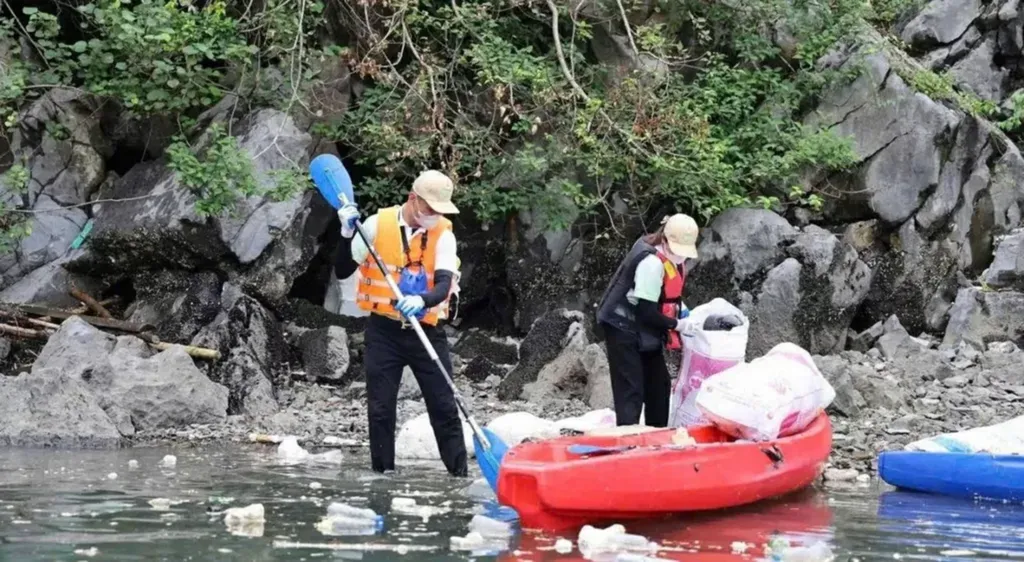 |
| Waste collection in the Ha Long Bay Landscape Complex – Lan Ha. |
| Photo: BQT/CVN |
In the central areas of heritage sites, specific regulations must be adopted quickly to reduce the use of plastic. The authorities must put in place support policies targeting, in particular, accommodation facilities with less than three stars and homestays, which generate large volumes of waste but have limited investment capacity.
In tourist sites, more drinking water stations and water charging points should be installed in piers and visit areas; garbage can systems and sorting panels should be completed and standardized. It is also necessary to develop exemplary hotel and restaurant models in terms of plastic reduction, and to manage waste management models to change the use behavior of single-use products.
In addition, it is necessary to invest in a coordinated manner in sorting, collection, transfer and recycling infrastructures; standardize the color codes of bins on a large scale to avoid confusion; adapt collection processes to local conditions; and strengthen the connection between on-site sorting and collection and recycling networks.
In coastal areas, particular attention must be paid to waste storage infrastructure, adapted to wind, storm and flood conditions, in order to limit the dispersion of waste into the marine environment.
Another group of important solutions is to create economic incentives for businesses, including through green financial mechanisms: exemptions or reductions in environmental taxes; priority access to loans to replace single-use plastics; technical support for data collection and the reorganization of waste management systems. For tourists, it is necessary to offer practical alternatives on site, such as reusable bottles, substitutes and clear signage.
Finally, control must be strengthened through the use of smart data, integration with smart city platforms and the installation of cameras in key tourist areas in order to quickly monitor and detect violations related to waste discharges.
source : le courrier du Vietnam

