
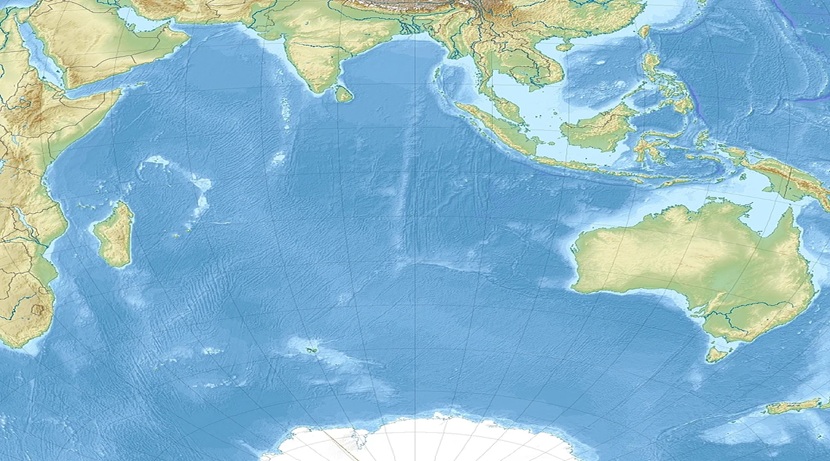
The Indian Ocean does not occupy the same media place as the South China Sea or the Taiwan Strait. Yet it is gradually establishing itself as one of the most strategic spaces of the 21st century.
« This maritime complex of nearly 75 million km² concentrates about 25% of global maritime traffic and nearly 40% of oil flows transported by sea, according to the International Energy Agency (IEA). «
A large part of the Gulf’s energy exports transit there before joining Asia, the main driver of global demand.
The Straits of Hormuz, Bab-el-Mandeb and Malacca are critical crossing points. A disruption in one of these corridors would have immediate consequences for energy prices, supply chains and global shipping costs. Houthi attacks on commercial ships in the Red Sea since the end of 2023 have already caused massive diversions by the Cape of Good Hope, lengthening delivery times and increasing freight costs.
In this context, competition between major powers no longer only concerns territories or alliances, but controls maritime routes, port infrastructure and digital flows that structure the global economy.
The Chinese strategy of the « pearL necklace »
For two decades, China has been methodically developing its presence in the Indian Ocean. Officially, Beijing presents this strategy as an economic extension of the « new silk roads ». In fact, it has an increasingly visible geopolitical dimension.
American and Indian analysts have been talking about the « pearl necklace » strategy since the 2000s. It is a network of ports connecting the South China Sea to the Middle East and East Africa, massively funded by China. This « pearly necklace » includes several strategic infrastructures, including Gwadar in Pakistan, Hambantota in Sri Lanka and Kyaukpyu in Myanmar.
In 2017, Beijing inaugurated its first permanent military base abroad in Djibouti. Located in the immediate vicinity of the Bab-el-Mandeb Strait, it allows the Chinese Navy to support its operations in the Red Sea and the western Indian Ocean. According to the US Department of Defense’s 2025 report on Chinese military capabilities, Beijing is now seeking to increase the logistical facilities that can support long-term naval operations.
The case of Sri Lanka illustrates Western concerns.
« Unable to repay certain loans, Colombo granted a 99-year lease on the port of Hambantota to a Chinese public company in 2017. »
Beijing challenges the idea of a « debt trap diplomacy », but the episode has reinforced fears of a growing strategic dependence of some riparian states.
Diego Garcia, pivot of the American presence
Faced with this rise in power, Washington retains a major military advantage: Diego Garcia. Located in the Chagos archipelago, this American-British base is the main base of the United States in the Indian Ocean.
Its geographical position allows it to simultaneously cover the Middle East, East Africa and South Asia. The base played a key role in American interventions in Afghanistan and Iraq. It remains essential today for American air and naval operations in the Indo-Pacific.
In 2024 and 2025, the United States strengthened its military presence in a context of increased regional tensions with Iran and a multiplication of attacks in the Red Sea. According to the New York Times, Diego Garcia welcomes several thousand British and American military and civilian personnel.
The question of the sovereignty of the Chagos has nevertheless weakened this architecture. After years of diplomatic and legal litigation, London accepted in 2024 the principle of a restitution of the archipelago to Mauritius. However, the final agreement signed in 2025 maintains a long-term lease guaranteeing the Western military presence on Diego Garcia.
India facing the risk of encirclement
For India, this development represents a major strategic challenge. New Delhi considers the Indian Ocean as its natural sphere of influence and observes with concern the progress of Chinese infrastructure around its territory.
Indian Foreign Minister Subrahmanyam Jaishankar acknowledged that India must now prepare for « a larger Chinese presence than before » in the region. In response, New Delhi is accelerating the modernization of its navy and strengthening its cooperation with the United States, Japan and Australia as part of the Quad.
However, India enjoys a considerable geographical advantage: its central position in the Indian Ocean gives it a strategic depth that China is still struggling to match despite the expansion of its port infrastructure.
France: power present but limited influence
France remains one of the few European countries with a permanent military presence in the Indian Ocean. Thanks to Reunion Island, Mayotte and the French Southern Territories, it has the second largest maritime domain in the world. Its exclusive economic zone reaches nearly 11 million km².
The Armed Forces of the southern Indian Ocean ensure a permanent presence in the region.
« The FAZSOI are based in Reunion Island and Mayotte. Paris also retains an important military establishment in Djibouti. About 1,500 French soldiers are stationed there.”
But this presence no longer guarantees an equivalent strategic influence. The French withdrawal from West Africa reduces its regional operational depth. The closure of bases in Senegal and Côte d’Ivoire illustrates this broader military recomposition.
The French Indo-Pacific strategy of 2025 insists on the protection of submarine cables and maritime surveillance. Paris is also strengthening its cooperation with India, Australia and the United Arab Emirates. However, the means remain limited in the face of the immensity of the Indo-Pacific theater. The National Navy distributes its capabilities between the Atlantic, Mediterranean, Arctic and Indo-Pacific. Budgetary constraints further complicate this strategic balance.
The European Union is also struggling to define a coherent strategy in the region. Brussels multiplies diplomatic initiatives without real European military integration. The security of trade routes still depends largely on the American naval power.
The invisible challenge of submarine cables
Behind ports and military bases, another issue is taking on importance: submarine cables. According to the International Telecommunications Organization, more than 95% of global data traffic passes through these discreet but vital infrastructures.
The Indian Ocean is a major crossroads of these digital flows linking Europe, the Middle East and Asia. Their vulnerability is increasingly worrying states. The incidents in the Baltic Sea since 2023 have recalled that targeted sabotage could permanently disrupt international communications and financial markets.
The protection of these infrastructures is now becoming an economic and military issue.
An increasingly fragile balance
The Indian Ocean is not today a theater of direct confrontation comparable to Ukraine or Taiwan. But rivalries are gradually intensifying. Each new port financed by Beijing, each reinforcement of Diego Garcia or each naval exercise of the Quad contributes to redrawing regional balances.
For Europe, the stakes are far from abstract. A major crisis in the Strait of Hormuz or in Bab-el-Mandeb would immediately cause a rise in energy prices, logistical disruptions and additional pressure on economies already weakened by trade and geopolitical tensions.
The South China Sea attracts the attention of the world. But it is perhaps in the Indian Ocean that the real strategic center of gravity of the 21st century is silently being built.