
Thanks to intensive tilapia farming, Egypt is the leading African producer of farmed fish. But this industry, which relies on the use of hormones, raises health, social and environmental questions.
This May morning is harvest day in Kafr el-Sheikh, in the north of the Nile Delta. A rectangular basin, dug on the ground and with an area of about two football fields, was dried up. A dark and thick, almost creamy mud lines the bottom, while a crowd of egrets, terns and kingfishers swirl in search of stranded fish. At the very end of the leveled basin, there is still a small portion of water, which is meticulously raked by a dozen men in thigh boots with the help of a black net.
As they get closer to the edge of the gouille, the water begins to bubble. Then everything goes very quickly: the fish are caught with landing nets, thrown into boxes and transferred from arm to arm until they reach a wooden wheelbarrow, where tilapias, mullets, carp and catfish struggle. The fish are sorted by species and size, then each 25-kilo case ends up in a refrigerated truck.
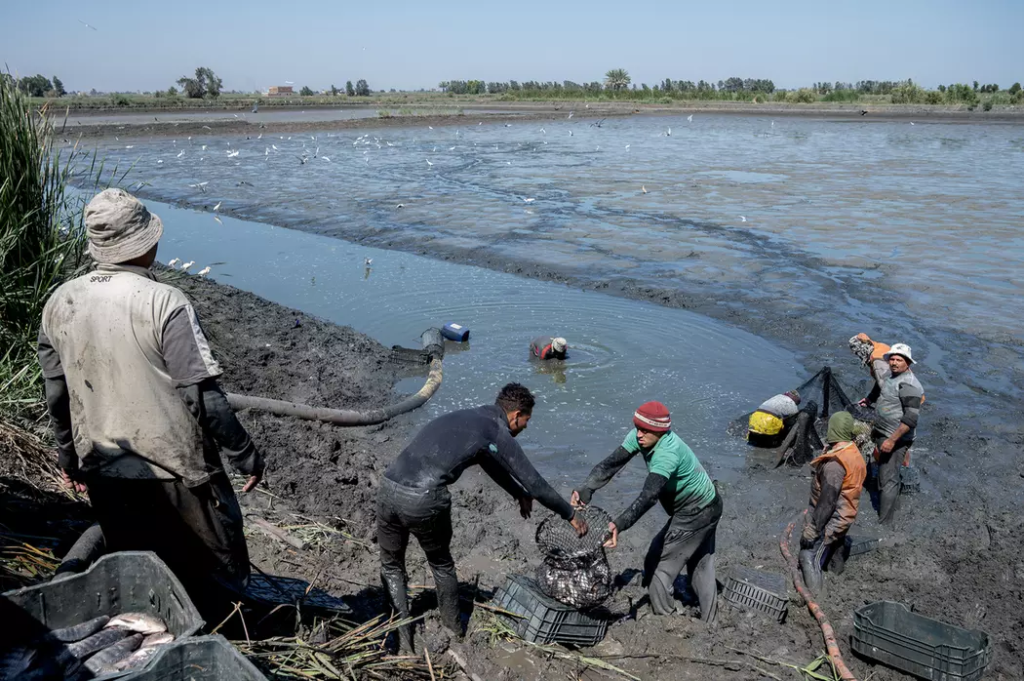
« We have been working since 6 a.m. and we have harvested about 20 tons of fish. It’s a good day, « says Fares Rashad, nephew of the farm owner, who supervises the operation. © Heba Khamis / Reporter
« We have been working since 6 a.m. and we have harvested about 20 tons of fish. It’s a good day, « says Fares Rashad, nephew of the farm owner, who supervises the operation. With a selling price of between 1 and 2 euros per kilo, the family will receive a nice lump sum, despite the significant costs incurred for the maintenance of the ponds and feeding the fish.
Fish with golden eggs
In Egypt, fish farming is a gold business that began about thirty years ago, mainly in the delta, and specifically in the governorate of Kafr el-Sheikh. This region, which borders Lake Bourlos and the Mediterranean, is not very conducive to agriculture because of its swampy and saline lands. Fish farming has arrived as a small miracle, generating substantial income for precarious populations. In a country with a galloping demographics [1], with scarce arable land, successive governments saw it as a valuable opportunity to increase food autonomy.
According to the latest figures from the Food and Agriculture Organization (FAO), the nearly 2 million tons of Egyptian fish produced each year are 80% from livestock and constitute no less than 25% of household protein intake.
The sector employs 300,000 people and has, according to the international aquaculture research organization WorldFish, 260,000 people have been removed from poverty. While Egypt is devastated by inflation and is going through the worst economic crisis in its history in three years, this low-tech and accessible industry, which weighs no less than $3.5 billion, has become essential.
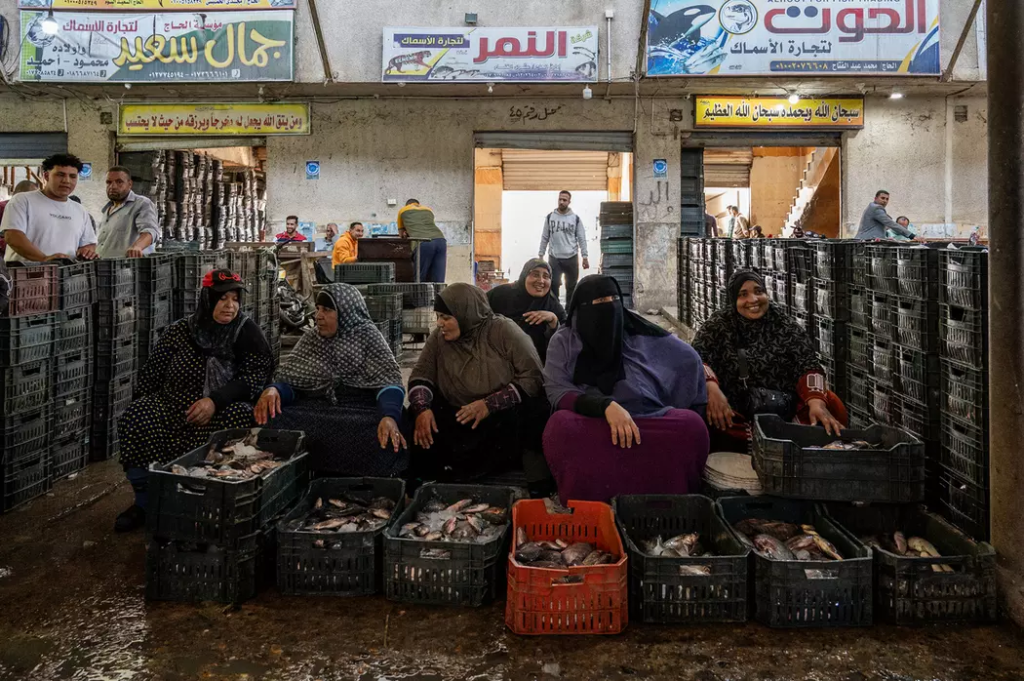
Women sell their fish production at the daily fish market in Kafr el-Sheikh. In the region, fish farming has arrived as a small miracle, generating substantial income for precarious populations. © Heba Khamis / Reporter
Egypt has thus become the leading African producer of farmed fish and is in the world’s top 10. Until now mainly intended for local consumption, Egyptian fish is preparing to continue its international expansion: at the end of April, the Egyptian public authority responsible for monitoring food safety, the NFSA, announced the approval by the European Union of the import of Egyptian aquaculture products.
Health and environmental risks
But this success story has its share of shadow. To understand it, you have to go to a hatchery, always in Kafr el-Sheikh. It is here, in the suffocating heat of a large white greenhouse, that millions of tilapia babies are born and grow in dozens of small stone basins. This species, naturally present in the Nile, makes up two-thirds of Egyptian fish production.
Particularly resistant to variations in temperature and salinity, appreciated by the Egyptians, it is the one that carries the entire sector. But to be intensive, its breeding must be only male, which is only possible with chemical manipulation.
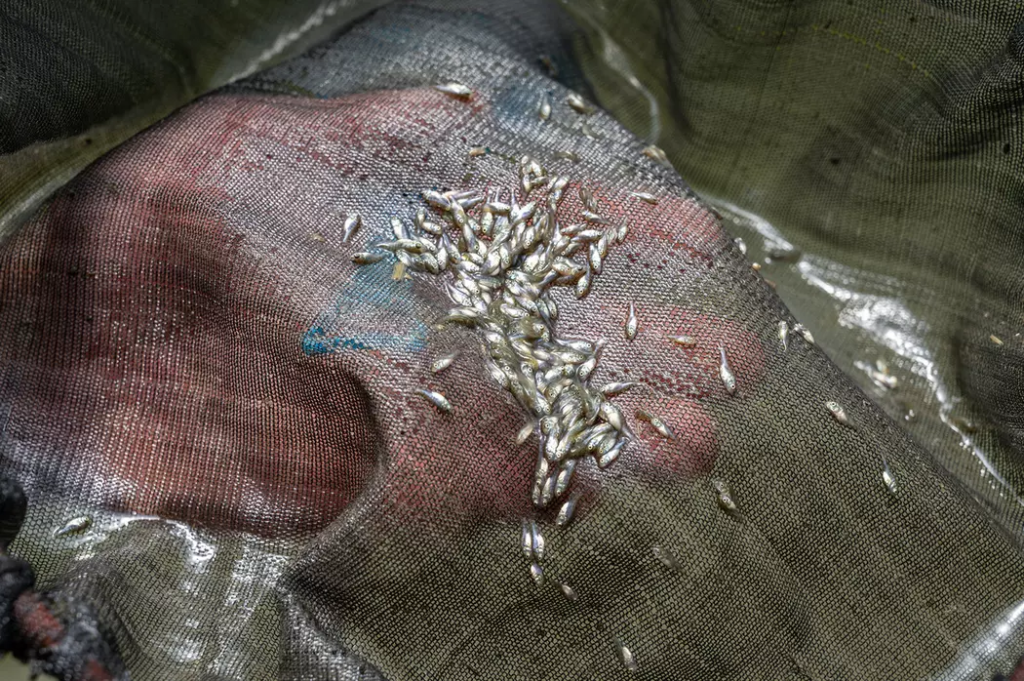
« The sex of tilapias is determined in the first days of their existence. That’s when we give them hormones, in their food, so that all fish become male, « explains Abdel Rahman, the owner of the hatchery. © Heba Khamis / Reporter
Abdel Rahman, the owner of the hatchery, explains: « The sex of tilapias is determined in the first days of their existence. That’s when we give them hormones, in their food, so that all fish become male. These grow faster than females, and become bigger, because they do not lose energy producing eggs. At the same time, a few flocks of females are kept, only for reproduction purposes. «
This so-called « monosex » fish farming was introduced by Egyptian researcher Ismaïl Radwan in the 1990s, following a trip to Southeast Asia, where intensive tilapia cultivation already existed.
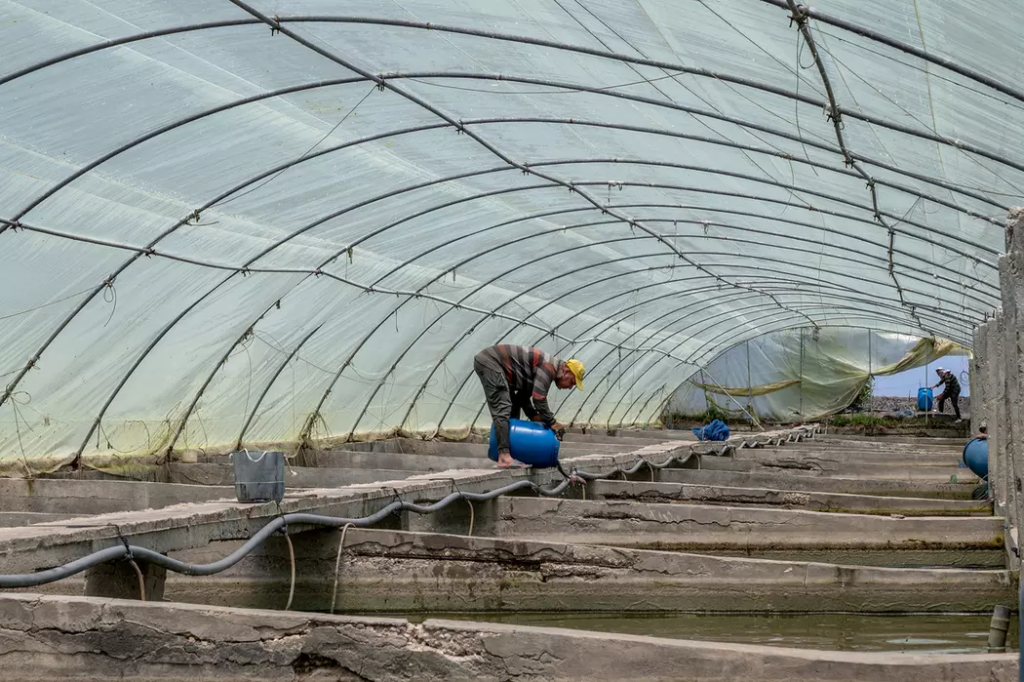
In this large white greenhouse located in Kafr el-Sheikh, millions of baby tilapias are born and grow in dozens of small stone pools. © Heba Khamis / Reporter
However, this practice involves health and environmental risks, according to several studies conducted in Egypt. One of them showed that the administration of hormones can cause organ alteration in tilapia. Another concluded that rats fed with tilapias that have undergone hormonal treatment suffer from liver disorders.
A third proved that hormone residues could still remain in fish that had matured and were destined for consumption. However, testosterone administered is an endocrine disruptor potentially dangerous for human health, and that is why the European Union decided, as early as 1981, to ban the use of hormones in all animal farms.
Double standards
How does the European Union meet these divergent standards? This is the question that arises, while the European authorities must ratify the agreement in the coming months, and have not yet communicated on this subject. According to the information available to Reporterre, the Egyptian army, which holds the reins of the country’s economy and has recently embarked on the fish farming business, is in the process of having its own megafarms certified according to international standards.
Does this mean that certified fish farms do not use hormones, or that the levels of hormones still present in fish meat are considered acceptable by the European Union? Impossible to answer these questions: the Egyptian army is a real black box that communicates little and almost never opens the doors of its industries.
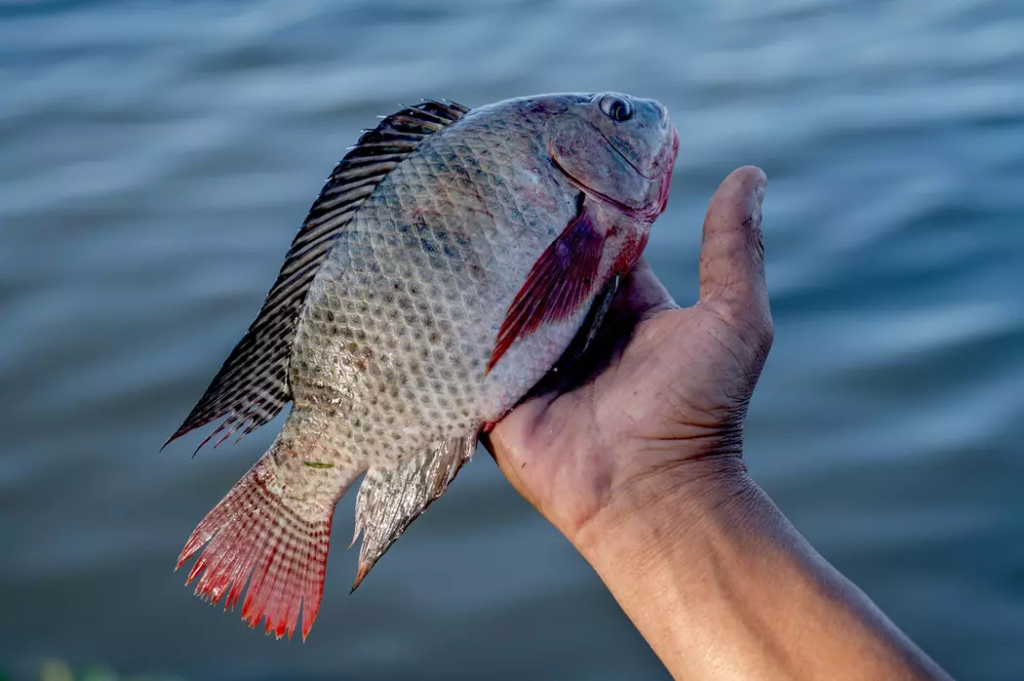
« Our wild fish is 100% natural, its taste is much better than farmed fish, but its size is smaller, » explains Ibrahim Yaqut Al-Abd, who fishes near his village, in Kom Dimis, at the western end of Lake Bourlos. © Heba Khamis / Reporter
In addition to hormones, other risks weigh on this fish farming. According to a meta-study by the Middle East Institute conducted in 2023, the majority of farms supply their basins with agricultural or industrial drainage water, dirty water that generates viral, bacterial and fungal diseases, and carries dangerous heavy metals, at levels that far exceed the thresholds of danger to humans.
An agreement criticized for its opacity
Megan Ferrando, a researcher with the Climate and Water Initiative think tank and author of this study, reacts in a nuanced way to the announcement of export to the EU: « From an economic point of view, this agreement is beneficial for both parties. But from an environmental perspective, although significant efforts have been made by the Egyptian government to rehabilitate the Delta lakes and improve aquaculture through extensive sustainable development projects, this industry will continue to increasingly face the environmental limitations of the delta. «
« It remains under considerable pressure related to human activities, such as urbanization and industrialization along the Nile, » she continues.
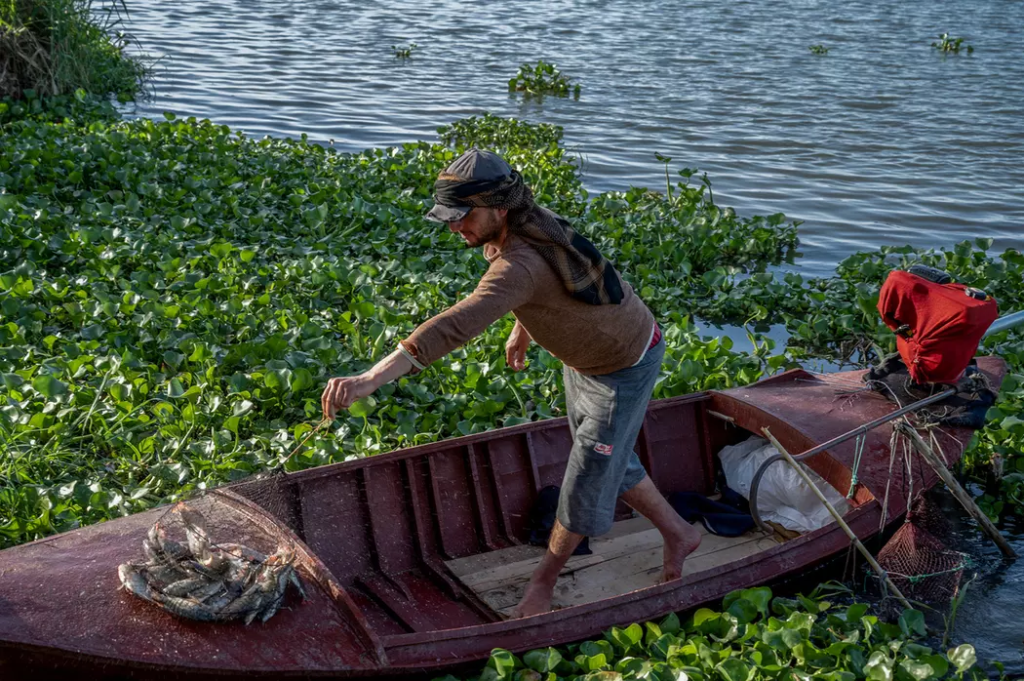
The drop in the level of Lake Bourlos, coupled with significant water pollution, has generated eutrophication, therefore an overdevelopment of certain plant species and a decrease in marine species. © Heba Khamis / Reporter
How to understand these commitments made by the European Union to collaborate with an industry that has so many environmental and health risks? The answer could be political. In 2024, European Commission President Ursula von der Leyen and Egyptian President Abdel Fattah al-Sissi signed an agreement in Cairo providing for a loan of 7.4 billion euros, in exchange for increased border control, while more than a million Sudanese have taken refuge in Egypt since the beginning of the war that ravages their country. It is possible that fish exports were part of this agreement criticized for its opacity.
Wild fish in retreat
In Kafr el-Sheikh, the bright future promised to fish farming contrasts with the state of natural waters. Due to the expansion of aquaculture farms, the level of Lake Bourlos has greatly decreased. Since this is shallow (1 meter on average), this has resulted in a decrease in its surface of about 30% over the last forty years. This drop in level, coupled with significant water pollution, has generated a eutrophication of the lake, therefore an overdevelopment of certain plant species and a decrease in marine species.
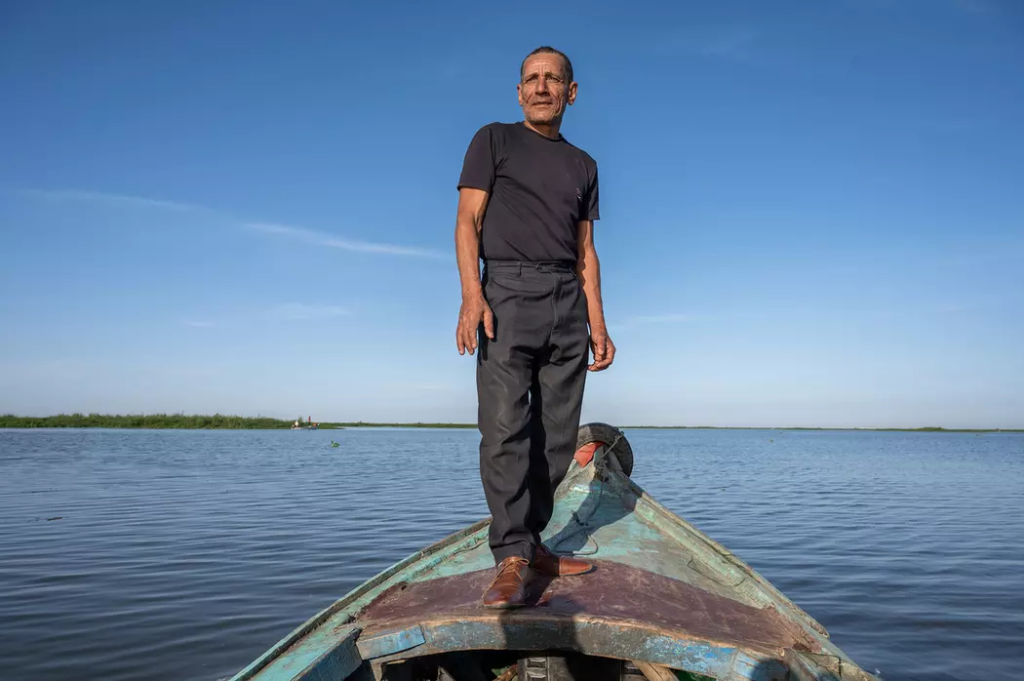
« For about thirty years, there have been fewer and fewer fish and more and more vegetation. Not only do we have fewer catches, but we also struggle to sell them, « says Ibrahim Yaqut Al-Abd, a 52-year-old fisherman. © Heba Khamis / Reporter
Near the village of Kom Dimis, at the western end of the lake, Ibrahim Yaqut Al-Abd, a 52-year-old fisherman with hands studded with scars from catching tilapias, launches his fine turquoise boat on the iridescent waters by the sunset.
He laments: « For about thirty years, there have been fewer and fewer fish and more and more vegetation. Not only do we have fewer sockets, but we also struggle to sell them. Our wild fish is 100% natural, its taste is much better than farmed fish, but its size is smaller. So buyers, who do not know how to tell the difference, prefer farmed fish. As a result, almost half of the local fishermen have changed jobs or have gone abroad.
source : reporterre

