
- With more than 70% of national production, the Dakhla-Oued Eddahab region is at the head of the aquaculture sector in this North African country
- The region offers many promising growth prospects
Aquaculture is considered a key sector of the economy of the Dakhla-Oued Eddahab region, contributing more than 70% of national production and offering many very promising growth prospects.
The city of Dakhla has a modern infrastructure, the first of its kind in Africa, for the development of the sector. It is an aquaculture plant that produces the scientific and technical data necessary to ensure the development of sustainable projects specializing in the production of fale, shellfish and algae, whether microscopic or intended for consumption.
The objective of scientific research for the sea fishing sector is to ensure the stability and sustainability of fish stocks, as well as the transfer of knowledge and expertise to professionals for effective management of the sector.

Morocco demonstrates that a targeted strategy, supported by a wide range of partners, adequate international funding and concrete and technologically innovative policies, can make aquaculture a central pillar of food security and the prosperity of the blue economy – PHOTO/ National Agency for the Development of Aquaculture (ANDA)
Leadership and growth prospects
The Dakhla-Oued Eddahab region is the sustainable aquaculture laboratory of the Kingdom of Morocco, offering countless investment opportunities in the sector. It is the first to pave the way for the development of this blue economy at the national level.
With a budget of 4.7 million Moroccan dirhams (440,000 euros) for the development of a new generation plan integrating a strategic environmental assessment, an aquaculture structure project (PSA) and its impact study, the Dakhla-Oued Eddahab region has become a pilot area to test the approach adopted to reconcile economic growth, environmental sustainability and attractiveness for investors.
As the official capital of aquaculture in this North African country, the city of Dakhla strengthens Morocco’s position as a major player in the blue economy at the regional and international levels.
In a context marked by a growing global interest in aquaculture in order to lighten the pressure on fisheries and meet the growing demand for marine protein, the Dajla-Oued Eddahab region benefits from great growth prospects that make it an important pole for oyster and mussel production nationwide.

The creation of these natural parks is part of a broader strategy to expand the area of marine protected areas – PHOTO/ National Agency for the Development of Aquaculture (ANDA)
With this in mind, Morocco intends to implement 450 aquaculture projects, 123 of which are intended for young people, artisanal fishing cooperatives and local project leaders, with a purely social vocation.
The ambition of this North African country is to reach an annual production of 390,000 tons, to create 6,300 direct jobs and to position the country as an African leader in sustainable aquaculture.
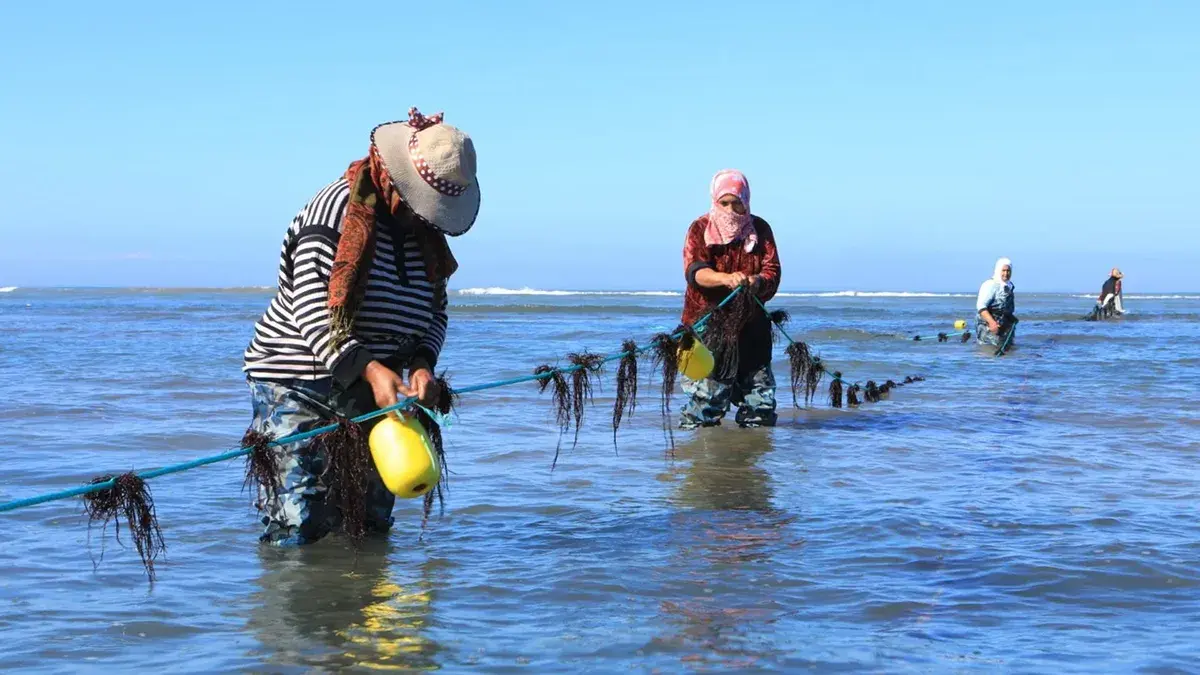
To this end, nearly 24,000 hectares of maritime areas have been identified for new investments, concentrated in three main sectors: fish farming, shellfish farming and algae cultivation. In 2025 alone, some 200 aquaculture farms were created and 322 agreements were signed for the development of new incubation units and the consolidation, consequently, of the supply chain.
Given the efforts made to develop this promising economy, mobilizing 1.5 billion dirhams (€140 million) of public investment in aquaculture, Morocco managed to reach a production of 7,000 tons in 2024, generating 310 million dirhams (29 million euros) of revenue.

The mission of the National Institute for Fisheries Research (INRH) is highlighted – PHOTO/ National Agency for the Development of Aquaculture (ANDA)
Scientific research
Scientific research plays a central role in the development of aquaculture; it ensures daily and real-time monitoring of the state of fish stocks in order to analyze their evolution and to formulate specific scientific recommendations that serve as the basis for effective fisheries management.
In this regard, it is worth highlighting the mission of the National Fisheries Research Institute (INRH), located in Dakhla-Oued Eddahab, which consists of supporting the dynamics of the sector through integrated scientific work carried out by its specialized laboratories, in order to ensure sustainable exploitation of fisheries resources and strengthen the foundations of the blue economy in the region.
The Institute has three main laboratories that operate in a complementary manner and cover the different aspects related to the management and sustainability of marine resources:
- The first, specialized in sea fishing, ensures daily monitoring of fish landings at the port of Dajla, as well as in fishing villages along the coast.
- The second, responsible for monitoring the quality of the marine environment and the health control of seafood, in particular clams.
- The third is an aquaculture plant that plays a key role in the research and development of the sector.
The work of the INRH is not limited to the health aspect, but also includes the performance of diagnostics on fisheries resources and their operating systems. It is also responsible for monitoring the marine environment and assessing the impact of human activities on coastal ecosystems.
Accredited according to international standards, the laboratory carries out regular monitoring operations, once a week, in order to control the sanitary quality of the clams and to ensure the absence of biotoxins that may represent a health risk to consumers.
In parallel with this work, the institute also makes recommendations aimed at raising awareness among various actors, investors and professionals of the need to respect ecological balances.

Conservation of resources
The work carried out by the INRH, through its three laboratories, is part of an integrated national vision that aims to establish a sustainable development model based on the enhancement and conservation of marine resources.
Thanks to this approach, the region manages to reconcile the exploitation and conservation of marine resources, thus guaranteeing their sustainability for future generations and strengthening the attractiveness of the sector for investments.
In accordance with the royal directives given by King Mohammed VI, relating to the development of the blue economy, the conservation of fisheries resources is not only a collective and shared responsibility, but also an essential pillar of this economic model that requires responsible and sustainable exploitation.
The objective of monitoring the exploitation of fisheries resources is to collect precise data on the quantities landed, the structure of fish stocks, in particular small pelagics, as well as to analyze the dynamics of these resources and to assess their level of exploitation; this contributes to decision-making based on scientific data guaranteeing sustainable production.
source : atalayar