
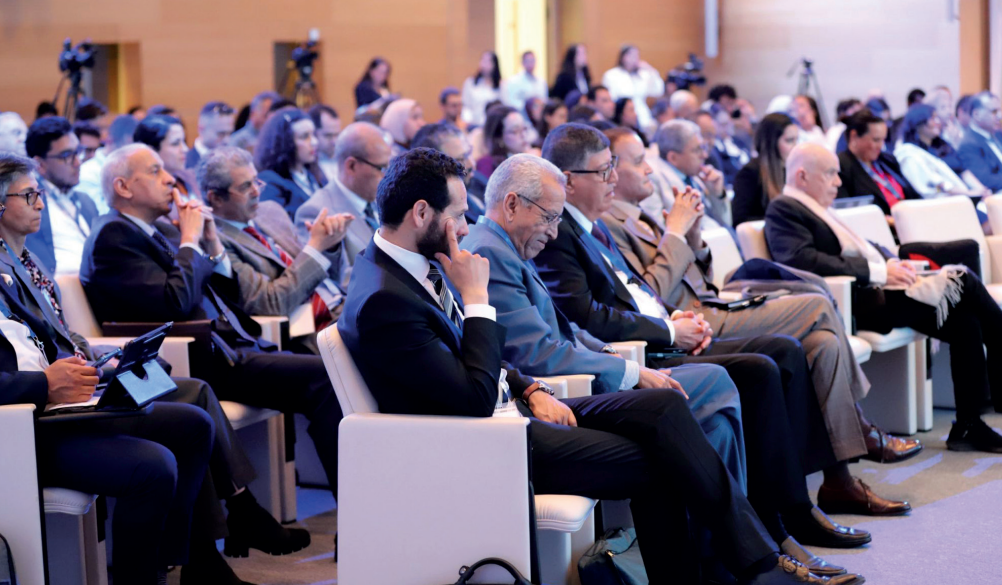
Long relegated to the peripheries of African development strategies, the sea is now resurfacing in the continent’s geopolitical, economic, and sovereignty-related discussions. In Rabat, at the African Maritime Symposium organized by the Policy Center for the New South (PCNS), experts, legal scholars, and strategists attempted to answer a question that has become central in the era of global restructuring: how to transform Africa’s immense maritime potential into a true instrument of power?
Behind the panel’s title, « African Maritime Spaces: A Strategic Diagnosis of Attributes and Limitations, » a single reality emerged: Africa possesses the space, is rich in resources, and even has the necessary strategic tools, yet continues to be hampered by its own political fragmentation, institutional inertia, and chronic inability to translate vision into action. For Georges Mba Asseko, advisor to the President of the Gabonese Republic and former head of the Blue Economy Division at the African Union Commission, the African maritime question almost points to a civilizational divide.
“Aquatic environments have been, since the dawn of time, the bond, the vehicle, the connector between peoples,” he reminds us, before lamenting that after independence, a large number of African states have gradually “turned their backs on the sea.” The paradox is all the more striking, for the continent lies at the crossroads of some of the world’s most important maritime routes.
More than a hundred ports now structure African trade, while the continent’s coastlines concentrate immense fishing, energy, and mineral resources. Yet, despite the abundance of strategies developed in recent years, namely the African Integrated Maritime Strategy 2050 (AIMS 2050), the African Blue Economy Strategy, and ocean governance projects, Africa is still struggling to translate its ambitions into operational action.
“In Africa, we are very good at developing instruments. We have strategies, we have action plans. But the fundamental question, in my opinion, is how we move from strategies to action,” asks Georges Mba Asseko. In his view, the continent no longer suffers from a lack of vision, but from a lack of mechanisms. Behind the grand continental ambitions, the same vulnerabilities persist: insufficient funding, a lack of implementation mechanisms, a shortage of specialized skills, and a lack of coordination between states. Thus, in an international context marked by the reshaping of geopolitical balances and the global battle for strategic resources, he calls for the emergence of a true “African Voice” on maritime issues.
“We need to have one voice. We need to have one vision. We need to have one objective. We need to have one strategy,” he insists. This continental fragmentation is also reflected in the weak commitment of states to their own legal instruments. Georges Mba Asseko cites, in particular, the Lomé Charter, the African Union’s only legally binding instrument in the maritime domain. “Ten years later, only three countries have ratified it. Are we serious?” he asks, in a remark that sounds almost like an admission of collective impotence. This question finds a natural extension in the presentation by Diénaba Beye, a lawyer specializing in international law in Senegal, who came to place African issues within the broader framework of the international law of the sea. According to her, African maritime spaces are not solely a matter of economics or trade. They also constitute spaces of sovereignty, jurisdiction, and strategic projection.
“The United Nations Convention on the Law of the Sea constitutes the ‘constitution’ of maritime spaces,” she reminds us. Behind the concepts of territorial sea, exclusive economic zone, continental shelf, and high seas lies, in reality, the control of resources, trade routes, and spheres of influence. The legal expert also discusses the African Union’s project to create a Common African Exclusive Maritime Zone within the framework of the AIMS 2050 strategy.
This continental ambition, however, runs up against a persistent political reality: African states remain deeply reluctant to pool their maritime sovereignty. « No state would agree to relinquish its sovereign rights over its territorial sea, » she explains. Diénaba Beye also warns of the upcoming realignments surrounding African demands for continental shelf extensions, which could redraw the areas under the jurisdiction of coastal states and, by extension, the continent’s maritime geopolitical balance.
His intervention focused primarily on the BBNJ, the international agreement on marine biodiversity beyond national jurisdictions, which entered into force in 2026. Sharing marine genetic resources, creating marine protected areas, conducting environmental impact assessments, and transferring technologies: this new instrument opens up unprecedented opportunities, but also reveals African vulnerabilities. Weak maritime surveillance capacities, a lack of continental coordination, and difficulty in building common positions continue to limit Africa’s influence in international negotiations.
“Almost all African states have signed the Blue and Blue Economy Agreement (BBNJ), but none have accompanied their ratification with an interpretative declaration. This particularly struck me,” she noted. Beyond the legal and geopolitical issues, the discussions also highlighted the growing importance of the blue economy in the continent’s future transformation pathways. From an economic perspective, Abdelmalek Faraj, a consultant expert at the World Bank in Morocco, emphasized the need to consider African maritime spaces as a truly integrated value chain.
“We have enormous opportunities, tools, and strategies at the African level, but the real problem lies in implementation,” he observes. Using fisheries resources as an example, he points out that Africa accounts for only about 10% of global fish production, even though a significant portion of its stocks are already overexploited. For him, the blue economy can no longer be conceived in silos.
Ports, fishing, maritime transport, logistics, industrial processing, and coastal tourism must now be considered as components of a single economic ecosystem. « The blue economy shouldn’t be conceived as a collection of siloed sectoral strategies. A systemic vision is needed, » he adds. The World Bank expert identifies three major obstacles: governance, financing, and access to information. Because beyond available capital, it is primarily the lack of accessible data, shared scientific knowledge, and economic visibility that continues to hinder investment. « Before encouraging an entrepreneur to invest, they must have access to all the necessary knowledge, » he explains. Abdelmalek Faraj thus calls for the democratization of maritime scientific data and greater involvement of the private sector in knowledge production.
“We must colonize the sea in a positive way,” he declared, advocating for broader access to maritime spaces, knowledge, and economic opportunities. As the discussions unfolded, one thing gradually became clear: maritime Africa remains an unfinished project. The continent possesses the space, resources, and ambition necessary to become a leading maritime power. But without a coordinated vision, operational tools, and genuine continental integration, this promise risks remaining merely a potential.
source : finances news