

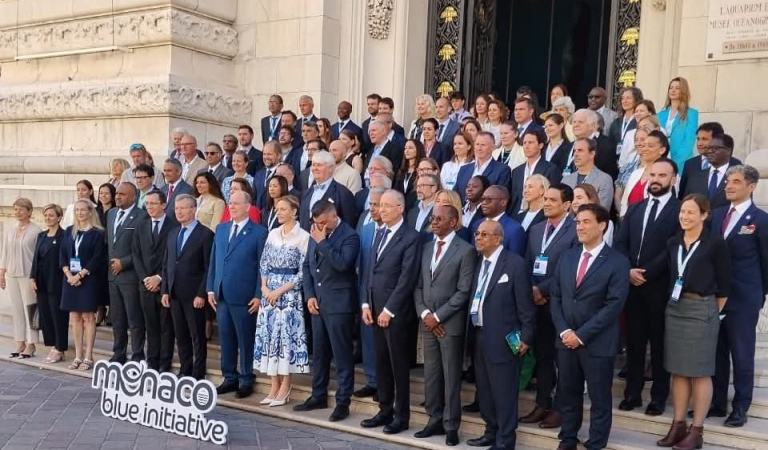
At the 17th Monaco Blue Initiative (MBI), Gabon reaffirmed its status as a global environmental powerhouse, not only through its vast rainforests in the Congo Basin, but also through the ambition and strength of its maritime policy. Addressing an audience of political decision-makers, scientists, international investors, and ocean governance experts, Gabon, through its Minister of the Sea, Fisheries, and the Blue Economy, Aimé Martial Massamba, delivered a powerful message: that of an Africa protecting its oceans and now demanding the financial resources to sustainably support this commitment.
Launched by His Serene Highness Prince Albert II of Monaco, the Monaco Blue Initiative has established itself over the years as one of the world’s leading forums for strategic thinking on the future of the oceans. This international platform brings together heads of state, financial institutions, environmental organizations, and blue economy specialists around a common goal: to transform political ambitions into financial mechanisms capable of preserving marine areas and ensuring their sustainable use.
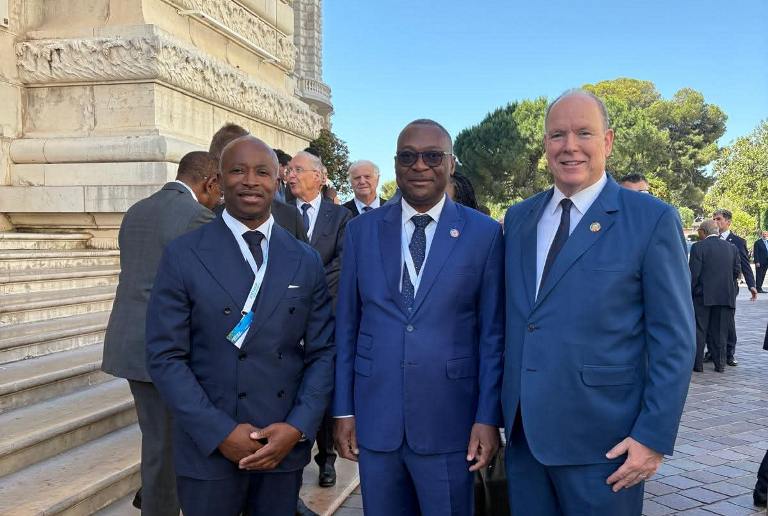
In this context of high geopolitical and ecological importance, Gabon’s presence attracted particular attention. The country appeared as the sole African representative embodying a concrete model of responsible maritime governance. This international recognition reflects Libreville’s growing credibility on environmental and climate issues.
« Blue Gabon »: an ambition that has become reality
Long known as the « green lung » of Africa thanks to its lush forests, Gabon now seeks recognition for another dimension of its natural heritage: its maritime power. Addressing major nations committed to ocean conservation, the Gabonese minister emphasized that the country boasts an exceptional Atlantic coastline, home to some of the world’s most remarkable biodiversity.
Gabonese waters constitute a major migratory corridor for humpback whales and tuna, while its beaches host some of the most important leatherback turtle nesting areas on the planet. This strategic ecological heritage places Gabon at the heart of global marine conservation efforts.
Under the leadership of the Head of State, the « Blue Gabon » concept has gradually transformed into a truly integrated public policy, linking environmental protection, economic sovereignty, and sustainable development. This vision has materialized in the creation of a vast network of Marine Protected Areas covering more than 26% of the country’s Exclusive Economic Zone (EEZ).
This figure far exceeds the regional average and brings Gabon closer to the global target known as « 30×30 », which aims to protect 30% of land and sea areas by 2030. A performance welcomed by international actors present in Monaco, who see in the Gabonese experience a credible African model of marine conservation.
A determined fight against illegal fishing
But beyond ecological advances, Gabon also wanted to alert the international community to one of the biggest scourges that weaken African maritime economies: illegal, unreported and unregulated (IUU) fishing.
In a particularly firm speech, Minister Aimé Martial Massamba denounced the plundering of African fishing resources by certain foreign industrial fleets operating illegally in the waters of the Gulf of Guinea.
« The ocean cannot be a lawless zone where foreign industrial fleets plunder the resources of sovereign nations with impunity, » he stressed to the participants.
This declaration reflects Gabon’s desire to defend its maritime sovereignty and protect its strategic resources against practices that directly threaten food security and coastal economies in Africa.
To counter this threat, Libreville has strengthened its maritime surveillance system through the use of satellite technology, increased patrols at sea, and the rigorous application of the Agreement on Port State Measures (ASPM). This strategy aims to better control fishing activities and penalize operators who violate the regulations.
The bet on blue finance
Aware, however, that ocean protection requires considerable resources, Gabon is now relying on innovative financial instruments to support its maritime policy.
The country has already distinguished itself as a pioneer in debt-for-nature swaps. This system allows for the reduction of a portion of the public debt in exchange for concrete environmental commitments.
In parallel, Gabon has issued blue bonds to sustainably finance projects related to the maritime economy, ecosystem conservation and sustainable management of fisheries resources.
Through this strategy, Gabon aims to position the African blue economy according to demanding international standards in environmental, social, and economic (ESG) governance. This approach could attract more international investors sensitive to climate issues and sustainable finance.
A strong call for international solidarity
At the close of this session, the Gabonese minister made a direct appeal to investors, financial institutions, philanthropists, and international partners. For Gabon, the future of the African blue economy now depends on the world’s ability to provide concrete support to countries that protect their natural resources for the benefit of the global climate.
The country believes that Africa should no longer be considered solely as a reservoir of biodiversity, but as a strategic player in the global ecological transition. This implies appropriate funding to develop sustainable infrastructure, create local fish processing plants, and implement modern technological traceability systems.
The message delivered in Monaco was clear: Gabon is ready. Its reforms are underway, its regulatory framework strengthened, and its political will fully embraced. Now, the challenge is to build the « international blue solidarity » it has called for, so that the efforts of developing countries for the planet are finally recognized, funded, and valued accordingly.
source : Gabon actu