
A delegation of nine Caribbean states and territories is in Martinique and Guadeloupe to discover the solutions put in place in the face of massive sargassum strandings. A regional cooperation carried out by the SARSEA project, endowed with 10 million euros.
Since Monday, June 1, Martinique and Guadeloupe have welcomed a delegation composed of about twenty representatives from nine Caribbean states and territories also facing the invasion of sargassum.
This visit is part of the SARSEA project, a regional cooperation program aimed at sharing experiences and solutions developed in the most affected territories.
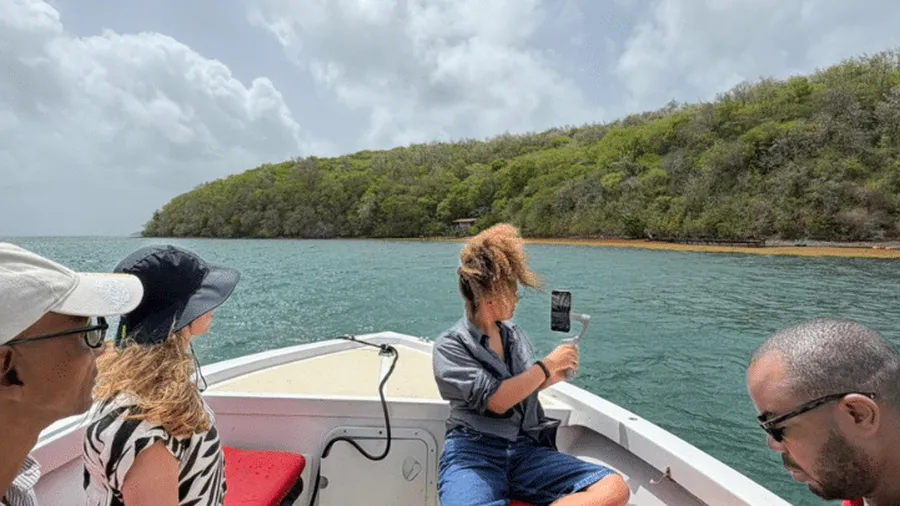
Off the François, participants were able to discover several devices deployed in Martinique to limit the impact of the larmings. On the program: demonstration of collection at sea, presentation of fixed and deviating dams to prevent brown algae from reaching the coasts as well as areas with high biodiversity.
An expertise born of several years of struggle
Among the actors mobilized, Stéphane Bero, a sailor-fisherman and designer of floating dams, has been working since 2017 on the development of solutions adapted to the Martinican context.
/outremer%2F2026%2F06%2F02%2F6a1e02451a869946432227.jpg)
Fishermen, on the front line in the fight against sargassum stranding. ©Noreen Babootarie
« It’s a new scourge and we need to have experience. Our experience as a professional sailor allows us to better understand sargassum, if not to be able to fight it. «
Stéphane Bero, fisherman
Its ambition is now to see these facilities develop in other sectors of the territory and in neighboring islands facing the same difficulties.
Barbados and neighboring islands looking for solutions
For the members of the delegation, the devices observed in Martinique are a source of concrete inspiration.
/outremer%2F2026%2F06%2F02%2F6a1e01d0f2c2f511929138.jpg)
Anti-sargass nets. ©Noreen Babootarie
In Barbados, the stranding mainly affects the Atlantic coast. According to Suzanna Aguero, a member of the European Union delegation in Barbados, the protections currently observed in Martinique could open up new prospects.
It recalls that Granada is among the most affected territories, with significant consequences for fisheries, food security and tourism.
Transforming sargassum into a resource
Beyond the collection, the project partners are also exploring avenues for the economic valorization of sargassum.
/outremer%2F2026%2F06%2F02%2F6a1e021a966ca363970840.jpg)
The sargathor, a tool for collecting sargassum or combating their stranding on the coasts. ©Noreen Babootarie
Several solutions are currently being studied: production of biofertilizers, biogas, fuels or electricity from a mixture of sargassum and organic waste from the hotel and catering industry.
« All this is very expensive. If we manage to value sargassum, it could contribute to the financing of operations while creating new jobs, especially for fishermen. «
Suzanna Aguero, member of the European Union delegation in Barbados
Discussions are already underway with a European company that plans to establish itself in Barbados to develop this type of project.
Equim the most affected islands
With an envelope of 10 million euros, the SARSEA project now aims to concretely support the most exposed territories.
« We hope to be able to equip the neighboring islands with the equipment and dams they need to block sargassum, but also encourage the creation of storage sites and support scientific research. «
Anne-Laure François, SARSEA project manager
Within a year, several dams could be installed in the five Caribbean territories most affected by the strandings, marking a new stage in the regional fight against this environmental phenomenon that has become a major issue for the entire Caribbean.
source : franceinfo