
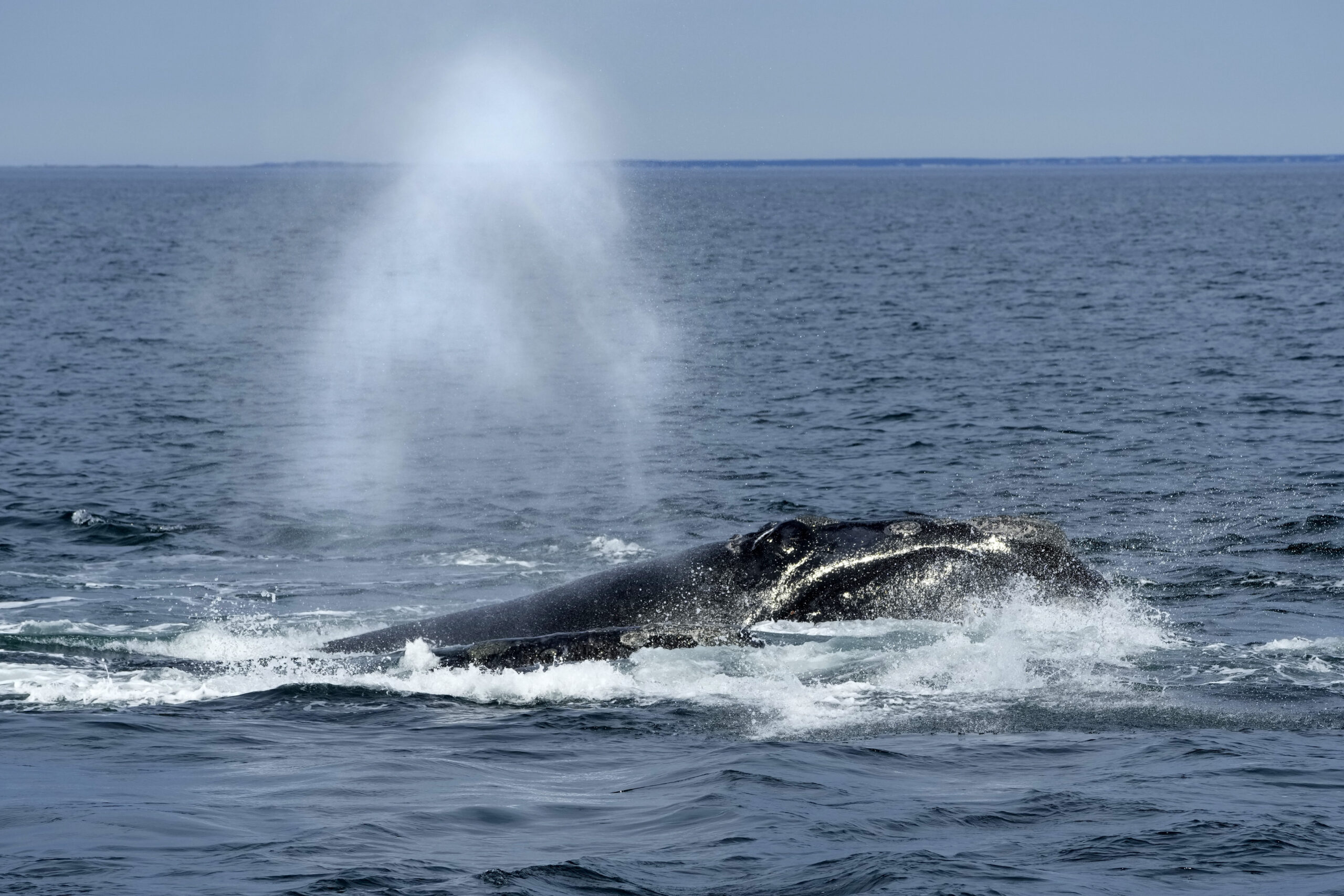
A North Atlantic right whale, caught in fishing gear, has been spotted off the east coast of New Brunswick, near Shippagan.
According to officials from the federal Department of Fisheries, the five-year-old male was last seen on Monday by Canadian and American observers aboard a surveillance aircraft flying over the Gulf of St. Lawrence.
Department of Agriculture and marine mammal rescue teams were trying to locate the whale on Tuesday. Federal officials indicated plans to attach a satellite tag to the fishing gear in which it is entangled to track its movements.
If weather and sea conditions permit, an attempt will be made to remove the net from this critically endangered animal, known as No. 5192.
The population of these giant mammals numbers fewer than 400 individuals, although their numbers have been slowly increasing since 2020. The Gulf of St. Lawrence around Anticosti Island and on the North Shore have become important feeding areas for them in the summer.
They migrate each spring from their calving grounds off Florida and Georgia to their feeding grounds which extend to the waters off New England, the Bay of Fundy and the Gulf of St. Lawrence.
« If you witness a rescue operation, we ask that you do not approach it, » the Department of Fisheries said in a statement Tuesday. « Keep your distance. Untangling operations are dangerous, and our partners need space and time to do their work safely. »
Regarding this latest entanglement, authorities stated that it was unclear what type of fishing gear was involved or where it originated. Entanglements and collisions with vessels are the leading causes of serious injury and death among North Atlantic right whales.
Last October, the North Atlantic Right Whale Conservation Consortium estimated the 2024 population at 384 individuals, an increase of 2.1% compared to 2023.
The population increased by 150 individuals between 2001 and 2011, then stabilized at around 500. A marked decline then began in 2017, when 12 whales died in Canadian waters and five more in American waters.
Later in the year, the Canadian government implemented a series of measures to improve whale protection, including enhanced aerial surveillance, restrictions on shipping lanes, speed limits for vessels, temporary closures of fishing areas, and real-time monitoring using underwater listening devices.
Scientists say that, as a result of the warming of the Atlantic Ocean, whales have changed their migration patterns.
Instead of heading to their traditional summer feeding grounds in the Bay of Fundy, most of the whales have moved further north to the Gulf of St. Lawrence, where they encounter heavier shipping traffic and heavily fished areas.
Since January, at least two North Atlantic right whales have died.
A four-year-old male named Division was found dead in January off the coast of North Carolina. The cause of death was severe entanglement in fishing gear. And less than two weeks later, a three-year-old female was found dead on an island off the coast of Virginia, although the cause of death remains uncertain.
Since the start of the calving season in mid-November, however, researchers have identified 23 new whale calves, the largest number of newborns since 2009.
source : cote nord