
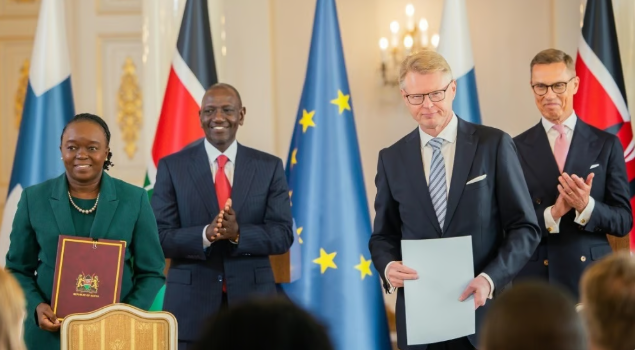
The Kenyan president is holding numerous meetings in Europe this week to solidify his country’s position as a key economic partner of the continent. From Brussels to Helsinki, Nairobi is highlighting digital technology and clean energy to attract European capital, businesses, and funding.
Kenyan President William Ruto has been on a European tour since June 7th, taking him to Belgium, Norway, and Finland. From one capital to the next, the head of state is pursuing the same objective: to consolidate his country’s position as a key African partner of Europe in the areas of digital technology, trade, and energy.
In Brussels, the first stop on the trip, William Ruto announced on June 8 that he had secured 139 million euros of new investments from the European Union, including 102.3 million euros (approximately 15.3 billion Kenyan shillings) under the EU-Kenya digital partnership, and 37 million euros for the African extension of the Blue Raman submarine cable, which will link Djibouti, Somalia, Kenya and Tanzania.
Economic Partnership
As part of its Global Gateway strategy, the European Commission has also detailed several funding initiatives, including €17 million to transform the Northern Corridor, the busiest trade route in East Africa, linking Mombasa (Kenya) to Kisangani (Democratic Republic of Congo), and €10 million for the Kenya Digital Transformation Centre.
Beyond financial support, the two sides are already bound by an Economic Partnership Agreement (EPA) signed in December 2023, which William Ruto claims has enabled Kenyan exports to the EU to increase by more than 20% since it came into effect. The president also launched the Kenya-Benelux Chamber of Commerce in Brussels, aimed at connecting Kenyan businesses to the Belgian, Dutch, and Luxembourg markets.
East Africa’s largest economy is also engaged in a data adequacy process, launched in May 2024. An adequacy decision is the act by which the European Commission recognizes that a third country protects personal data at a level equivalent to its own, thus authorizing its free movement from Europe. Kenya would therefore become the first African country to benefit from this, an advantage for its outsourcing sector.
The clean energy argument
It was in Brussels that William Ruto presented one of the central arguments of his tour: local processing backed by clean energy. Addressing business leaders gathered at the Kenya-Belgium roundtable, he urged Benelux manufacturers to process minerals and agricultural products on Kenyan soil, rather than exporting raw materials for processing elsewhere. » Produce it in Kenya. Produce it in Africa. Produce it cleanly. Sell it in Europe and around the world , » he declared.
The head of state linked this offer to the EU’s carbon border adjustment mechanism, arguing that goods produced using Kenyan low-carbon energy enter the European market with a smaller carbon footprint and reduced tariffs. He set Benelux companies the target of tripling bilateral trade, from approximately USD 335 million (around €290 million) in 2024 to USD 1 billion (around €865.5 million) in 2030. In Oslo, the Kenyan president reiterated the same argument, this time addressing Norwegian capital.
Speaking before the Confederation of Norwegian Enterprise on June 9, he advocated for a shift from development cooperation to long-term investment, highlighting a renewable energy network with over 90% renewable energy. The Kenyan leader also met with the CEO of Norfund, the Norwegian development finance institution.
With a long-standing presence in the East African country, Norfund held a portfolio of 46 billion Kenyan shillings (approximately €307.5 million) in 2023, spread across finance, energy, and other sectors. In the area of the blue economy, the visit to Norway resulted in a commitment from the maritime operator Wilhelmsen Ship Management to recruit 1,000 Kenyan seafarers by 2030, including an initial cohort of 120 before the end of the year.
In the wake of Africa Forward
William Ruto’s European tour extends a diplomatic sequence that began in Nairobi on May 11 and 12, when Kenya co-hosted the Africa Forward summit with France. The Kenyan leader is capitalizing on his status as a privileged African partner of several European countries, presenting his country as the gateway to the African Continental Free Trade Area. Before returning to Nairobi, he is making a final state visit to Finland this Wednesday, which will include another bilateral business forum.
The stakes go beyond mere diplomatic relations. The European Union remains the primary market for Kenyan exports, accounting for 21.1% of the total, and trade in goods between the two partners reached €3 billion in 2025. European companies also represent 20% of the country’s stock of foreign direct investment (FDI).
There are ways to strengthen this cooperation, starting with the conclusion of the data adequacy process and the full implementation of the EPA, although several trade issues remain to be resolved.
source : la tribune