

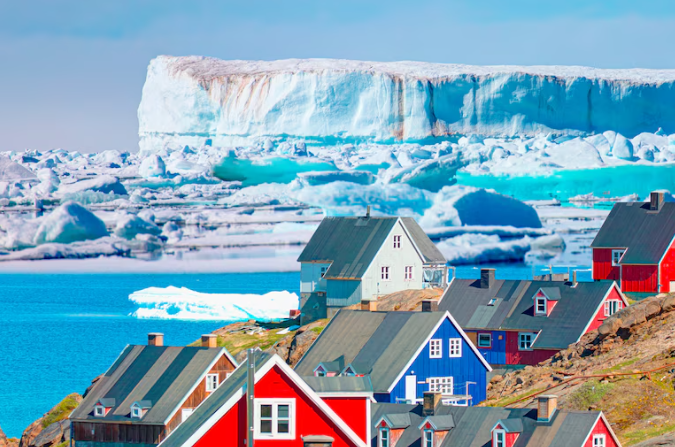
New temperature records were observed in Antarctica in June 2026. At the same time, a study shows that there are four times more icebergs in Danish Greenland than there were 25 years ago.
The Antarctic Peninsula experienced record temperatures in early June 2026, up to 20 degrees above seasonal norms at the start of the austral winter, with ice melt and atypical rainfall, according to meteorologists and climatologists.
According to various scientists interviewed by AFP, climate change has an influence, but the specifics of the Antarctic climate and its strong temperature variations require more data for an accurate picture.
Please close the floating video to resume playback here.
A local record for June, 15.4°C, was recorded between June 5 and 6 in Esperanza, an Argentine scientific base on the Trinidad Peninsula, at the northern end of the Antarctic Peninsula, facing the southern tip of the American continent, Jose Luis Stella, a meteorologist specializing in climate at the Argentine National Meteorological Service, told AFP.
The previous record for a June in Esperanza was 13.3°C in 1998, he points out. And the average maximum temperature in June there is -6.2°C.
Even though Argentina as a whole « experienced an abnormally warm start to June, » the Antarctic Peninsula recorded temperatures « up to 20°C above normal, » he summarizes. « Records were broken, with temperatures very unusual for this time of year. »
11 degrees when the average is -10!
On the same dates, the Marambio base, another Argentinian station in Antarctica, recorded 11.8°C, and the San Martin base 9.4°C, while, for the season, the averages there are respectively -10.7°C and -5.6°C.
In Esperanza, « daily highs have remained above 0°C continuously for the past 21 days, » explained Raul Cordero, a climatologist at the University of Groningen. As a result, « vast areas in the far north of the Antarctic continent are snow-free. »
According to him, « the event is not isolated, but confirms a trend », and unless « global warming is stopped, this type of event will continue to occur with an increasing frequency ».
Polar climatologist Thomas Caton Harrison, of the British Antarctic Survey, believes that « there is reliable evidence that climate change is having an influence, but the effect is complex in this region. »
Shade
Also, « given that Antarctica experiences strong temperature fluctuations, a large amount of data needs to be collected over many years to have a global understanding, » he cautioned to AFP.
Jose Luis Stella also offers a more nuanced perspective: while « the trend is towards rising temperatures » in Argentine Antarctica, the recent phenomenon « does not necessarily respond » to climate change.
Four times more icebergs in Greenland
Greenland glaciers are releasing four times more icebergs than 25 years ago due to climate change, a phenomenon whose implications extend to maritime traffic and marine ecosystems, according to a study reported Thursday, June 11, 2026 by the Technical University of Denmark (DTU).
« Our results indicate a direct, climate-induced link between changes in surface glaciers, the intensification of iceberg movement and the increased availability of hard substrates on the deep seabed, » says the study published by the scientific journal « Nature ».
Accelerated calving (iceberg production) of glaciers marks coastal environments and affects the entire system beyond the Arctic.
« We know, thanks to measurements and satellite observations, that the large glaciers of northeastern Greenland have lost stability over the past few decades, » explained Shfaqat Abbas Khan, one of the authors of the study, quoted in a DTU press release.
In the Fram Strait, between northeastern Greenland and Svalbard, « the occurrence of icebergs has quadrupled since 2000, » the statement said.
Large earmarked funds
In addition, the proportion of iceberg groups, originating from Greenland but also from the Russian Arctic and comprising more than five individual icebergs, has increased by 4.5% per decade since the turn of the century.
« The consequences are not limited to rising sea levels, but directly affect deep-sea ecosystems, far from glaciers, » Khan stressed.
Icebergs carry large quantities of rock and sediment over several hundred kilometers offshore before sinking and transforming life on the seabed.
Furthermore, as the shrinking ice pack opens up new shipping routes, the risk of ships encountering icebergs more frequently on their journey increases.
source : l’avenir