
The International Alliance, a key element of the recently launched European OceanEye initiative , will directly support the Global Ocean Observing System (GOOS), helping to strengthen the long-term resilience of ocean observation and its global coordination, as well as filling critical gaps in under-monitored areas of the southern hemisphere, the Arctic, deep-sea and coastal zones.
On June 3, 2026, the European Commission officially launched OceanEye, an ambitious initiative to strengthen ocean observation, improve access to ocean intelligence and strengthen international cooperation for a sustainable and resilient ocean future.
At the heart of OceanEye is the clear recognition that understanding and protecting the ocean requires sustained, coordinated, and globally connected observations. The initiative identifies ocean observation as a critical infrastructure, essential for climate action, the protection of marine ecosystems, sustainable ocean management, maritime security, and the future of the ocean economy.
A key element of OceanEye is the creation of an International Alliance to support the Global Ocean Observing System (GOOS), an IOC-led program providing leadership and coordination for a global system of sustained ocean observations.
The International Alliance will be coordinated by the European Commission and the IOC, and will bring together countries and partners to ensure sustainable investments, promote open and accessible ocean data, and strengthen GOOS capacity globally. These efforts are closely aligned with the UN Decade of Ocean Science for Sustainable Development (2021-2030), led by the IOC, which aims to ensure that ocean knowledge directly supports society’s needs.
“We call on all Member States and global partners to join us in supporting the Global Ocean Observing System and making OceanEye a reality,” said Ursula von der Leyen, President of the European Commission.
Moving from vision to action
The momentum behind OceanEye continued on June 10th at the first Digital Ocean Week in Brussels, organised by Mercator Ocean International. The event brought together European institutions, Member States and ocean organisations to discuss the implementation of OceanEye and its role in strengthening global ocean observation capabilities.
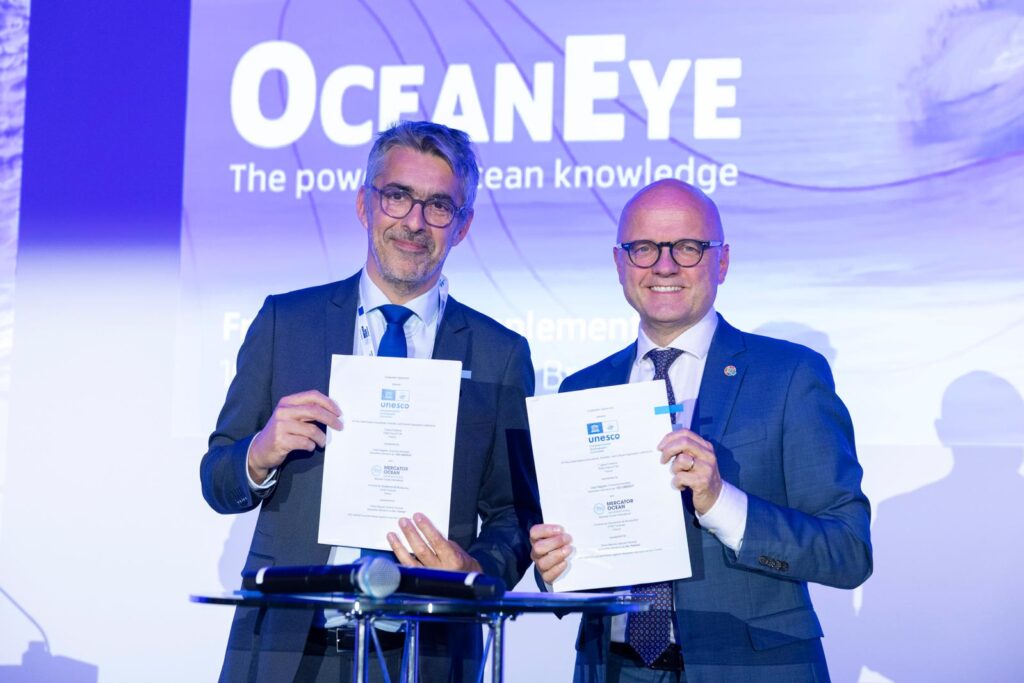
At the event, the IOC and Mercator Ocean International signed a cooperation agreement to deepen collaboration in support of Global Observing Systems (GOOS). Digital solutions and AI are entirely data-dependent, and in turn, Europe’s emerging digital ocean capabilities can contribute to the optimized design and implementation of a more robust global observing system.
The agreement will support enhanced scientific cooperation to assess and optimize GOOS, identify observation gaps and guide future investments, strengthening connections between satellites, in situ observation networks and digital ocean infrastructure.
Next steps: Our Ocean Conference
The next opportunity to advance the International Alliance’s support for GOOS will present itself at the 11th Our Ocean conference in Kenya, where OceanEye will be featured at a dedicated side event on June 17, with the aim of gathering commitments to support the long-term sustainability of GOOS and strengthening international cooperation for ocean observation.
“Strengthening the Global Ocean Observing System is not just a scientific challenge, it is a governance challenge. We need an optimized system that countries can maintain over time, and this will only be possible with stronger investments and closer cooperation with governments,” said Vidar Helgesen, IOC Executive Secretary.
As humanity faces accelerating changes in the oceans and on land, resilient and robust observation systems are more important than ever. OceanEye reflects a growing recognition that investing in ocean observation today is an investment in safety and security, climate resilience, biodiversity, sustainable development, and the future of society and our planet.
Source : goosocean